Overview
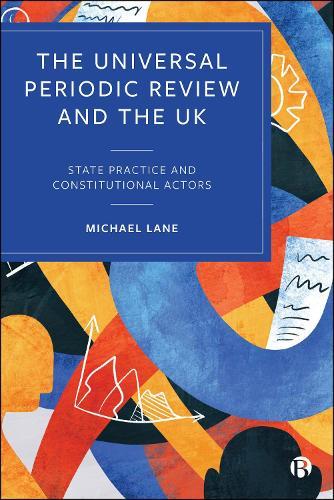
Available open access digitally under CC-BY-NC-ND licence. Foreword by Gianni Magazzeni, former Senior UN/OHCHR Official and UPR Chief at the United Nations. This book analyses the impact of the United Nations' Universal Periodic Review (UPR) process through a case study of the UK. It advances a dual-perspective assessment of the UPR: the 'external' perspective, which focuses on a state's practice at the UPR, and the 'internal' perspective, which examines the influence of the UPR on the executive, legislature and judiciary. The author introduces a new framework for assessing state participation, drawing on Kathryn Sikkink's 'Evidence for Hope' to advance the methodological rigour of UPR research. The UK context explored in the book highlights the influence of domestic politics, institutional capacity and accountability processes, with implications for Westminster systems worldwide. It is crucial reading for scholars, policy makers and practitioners of international human rights law.
Full Product Details
Author: Michael Lane (University of Worcester)
Publisher: Bristol University Press
Imprint: Bristol University Press
ISBN: 9781529250053
ISBN 10: 1529250056
Pages: 226
Publication Date: 29 May 2026
Audience:
College/higher education
,
General/trade
,
Postgraduate, Research & Scholarly
,
General
Format: Paperback
Publisher's Status: Forthcoming
Availability: Awaiting stock

Reviews
""This timely and well-written book focuses on an often overlooked human rights monitoring mechanism that is - contrary to almost all human rights mechanisms - truly universal in scope and application. Its focus on what international human rights law does and the combination of legal-doctrinal with interdisciplinary and empirical approaches and theories is much needed, especially in times in which human rights and international law are under attack and their effectiveness is questioned. Particularly valuable is that the book moves beyond the unitary conception of the state by carefully examining the different involvement in and uptake of the UPR process by the executive, legislature and judiciary. The book shows the opportunities for the UPR to be a catalyst for domestic mobilisation and leverage for domestic actors. It contains worthwhile recommendations for the UPR and the actors engaging with this process. This book constitutes a wonderful addition to the existing academic literature and a rich source of inspiration for practitioners and stakeholders involved."" Prof. Jasper Krommendijk, Radboud University Nijmegen ""“A groundbreaking study offering innovative assessment tools and profound insights into the Universal Periodic Review’s impact on domestic governance and human rights practice."" Jean-Marie Kamatali, The Claude W. Pettit College of Law, Ohio Northern University
""This timely and well-written book focuses on an often overlooked human rights monitoring mechanism that is - contrary to almost all human rights mechanisms - truly universal in scope and application. Its focus on what international human rights law does and the combination of legal-doctrinal with interdisciplinary and empirical approaches and theories is much needed, especially in times in which human rights and international law are under attack and their effectiveness is questioned. Particularly valuable is that the book moves beyond the unitary conception of the state by carefully examining the different involvement in and uptake of the UPR process by the executive, legislature and judiciary. The book shows the opportunities for the UPR to be a catalyst for domestic mobilisation and leverage for domestic actors. It contains worthwhile recommendations for the UPR and the actors engaging with this process. This book constitutes a wonderful addition to the existing academic literature and a rich source of inspiration for practitioners and stakeholders involved."" Prof. Jasper Krommendijk, Radboud University Nijmegen
Author Information
Michael Lane is a Lecturer in Law at the University of Worcester, UK. His research concerns the relationship between international human rights law and institutions and domestic legal systems. He is particularly interested in the United Nations’ human rights mechanisms. His research has been published widely, and he regularly contributes written reports to United Nations bodies and parliamentary inquiries. He is also actively involved in consultancy and capacity building with individuals and organisations to help them engage with the international human rights mechanisms.