Overview
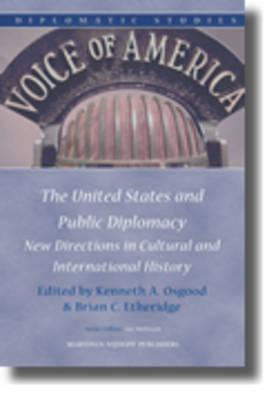
Public diplomacy is the art of cultivating public opinion to achieve foreign policy objectives. A vital tool in contemporary statecraft, public diplomacy is also one of the most poorly understood elements of a nation’s “soft power.” The United States and Public Diplomacy adds historical perspective to the ongoing global conversation about public diplomacy and its proper role in foreign affairs. It highlights the fact that the United States has not only been an important sponsor of public diplomacy, it also has been a frequent target of public diplomacy initiatives sponsored by others. Many of the essays in this collection look beyond Washington to explore the ways in which foreign states, non-governmental organizations, and private citizens have used public diplomacy to influence the government and people of the United States.
Full Product Details
Author: Kenneth. A. Osgood ,
Brian Craig Etheridge ,
Kenneth A Osgood
Publisher: Brill
Imprint: Martinus Nijhoff
Edition: 392 pp.
Volume: 5
Dimensions:
Width: 16.00cm
, Height: 2.70cm
, Length: 24.00cm
Weight: 0.820kg
ISBN: 9789004176911
ISBN 10: 9004176918
Pages: 392
Publication Date: 16 February 2010
Audience:
College/higher education
,
Undergraduate
,
Postgraduate, Research & Scholarly
Format: Hardback
Publisher's Status: Active
Availability: In Print

This item will be ordered in for you from one of our suppliers. Upon receipt, we will promptly dispatch it out to you. For in store availability, please contact us.
Reviews
The strength of this volume lies in its focus on public diplomacy outside the traditional domains of high profile policies and the rise of the national security state. Unquestionably there are benefits from historical studies of Cold War public diplomacy and more recent scholarship on campaigns to combat violent extremism. But, as this book demonstrates there is a great deal to be learned from public diplomacy strategies and methods of actors in other contexts... The greatest value of these essays is not in their occasional discourse on public diplomacy theory. It is their innovative approaches to diplomatic history and rich load of empirical evidence that will be most useful to theorists and practitioners. (The Hague Journal of Diplomacy, 2010)
Author Information
Kenneth Osgood, Ph.D. (2001) in History, University of California at Santa Barbara, is associate professor of history at Florida Altantic University. He is the author of Total Cold War: Eisenhower's Secret Propaganda Battle at Home and Abroad (2006). Brian C. Etheridge, Ph.D. (2002) in History, The Ohio State University, is associate professor of history at and director of the U.S. Foreign Policy Center at Louisiana Tech University, where he also holds the John D. Winter Endowed Professorship in History.