|
|
|||
|
||||
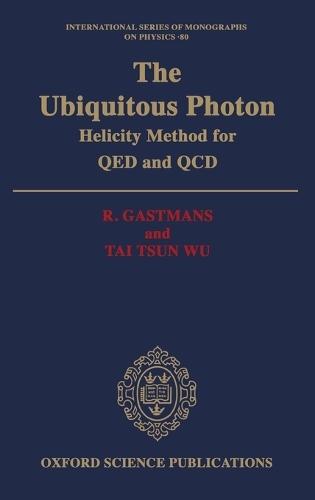
OverviewThis text provides a pedagogical introduction to the helicity method, illustrated by many examples and summarizing some ten years of research on the subject. Full Product DetailsAuthor: R. Gastmans , Tai Tsun WuPublisher: Oxford University Press Imprint: Clarendon Press Volume: 80 Dimensions: Width: 16.30cm , Height: 4.20cm , Length: 24.20cm Weight: 1.114kg ISBN: 9780198520436ISBN 10: 0198520433 Pages: 662 Publication Date: 05 July 1990 Audience: College/higher education , Professional and scholarly , Postgraduate, Research & Scholarly , Professional & Vocational Format: Hardback Publisher's Status: Active Availability: To order Stock availability from the supplier is unknown. We will order it for you and ship this item to you once it is received by us. Table of ContentsIntroduction; Feynman diagrams; Helicity states; Single bremsstrahlung in QED; Single bremsstrahlung in QCD; Double bremsstrahlung; Finite mass effects; The production of quarkonia; Summary of QED formulae; Summary of QCD formulae; Polarization; Beamstrahlung; Outlook; Appendix A: Traces: Cut-and-Paste; Appendix B: The Process; Appendix C: Colour traces; Bibliography; Author index; Subject index.Reviews'This book ought to be in every physics department library. Most high-energy physicists would benefit from reading at least the first three chapters. It is a remarkable book.' Professor J. C. Taylor (University of Cambridge), Contemporary Physics, Volume 32, No. 3 1991 `.. this is an excellent account of the `helicity technique' for computing Feyman amplitudes.' `The clear writing and explanation, together with its role as a reference book for matrix elements make it a valuable addition to the phenomenologists library.' Nuclear and Particle Physics '.. this is an excellent account of the 'helicity technique' for computing Feyman amplitudes.' 'The clear writing and explanation, together with its role as a reference book for matrix elements make it a valuable addition to the phenomenologists library.' Nuclear and Particle Physics 'This book ought to be in every physics department library. Most high-energy physicists would benefit from reading at least the first three chapters. It is a remarkable book.' Professor J. C. Taylor (University of Cambridge), Contemporary Physics, Volume 32, No. 3 1991 Author InformationTab Content 6Author Website:Countries AvailableAll regions |
||||