Overview
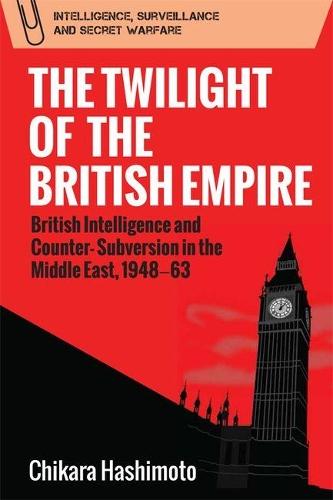
This book reveals, for the first time, a hitherto unexplored dimension of Britain's engagement with the post-war Middle East: the counter-subversive policies and measures conducted by the British Intelligence and Security Services and he Information Research Department (IRD) of the Foreign Office, Britain's secret propaganda apparatus. Between 1948 and 1963, British policymakers used intelligence as a tool to maintain British influence in Middle Eastern countries such as Egypt, Iraq, Jordan, Lebanon, Turkey and Iran. Discover how Britain tried to influence regional intelligence and security services and shape their approach to countering communist subversion. However, amidst disagreements over the nature of the threat and levels of brutality used to counter it, intelligence and secret liasons ultimately failed to protect Britain's waning influence.
Full Product Details
Author: Chikara Hashimoto ,
Lecturer in International Relations Rory Cormac (University of Nottingham)
Publisher: Edinburgh University Press
Imprint: Edinburgh University Press
ISBN: 9781474410458
ISBN 10: 1474410456
Pages: 296
Publication Date: 31 October 2017
Audience:
College/higher education
,
Postgraduate, Research & Scholarly
Format: Hardback
Publisher's Status: Active
Availability: Manufactured on demand

We will order this item for you from a manufactured on demand supplier.
Reviews
The Twilight of the British Empire is an outstanding piece of historical research, reflecting Hashimoto's diligence and prowess as a scholar ... [It] has enduring relevance for more recent history, not least with the dangers of major powers viewing the complexities of regional politics through their own ideological lenses (as was often the case, for example, during the Cold War and in the post-2001 War on Terror). The Twilight of the British Empire demonstrates the ethical and political pitfalls of aligning with police states. Further, it underlines the danger of overlooking the fact that certain political beliefs, which may be anathema to Western societies, are often seen elsewhere as a means of liberation from corrupt and despotic regimes. -- Geraint Hughes, King's College London, and R. Gerald Hughes, Aberystwyth University, Intelligence and National Security
This book can be recommended for the light it sheds on Britain's role in the Middle East through the prism of multilateral intelligence co-operation and counter-subversion. The author demonstrates how intelligence liaison connected and posed challenges, and the difficulties liaisons faced in trying to influence governments. [...] Scholars interested in British intelligence or international relations in the early Cold War will find this a welcome monograph.--Ryan Shaffer The English Historical Review, Volume 134, Issue 570, October 2019
The Twilight of the British Empire is an outstanding piece of historical research, reflecting Hashimoto's diligence and prowess as a scholar ... [It] has enduring relevance for more recent history, not least with the dangers of major powers viewing the complexities of regional politics through their own ideological lenses (as was often the case, for example, during the Cold War and in the post-2001 War on Terror). The Twilight of the British Empire demonstrates the ethical and political pitfalls of aligning with police states. Further, it underlines the danger of overlooking the fact that certain political beliefs, which may be anathema to Western societies, are often seen elsewhere as a means of liberation from corrupt and despotic regimes. -- Geraint Hughes, King's College London, and R. Gerald Hughes, Aberystwyth University, Intelligence and National Security
The Twilight of the British Empire is an outstanding piece of historical research, reflecting Hashimoto's diligence and prowess as a scholar ... [It] has enduring relevance for more recent history, not least with the dangers of major powers viewing the complexities of regional politics through their own ideological lenses (as was often the case, for example, during the Cold War and in the post-2001 War on Terror). The Twilight of the British Empire demonstrates the ethical and political pitfalls of aligning with police states. Further, it underlines the danger of overlooking the fact that certain political beliefs, which may be anathema to Western societies, are often seen elsewhere as a means of liberation from corrupt and despotic regimes. -- Geraint Hughes, King's College London, and R. Gerald Hughes, Aberystwyth University, Intelligence and National Security
Author Information
Chikara Hashimoto (1975 2016) wais Assistant Professor in International Relations at the University of Sharjah, UAE.