Overview
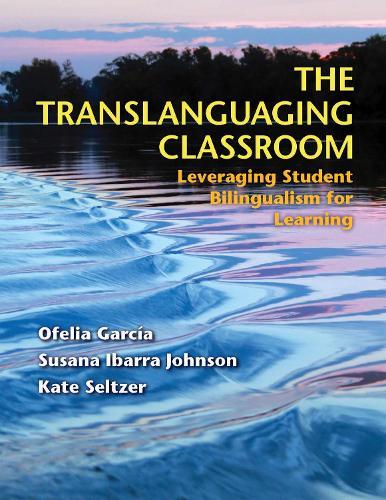
The Translanguaging Classroom: Leveraging Student Bilingualism for Learning shows teachers, administrators, professional development providers, and researchers how to use translanguaging to level the playing field for bilingual students in English-medium and bilingual classrooms. The term translanguaging can be understood in two different ways. From a sociolinguistic perspective, translanguaging can be understood as the dynamic language practices of bilinguals. From a pedagogical perspective, translanguaging can be understood as an instructional and assessment framework that teachers can use strategically and purposefully to: Support bilingual students as they engage with and comprehend complex content and texts Provide opportunities for bilingual students to develop linguistic practices for academic contexts Make space for students’ bilingualism and ways of understanding Support bilingual students’ socioemotional development and bilingual identities GarcÍa, Ibarra Johnson, and Seltzer illustrate their translanguaging pedagogy in action with examples from three very different contexts: a 5th-grade dual-language bilingual class taught by a bilingual teacher in New Mexico, an 11th-grade English-medium social studies class serving a predominantly Latino classroom taught by an English monolingual teacher in New York, and a 7th-grade ESL teacher working with students from a variety of linguistic and cultural backgrounds in California. Teachers learn to use translanguaging for instruction and assessment to meet and exceed content and language development standards in their classrooms. Special Features Learning objectives for every chapter Vignettes to illustrate pedagogical strategies Sample translanguaging unit designs for instruction and assessment in bilingual and English-medium contexts Tools for teacher planning, implementation, and evaluation End-of-chapter activities to help teachers apply what they learn to their own classrooms
Full Product Details
Author: Ofelia García ,
Susana Ibarra Johnson ,
Kate Seltzer
Publisher: Caslon, Inc.
Imprint: Caslon, Inc.
Dimensions:
Width: 21.50cm
, Height: 1.00cm
, Length: 27.90cm
Weight: 5.200kg
ISBN: 9781934000199
ISBN 10: 1934000191
Pages: 224
Publication Date: 30 August 2016
Audience:
Professional and scholarly
,
Professional & Vocational
Format: Paperback
Publisher's Status: Active
Availability: In Print

This item will be ordered in for you from one of our suppliers. Upon receipt, we will promptly dispatch it out to you. For in store availability, please contact us.
Reviews
While the concept of translanguaging is a relatively new term in the world of bilingualism and bilingual education, the ideas in the book are not necessarily new. In conversations, the concept of translanguaging has always felt a oeforceda for me. Translanguaging could be described as a oethe day-to-day practices [that] provided multiple opportunities for students to have ongoing access to each other's linguistic, cultural, and cognitive resources, and these practices had consequences that extended beyond the classroom wallsa (GutiA(c)rrez et al., 1999). Yet this was a definition used by Gutierrez in the 1990s to describe hybridity and the Third Space. One thing this book does exceptionally well is give names to concepts that have been floating out there as informal or less-known techniques and put them into a functional framework. After reading this book, I was able to adopt new terms to describe the language learning process and was also able to start framing conversations with a new pedagogical and equitable approach for teachers. In my role as a dual language instructional coach, I have already started to see shifts in teacher beliefs about student strengths and instructional approaches. --Rachel K. Gilbert
We have found Caslon's books to be a perfect fit for the Bilingual Teacher Pathway Program, which is a two-year teacher preparation program for bilingual educational assistants who want to become teachers. Recently, I looked at your guiding principles that made me feel like I had found a home! Thank you for publishing such awesome books! --DescriptionAuthorsReviews Rachel K. Gilbert Jeffco Public S De La Vega
Author Information
Ofelia García, is Professor Emerita in the Ph.D. programs in Urban Education and Latin American, Iberian and Latino Cultures at The Graduate Center of the City University of New York. García has published widely in the areas of bilingualism/multilingualism and bilingual education, language education, language policy, and sociology of language. The American Educational Research Association has awarded her three Lifetime Research Achievement Awards--Distinguished Contributions to Social Contexts in Education (2019), Bilingual Education (2017), and Second Language Acquisition Leadership through Research (2019). She is a member of the U.S. National Academy of Education. Susana Ibarra Johnson is an adjunct professor at the University of New Mexico in literacy and bilingual education. Her commitment to improving the education of bilingual students stems from her experience as a bilingual learner and teacher. For the past decade, she has been facilitating professional learning in bilingual education program implementation, critical literacy, and bilingual acquisition in New Mexico and nationally. Kate Seltzer is a doctoral candidate in the Urban Education Ph.D. program at the Graduate Center, CUNY. Seltzer also teaches courses at the City College of New York, CUNY. Before this, Seltzer worked as a high school English language arts teacher in New York City where most of her students were bilingual.