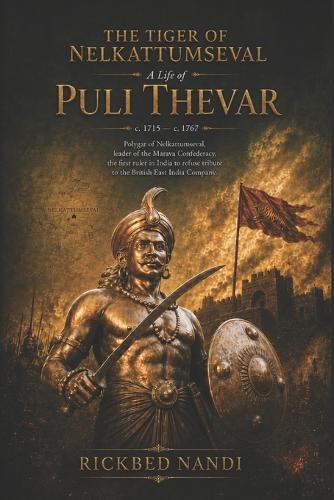
Overview
I want to tell you about a man you've probably never heard of. His name was Puli Thevar. He was born around 1715 in a small village in what is now the Tenkasi district of Tamil Nadu, on the dry side of the Western Ghats - a stone's throw from the great temple town of Sankarankovil, an hour's drive from the larger town of Tirunelveli, and a world away from anywhere a tourist would think to go today. He died around 1767 - possibly. We don't actually know. That sentence is going to keep coming up. Buckle in. Here's why he matters. In 1755, when Robert Clive was still a comparatively minor figure in the south and the British East India Company was a trading concern with a sideline in armies, a south Indian chieftain refused - flatly, gleefully, in writing - to pay a tribute they considered theirs by right. He raised a confederation of his neighbors. He allied with the kingdom of Travancore on his west and welcomed three Pathan generals who had nowhere else to go after their old patron Chanda Sahib lost his head in Tanjore in 1752. And then he did the unthinkable thing: he won. Not for long. Not forever. But for twelve years he held the Company off, and in 1759 he handed Yusuf Khan - the brilliant Tamil-born Muslim convert general who would go on to terrify everyone south of the Cauvery - the only field defeat of his life, at Vasudevanallur. Think about that for a second. The man who broke Yusuf Khan was a guy from a village whose name most Indians can't pronounce on the first try. In 1857, when the Great Indian Rebellion broke out in the north and the British called it a ""Mutiny"" and the nationalists later called it the First War of Independence, nobody was particularly thinking about Puli Thevar. They should have been. The Polygar Wars - the long, sputtering, often-defeated, sometimes-victorious uprisings of the southern chieftains against the Company - preceded 1857 by exactly one hundred years. And the first Polygar to raise a sword wasn't Veerapandiya Kattabomman (the one you might have heard of, who got a Sivaji Ganesan film and a postage stamp), but Puli Thevar, who lived two generations earlier and who, in fact, was failed by Kattabomman's own grandfather in 1756, at the Battle of Tirunelveli, when the eastern Polygars defected to the Nawab's side. The story of the south Indian resistance to the British is, in a way, the story of the betrayal of Puli Thevar by his own cousins, the slow walking-back of solidarity that ended a hundred years later with the British supreme. We're going to spend a long time on that.
Full Product Details
Author: Rickbed Nandi ,
Rickbed Nandi
Publisher: Independently Published
Imprint: Independently Published
Dimensions:
Width: 15.20cm
, Height: 1.20cm
, Length: 22.90cm
Weight: 0.354kg
ISBN: 9798199026451
Pages: 188
Publication Date: 28 May 2026
Audience:
General/trade
,
General
Format: Paperback
Publisher's Status: Active
Availability: Available To Order

We have confirmation that this item is in stock with the supplier. It will be ordered in for you and dispatched immediately.