Overview
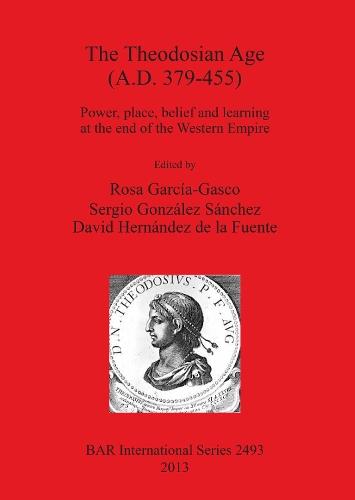
The Theodosian Age was a controversial and fascinating period in the Late Roman Empire. Religious controversies and barbaric strife distressed the population. However, there was a remarkable blossoming of the arts, as evidenced by the literary and philosophical trends: a paradoxical first Renaissance of the Classical World at a 'time of anxiety'. The present volume combines diverse interests and methodologies with a single purpose: to give an overall picture of the new trends and perspectives currently used in the research of the epoch of Theodosius the Great and his successors, with special emphasis on the dynamics of places, power, belief and learning, and their mutual interdependencies. This monograph, stemming from the 2010 2nd International Congress on Late Antiquity held in Segovia (Spain), offers a scientific update and a dialogue between several disciplines. The Theodosian Age (AD 379-455): Power, Place, Belief and Learning at the End of the Western Empire is structured in two main sections - Ancient History and Archaeology, and Philosophy and Literature - and includes among the contributors some of the most relevant scholars in their fields: P. Barceló, M. V. Escribano, G. Montes Cala, R. Sanz Serrano, N. Christie, etc.
Full Product Details
Author: Rosa García-Gasco ,
Sergio González ,
David Hernández de la Fuente
Publisher: BAR Publishing
Imprint: BAR Publishing
Volume: 2493
Weight: 1.097kg
ISBN: 9781407311074
ISBN 10: 1407311077
Pages: 275
Publication Date: 15 April 2013
Audience:
Professional and scholarly
,
Professional & Vocational
Format: Paperback
Publisher's Status: Active
Availability: Available To Order

We have confirmation that this item is in stock with the supplier. It will be ordered in for you and dispatched immediately.
Language: papers in English and Spanish
Author Information
Rosa García-Gasco is currently an Instructor of Classical Greek and Latin in the Public System of Secondary Education of the Government of Madrid and an associate researcher in the Department of Greek Philology and Indoeuropean Linguistics at the University Complutense of Madrid, where she has been collaborating since 2004 in several projects. She earned her PhD with her Doctoral Thesis Orpheus and Orphism in Nonnus' Dionysiaca in 2007. García-Gasco has since then published numerous chapters on Greek religion and myth in collected books, as well as on Greek drama and rhetorics. She is currently working on epics, Dionysus, dramatic literature and performance. Sergio González Sánchez is currently a Ph.D. candidate in the School of Archaeology and Ancient History at the University of Leicester. His research focuses on the creation of ancient and modern myths around Roman-Barbarian interactions, their influence on the creation of national identities and the analysis of different traditions of archaeological interpretation. He has published articles on the topic and has participated in archaeological projects in Italy and the UK. He has recently presented papers at different international conferences on Roman archaeology and imperialism. He combines his doctoral activity with the teaching of Latin and Greco-Roman literature at the University of Leicester. David Hernández de la Fuente is Assistant Professor at the Department of Ancient History at Universidad Nacional de Educación a Distancia (Madrid, Spain) and Lecturer at the University of Potsdam (Germany), where he was a Humboldt Fellow (2009-2011). He has published an interpretation on Nonnus' Dionysiaca (Bakkhos Anax, 2008) stemming from his first PhD dissertation, and numerous articles and reviews on Greek Literature (esp. Nonnus), Philosophy and Religion (Oracles, History of Platonism, etc.). Among his several books, he has edited New Perspectives on Late Antiquity (2011) and authored Vidas de Pitágoras (2011).