Overview
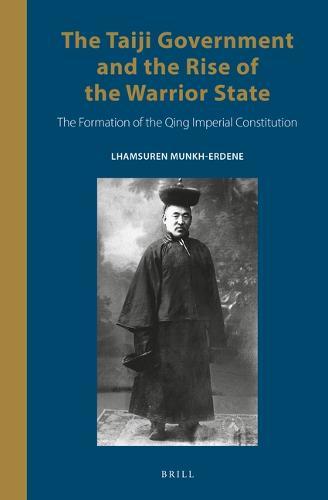
Read The Taiji Government and you will discover a bold and original revisionist interpretation of the formation of the Qing imperial constitution. Contrary to conventional wisdom, which portrays the Qing empire as a Chinese bureaucratic state that colonized Inner Asia, this book contends quite the reverse. It reveals the Qing as a Warrior State, a Manchu-Mongolian aristocratic union and a Buddhist caesaropapist monarchy. In painstaking detail, brushstroke by brushstroke, the author urges you to picture how the Mongolian aristocratic government, the Inner Asian military-oriented numerical divisional system, the technique of conquest rule, and the Mongolian doctrine of a universal Buddhist empire together created the last of the Inner Asian empires that conquered and ruled what is now China.
Full Product Details
Author: Lhamsuren Munkh-Erdene
Publisher: Brill
Imprint: Brill
Volume: 14
Dimensions:
Width: 15.50cm
, Height: 4.10cm
, Length: 23.50cm
Weight: 1.068kg
ISBN: 9789004461697
ISBN 10: 9004461698
Pages: 568
Publication Date: 14 October 2021
Audience:
Professional and scholarly
,
Professional & Vocational
Format: Hardback
Publisher's Status: Active
Availability: Manufactured on demand

We will order this item for you from a manufactured on demand supplier.
Reviews
"“Despite strongly developed historiography on the Mongolian sources of Qing institutions and political culture, in my view Munkh-Erdene is the first to develop in English the idea of a continuing organic relationship with the Mongolian aristocracy as a central controlling principle of Qing imperial governance. And what he proposes does challenge modern historiography. (…) Not only did taiji governance in Mongolia continue without disruption, it became the foundation of the dominant political values of the Qing state—its constitution. On this point Munkh-Erdene places himself in opposition to David M. Farquhar, Christopher P. Atwood, Nicola Di Cosmo, Johan Elverskog, Peter C. Perdue, Zhang Shiming and others (Oka Hiroki is given an occasional merit for not being entirely sinocentric), who all argue that the Qing used progressive bureaucratization (though in varying degrees) of the governance of Mongolia as its most effective tool for undermining the traditional elites and installing its own tame Mongol aristocrats and religious leaders. (…) No Qing, Mongolia, or Inner Asia specialist who gives The Taiji State an attentive reading will accept stock generalizations about conquest, empire, or Mongolia.” - Pamela Crossley, Journal of Chinese Studies, DOI: 10.29708/JCS.CUHK.202301_(76).0012 ""One can read Lhamsuren Munkh-Erdene’s new book in one of two ways: either as a well-documented study of Manchu-Mongolian relations and the concurrent transformation of indigenous Mongolian political institutions in the early seventeenth century or as an ambitious revision of fundamental narratives of Mongolian and Qing history between 1600 and 1911.(...) Whichever angle the reader adopts, this is a work that deserves to be taken seriously and that will certainly inspire lively debate among students of Qing history, Mongolian studies, and comparative empire alike.[T]his is a very rich book, ambitious and wide-ranging, assiduously researched, and clearly organized and presented, which will repay careful reading and rereading."" - Mark Elliott, Harvard University, Journal of Asian Studies, 82:2 (2023) doi: 10.1215/00219118-10290740"
Author Information
Lhamsuren Munkh-Erdene, Ph.D. (2004), Hokkaido University, is Professor of History and Anthropology at National University of Mongolia, and a Visiting Fellow at the Max Planck Institute for Social Anthropology. He has published articles on the Inner Asian political order, including “The Rise of the Chinggisid Dynasty: Pre-modern Eurasian Political Order and Culture at a Glance”.