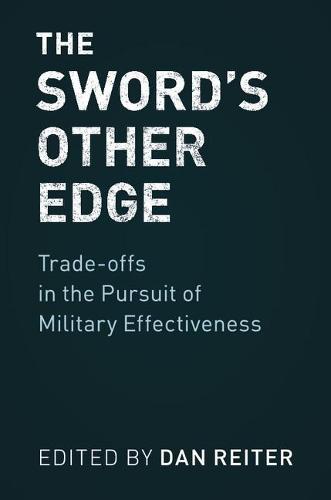
Full Product Details
Author: Dan Reiter (Emory University, Atlanta)
Publisher: Cambridge University Press
Imprint: Cambridge University Press
Dimensions:
Width: 15.70cm
, Height: 2.10cm
, Length: 23.50cm
Weight: 0.540kg
ISBN: 9781108416726
ISBN 10: 1108416721
Pages: 288
Publication Date: 09 November 2017
Audience:
College/higher education
,
Professional and scholarly
,
Tertiary & Higher Education
,
Professional & Vocational
Format: Hardback
Publisher's Status: Active
Availability: Manufactured on demand

We will order this item for you from a manufactured on demand supplier.
Reviews
Advance praise: 'The Sword's Other Edge presents a path-breaking new perspective on how states and non-state actors pursue military effectiveness, focusing on tradeoffs they often must confront. Previous work focusses either on gains or losses in effectiveness that technologies and tactical innovations provide. This new volume presents a coherent approach to understanding the net effect on effectiveness of changes in the ways that states employ military power. The authors provide insights into critical dimensions of contemporary foreign policy issues, including drone strikes, military robotics, counterinsurgency, ISIS, nuclear weapons, rising military threats from Russia, and others. The chapters and examples are filled with rich historical depth, including case studies of World War II, the 1973 Yom Kippur War, the Korean War, and others, as well as quantitative analyses of the ongoing Philippine insurgency, and of all conventional wars since 1800. A must-read for students, policy makers, and concerned citizens.' Allan C. Stam, Frank Batten School of Leadership and Public Policy, University of Virginia Advance praise: 'How should states employ force? Eschewing simplistic arguments, this fascinating volume studies the tradeoffs militaries inevitably struggle with. From financing, to force mix, to tactics, the chapters show us that there is no free lunch in war; every choice has costs and benefits. Policymakers would do well to heed the lessons in this volume.' Jacob N. Shapiro, Princeton University Advance praise: 'The Sword's Other Edge is a must-read for students of war. For starters, it does a fine job showing that military effectiveness is a function of a host of different factors, which are nicely catalogued in the book. Moreover, it makes clear that maximizing military effectiveness often involves significant costs, and thus policymakers and strategists need to think hard about the resulting tradeoffs. Toward that end, Reiter and his fellow authors provide a first-rate framework for analyzing the various tradeoffs that arise when a country tries to employ its fighting forces in the most effective way possible.' John J. Mearsheimer, R. Wendell Harrison Distinguished Service Professor of Political Science, University of Chicago
'The Sword's Other Edge presents a path-breaking new perspective on how states and non-state actors pursue military effectiveness, focusing on tradeoffs they often must confront. Previous work focusses either on gains or losses in effectiveness that technologies and tactical innovations provide. This new volume presents a coherent approach to understanding the net effect on effectiveness of changes in the ways that states employ military power. The authors provide insights into critical dimensions of contemporary foreign policy issues, including drone strikes, military robotics, counterinsurgency, ISIS, nuclear weapons, rising military threats from Russia, and others. The chapters and examples are filled with rich historical depth, including case studies of World War II, the 1973 Yom Kippur War, the Korean War, and others, as well as quantitative analyses of the ongoing Philippine insurgency, and of all conventional wars since 1800. A must-read for students, policy makers, and concerned citizens.' Allan C. Stam, Frank Batten School of Leadership and Public Policy, University of Virginia 'How should states employ force? Eschewing simplistic arguments, this fascinating volume studies the tradeoffs militaries inevitably struggle with. From financing, to force mix, to tactics, the chapters show us that there is no free lunch in war; every choice has costs and benefits. Policymakers would do well to heed the lessons in this volume.' Jacob N. Shapiro, Princeton University, New Jersey 'The Sword's Other Edge is a must-read for students of war. For starters, it does a fine job showing that military effectiveness is a function of a host of different factors, which are nicely catalogued in the book. Moreover, it makes clear that maximizing military effectiveness often involves significant costs, and thus policymakers and strategists need to think hard about the resulting tradeoffs. Toward that end, Reiter and his fellow contributors provide a first-rate framework for analyzing the various tradeoffs that arise when a country tries to employ its fighting forces in the most effective way possible.' John J. Mearsheimer, R. Wendell Harrison Distinguished Service Professor of Political Science, University of Chicago
Author Information
Dan Reiter is the Samuel Candler Dobbs Professor of Political Science at Emory University, Atlanta. He is the award-winning author of three books, Crucible of Beliefs: Learning, Alliances and World Wars, Democracies at War (with Allan C. Stam, 1996), and How Wars End (2009), as well as dozens of articles about the causes, prosecution, and termination of war, alliances, domestic politics and international relations, nuclear weapons, terrorism, and other topics. He is a recipient of the Karl Deutsch Award, given annually to the leading scholar of international relations under the age of 40 or within ten years of having received a Ph.D.