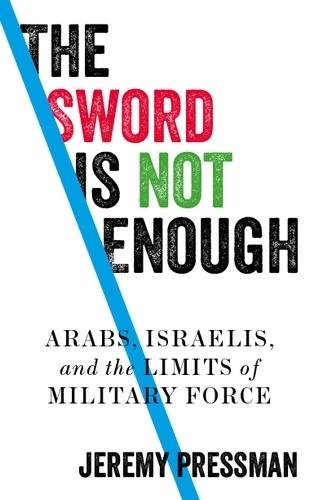
Full Product Details
Author: Jeremy Pressman
Publisher: Manchester University Press
Imprint: Manchester University Press
ISBN: 9781526146175
ISBN 10: 1526146177
Pages: 296
Publication Date: 20 August 2020
Audience:
College/higher education
,
Professional and scholarly
,
General/trade
,
Tertiary & Higher Education
,
Professional & Vocational
Format: Hardback
Publisher's Status: Active
Availability: Manufactured on demand

We will order this item for you from a manufactured on demand supplier.
Reviews
'This book should be read carefully and internalised by policy makers in the Middle East and in Washington. It utterly demolishes the argument that force alone can achieve a political solution to a conflict; and it argues cogently that the reliance on force alone can increase the chances of more violence, unintended escalation, war, and greater insecurity. Pressman does not argue for abandoning the use of force when necessary, but rather he stresses the need to marry force and diplomacy in order to achieve political goals that resolve conflicts. How much better off would we be if these critical lessons were applied by our leaders.' Daniel Kurtzer, Princeton University, former U.S. Ambassador to Egypt and Israel -- .
'This book utterly demolishes the argument that force alone can achieve a political solution to a conflict; and it argues cogently that the reliance on force alone can increase the chances of more violence, unintended escalation, war, and greater insecurity. How much better off would we be if these critical lessons were applied by our leaders.' Daniel Kurtzer, S. Daniel Abraham Professor of Middle East Policy Studies, Princeton University and former U.S. Ambassador to Egypt and Israel 'Well-argued and convincing, Pressman shows the crucial limitations of war and the reliance on military power. Pressman brilliantly shows that the use of force often leads to counter-reactions, and consequently, is often counter-productive.' Hilde Henriksen Waage, Professor of History, University of Oslo 'A respected expert on the Arab-Israeli conflict, Pressman thoughtfully drives his conclusion home through rich analysis of multiple episodes in the history of the conflict. Illuminating and worth reading.' Shibley Telhami, Anwar Sadat Professor for Peace and Development, University of Maryland 'Clear, balanced and informative: a must-read for anyone who cares about the region.' Mira Sucharov, Professor of Political Science, Carleton University, Canada 'The book skillfully draws on scholarly research, statements made by Israeli, Palestinian, and other Arab leaders, news reports, and additional primary and secondary sources. Written in a clear and accessible style, The Sword Is Not Enough is a smooth read for those well-versed in the political history of the region, and it is also appropriate for students with basic, but limited, background knowledge of the conflict.' Diana B. Greenwald, Department of Political Science, City College of New York for the International Journal of Middle East Studies (2022), 1-3 -- .
'This book should be read carefully and internalised by policy makers in the Middle East and in Washington. It utterly demolishes the argument that force alone can achieve a political solution to a conflict; and it argues cogently that the reliance on force alone can increase the chances of more violence, unintended escalation, war, and greater insecurity. Pressman does not argue for abandoning the use of force when necessary, but rather he stresses the need to marry force and diplomacy in order to achieve political goals that resolve conflicts. How much better off would we be if these critical lessons were applied by our leaders.' Daniel Kurtzer, Princeton University, former U.S. Ambassador to Egypt and Israel 'Well-argued and convincing, Pressman shows the crucial limitations of war and the reliance on military power. In the Arab-Israeli conflict, there has been an overemphasis on the belief in military force as the best means to advance political, national and security goals. Pressman brilliantly shows that the use of force often leads to counter-reactions, and consequently, is often counter-productive.' Hilde Henriksen Waage, University of Oslo -- .
Author Information
Jeremy Pressman is Associate Professor of Political Science and Director of Middle East Studies at the University of Connecticut. He is author of Warring Friends: Alliance Restraint in International Politics and co-author of Point of No Return: The Deadly Struggle for Middle East Peace. Pressman has held fellowships at Brandeis, Harvard, and the University of Sydney, as well as the Norwegian Nobel Institute where he was a Fulbright fellow.