Full Product Details
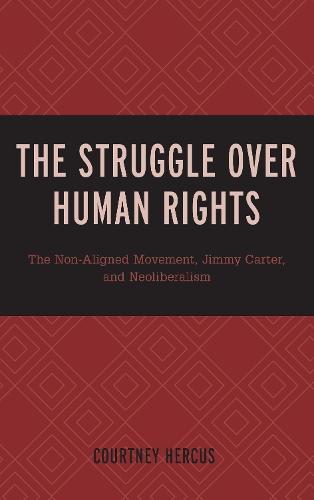
Author: Courtney Hercus
Publisher: Bloomsbury Publishing Plc
Imprint: Lexington Books
Dimensions:
Width: 15.90cm
, Height: 2.30cm
, Length: 23.90cm
Weight: 0.476kg
ISBN: 9781498574013
ISBN 10: 1498574017
Pages: 224
Publication Date: 17 January 2019
Audience:
Professional and scholarly
,
Professional & Vocational
Format: Hardback
Publisher's Status: Active
Availability: Manufactured on demand

We will order this item for you from a manufactured on demand supplier.
Reviews
The Struggle over Human Rights delivers a granular critical theoretical analysis of the hegemonic struggle over human rights - elsewhere recognized as human wrongs - from its lineages in the twentieth century and into the post-Cold War era. Its honing in on how the Jimmy Carter administration narrowed the hegemonic definition of human rights in alignment with transnational capital makes this book an essential read. -- Adam David Morton, University of Sydney Individual human rights, as propounded by the Carter administration, were deployed paradoxically to defeat of the non-aligned movement for a more equitable world order, this doctrine having developed in step with the transnationalization of capital in the 1970s. The Struggle over Human Rights stands as a model of critical political economy scholarship and is a tribute to the thinking of the late Robert Cox as the doyen of that strand of thought. -- Kees van der Pijl, Professor Emeritus, University of Sussex In this well-researched book, Courtney Hercus provides a neo-Gramscian interpretation of the de-prioritization of social, economic, and cultural human rights. This interpretation emphasizes the hegemony of a particular interpretation of liberalism and `liberal world order', within and beyond the USA in the second half of the twentieth century. By revealing how the Carter administration prioritized freedom from governmental action as the key to human rights, this book simultaneously reinforces the importance to human rights history of the counter-hegemonic, post-colonial projects of the 1960s, to which Carter felt the need to respond, and challenges the assumption that the Reagan presidency initiated the neo-liberalism that many people still see within contemporary human rights discourse. -- David Karp, University of Sussex
The Struggle over Human Rights delivers a granular critical theoretical analysis of the hegemonic struggle over human rights - elsewhere recognized as human wrongs - from its lineages in the twentieth century and into the post-Cold War era. Its honing in on how the Jimmy Carter administration narrowed the hegemonic definition of human rights in alignment with transnational capital makes this book an essential read. -- Adam David Morton, University of Sydney
The Struggle over Human Rights delivers a granular critical theoretical analysis of the hegemonic struggle over human rights - elsewhere recognized as human wrongs - from its lineages in the twentieth century and into the post-Cold War era. Its honing in on how the Jimmy Carter administration narrowed the hegemonic definition of human rights in alignment with transnational capital makes this book an essential read. -- Adam David Morton, University of Sydney Individual human rights, as propounded by the Carter administration, were deployed paradoxically to defeat of the non-aligned movement for a more equitable world order, this doctrine having developed in step with the transnationalization of capital in the 1970s. The Struggle over Human Rights stands as a model of critical political economy scholarship and is a tribute to the thinking of the late Robert Cox as the doyen of that strand of thought. -- Kees van der Pijl, Professor Emeritus, University of Sussex In this well-researched book, Courtney Hercus provides a neo-Gramscian interpretation of the de-prioritization of social, economic, and cultural human rights. This interpretation emphasizes the hegemony of a particular interpretation of liberalism and 'liberal world order', within and beyond the USA in the second half of the twentieth century. By revealing how the Carter administration prioritized freedom from governmental action as the key to human rights, this book simultaneously reinforces the importance to human rights history of the counter-hegemonic, post-colonial projects of the 1960s, to which Carter felt the need to respond, and challenges the assumption that the Reagan presidency initiated the neo-liberalism that many people still see within contemporary human rights discourse. -- David Karp, University of Sussex
Author Information
Courtney Hercus holds a doctorate in international relations from Macquarie University.