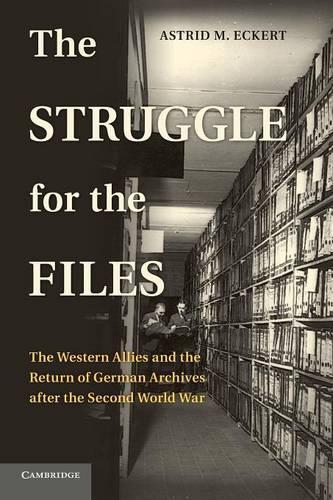
Full Product Details
Author: Astrid M. Eckert (Emory University, Atlanta)
Publisher: Cambridge University Press
Imprint: Cambridge University Press
Dimensions:
Width: 15.20cm
, Height: 2.50cm
, Length: 22.90cm
Weight: 0.650kg
ISBN: 9781107629202
ISBN 10: 1107629209
Pages: 444
Publication Date: 27 February 2014
Audience:
Professional and scholarly
,
Professional & Vocational
,
Postgraduate, Research & Scholarly
Format: Paperback
Publisher's Status: Active
Availability: Manufactured on demand

We will order this item for you from a manufactured on demand supplier.
Reviews
'Eckert's book does far more than trace the wartime and postwar fate of German archival records. It manages to incorporate a detailed and impeccably researched treatment of 'ownership' with a broader discussion of the international debate about the path of German history and the future of Germany. This issue interests a much wider audience within the field of German history and within the discipline of history as a whole. The other characteristic of this work that deserves emphasis is its transnational character. Eckert is so well versed in the history of Germany, Britain, and the United States that she can carry off a narrative of their interaction in the postwar period with success and with verve.' Richard Breitman, Distinguished Professor, American University 'The Struggle for the Files is an essential read for historians of Germany and the twentieth-century Atlantic world. Astrid Eckert provides a masterful, even riveting, account of the tangled odyssey of captured German archives after World War II - from the Allied confiscation and exploitation of Nazi-era records to the contentious return of the records to West Germany in the 1950s and after. At the same time she weaves her narrative within broader questions concerning the Allies' unprecedented archival guardianship. Partly these were immediate matters, ranging from the political and cultural sovereignty of a recent enemy-turned-ally to the use of wartime German records for Cold War intelligence. But they also concern the larger, more crucial, and most enduring postwar question of who would serve as the custodian and arbiter of Germany's catastrophic recent history.' Norman J. W. Goda, author of Tales from Spandau: Nazi Criminals and the Cold War 'Who knew you could write a thriller about archival transfer? This is a real page-turner, offering an exciting international tale of Cold War relations, Vergangenheitsbewaltigung, and the writing of German history. Eckert's mastery of the archives - as well as the archival politics - of three nations is remarkable.' Mark Roseman, Professor of History and Pat M. Glazer Chair of Jewish Studies, Indiana University 'This is the book we have long needed. In no period of history has a study of the fate of the archives and public records of a nation defeated in war been more important than in the case of Nazi Germany. Astrid M. Eckert has created a splendid account of the postwar saga of the German records, and of their international importance through the long decades of the Cold War. Based on imaginative prodigious research and shrewd and judicious analyses, and written in a cogent and compelling narrative style, Professor Eckert's command of both the sources and the subject is complete. This is an important, and indeed essential, work of historical scholarship.' Charles W. Sydnor, Jr, Emory and Henry College, Virginia '... riveting reading.' The Times Literary Supplement '... the author brilliantly recounts cooperative achievements and internal squabbles among scholars across the national boundaries. The book's translation, provided by the German Historical Institute in Washington, DC, is excellent.' Diethelm Prowe, The Journal of Modern History Eckert's book does far more than trace the wartime and postwar fate of German archival records. It manages to incorporate a detailed and impeccably researched treatment of `ownership' with a broader discussion of the international debate about the path of German history and the future of Germany. This issue interests a much wider audience within the field of German history and within the discipline of history as a whole. The other characteristic of this work that deserves emphasis is its transnational character. Eckert is so well versed in the history of Germany, Britain, and the United States that she can carry off a narrative of their interaction in the postwar period with success and with verve. Richard Breitman, Distinguished Professor, American University The Struggle for the Files is an essential read for historians of Germany and the twentieth-century Atlantic world. Astrid Eckert provides a masterful, even riveting, account of the tangled odyssey of captured German archives after World War II - from the Allied confiscation and exploitation of Nazi-era records to the contentious return of the records to West Germany in the 1950s and after. At the same time she weaves her narrative within broader questions concerning the Allies' unprecedented archival guardianship. Partly these were immediate matters, ranging from the political and cultural sovereignty of a recent enemy-turned-ally to the use of wartime German records for Cold War intelligence. But they also concern the larger, more crucial, and most enduring postwar question of who would serve as the custodian and arbiter of Germany's catastrophic recent history. Norman J. W. Goda, author of Tales from Spandau: Nazi Criminals and the Cold War Who knew you could write a thriller about archival transfer? This is a real page-turner, offering an exciting international tale of Cold War relations, Vergangenheitsbewaltigung, and the writing of German history. Eckert's mastery of the archives - as well as the archival politics - of three nations is remarkable. Mark Roseman, Professor of History and Pat M. Glazer Chair of Jewish Studies at Indiana University This is the book we have long needed. In no period of history has a study of the fate of the archives and public records of a nation defeated in war been more important than in the case of Nazi Germany. Astrid M. Eckert has created a splendid account of the postwar saga of the German records, and of their international importance through the long decades of the Cold War. Based on imaginative prodigious research and shrewd and judicious analyses, and written in a cogent and compelling narrative style, Professor Eckert's command of both the sources and the subject is complete. This is an important, and indeed essential, work of historical scholarship. Charles W. Sydnor, Jr, Emory and Henry College, Virginia In her captivating book Atrid M. Eckert details the odyssey of the German archives after 1945 from their seizure by the victorious armies to their piecemeal, still incomplete return to Germany in the decades since. Christina Morina, American Historical Review ... exceptionally readable, especially for such a dense and detailed work. Laura Millar, Archivaria ... a quality historical narrative proving how critical archival records are to the political, social, and historical fabric of a nation. It successfully places archives in a position in which their possession is power. While that power is largely symbolic, it has the ability to build or undermine the very essence of sovereignty. Anything offering that level of respect to archives is worth reading. Shawn San Roman, Archival Issues ... the author brilliantly recounts cooperative achievements and internal squabbles among scholars across the national boundaries. The book's translation, provided by the German Historical Institute in Washington, DC, is excellent. Diethelm Prowe, The Journal of Modern History
'Eckert's book does far more than trace the wartime and postwar fate of German archival records. It manages to incorporate a detailed and impeccably researched treatment of 'ownership' with a broader discussion of the international debate about the path of German history and the future of Germany. This issue interests a much wider audience within the field of German history and within the discipline of history as a whole. The other characteristic of this work that deserves emphasis is its transnational character. Eckert is so well versed in the history of Germany, Britain, and the United States that she can carry off a narrative of their interaction in the postwar period with success and with verve.' Richard Breitman, Distinguished Professor, American University 'The Struggle for the Files is an essential read for historians of Germany and the twentieth-century Atlantic world. Astrid Eckert provides a masterful, even riveting, account of the tangled odyssey of captured German archives after World War II - from the Allied confiscation and exploitation of Nazi-era records to the contentious return of the records to West Germany in the 1950s and after. At the same time she weaves her narrative within broader questions concerning the Allies' unprecedented archival guardianship. Partly these were immediate matters, ranging from the political and cultural sovereignty of a recent enemy-turned-ally to the use of wartime German records for Cold War intelligence. But they also concern the larger, more crucial, and most enduring postwar question of who would serve as the custodian and arbiter of Germany's catastrophic recent history.' Norman J. W. Goda, author of Tales from Spandau: Nazi Criminals and the Cold War 'Who knew you could write a thriller about archival transfer? This is a real page-turner, offering an exciting international tale of Cold War relations, Vergangenheitsbewaltigung, and the writing of German history. Eckert's mastery of the archives - as well as the archival politics - of three nations is remarkable.' Mark Roseman, Professor of History and Pat M. Glazer Chair of Jewish Studies, Indiana University 'This is the book we have long needed. In no period of history has a study of the fate of the archives and public records of a nation defeated in war been more important than in the case of Nazi Germany. Astrid M. Eckert has created a splendid account of the postwar saga of the German records, and of their international importance through the long decades of the Cold War. Based on imaginative prodigious research and shrewd and judicious analyses, and written in a cogent and compelling narrative style, Professor Eckert's command of both the sources and the subject is complete. This is an important, and indeed essential, work of historical scholarship.' Charles W. Sydnor, Jr, Emory and Henry College, Virginia '... riveting reading.' Times Literary Supplement
Author Information
Astrid M. Eckert is Assistant Professor in the Department of History at Emory University. Eckert's dissertation on the history of the captured German records, which forms the basis of this book, won the Hedwig Hintze Prize from the German Historical Association and the Friedrich Meinecke Award from the History Department of Free University Berlin. Her work has been supported by grants from the Fulbright Foundation, the German National Academic Foundation, the Fox International Fellowships at Yale, and the American Academy Berlin. She has published articles in Central European History, Studies in Contemporary History and Vierteljahrshefte für Zeitgeschichte.