Overview
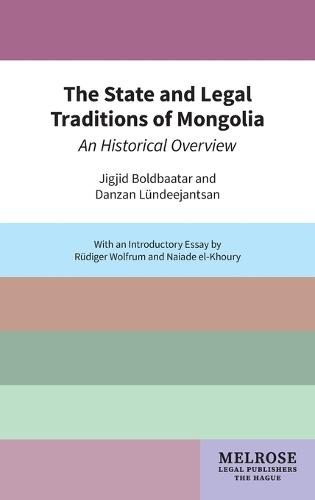
This encyclopedic volume offers a comprehensive overview of the history and development of the Mongolian State and legal system from the Hun (Xanadu) Empire to the present day. It delves into the State and legal relations of the Great Mongol Empire and highlights the Mongols' unique nomadic governance style. Although their global influence waned over time and Mongolia's independence repeatedly came under threat, the Mongols' profound influence is evident in their contributions to establishing a vast, unified country between Russia and China, with its own, unique legal legacies. Mongolia's transition to democracy and a market-oriented economy, the new Constitution adopted in 1992 and the extensive reforms to the legal system undertaken since then are also explored. The astounding breadth of research and wealth of fascinating detail which this volume offers, using a wide array of resources hitherto inaccessible in English, make it a unique and important book for scholars of constitutional law, comparative law and legal history as well as for anyone interested in the region and the processes by which Statehood is forged.
Full Product Details
Author: Jigjid Boldbataar ,
Danzan Lündeejantsan ,
Rüdiger Wolfrum
Publisher: Melrose Legal Publishers
Imprint: Melrose Legal Publishers
Dimensions:
Width: 15.60cm
, Height: 2.70cm
, Length: 23.40cm
Weight: 0.857kg
ISBN: 9789083407524
ISBN 10: 9083407527
Pages: 490
Publication Date: 14 February 2025
Audience:
General/trade
,
General
Format: Hardback
Publisher's Status: Active
Availability: Available To Order

We have confirmation that this item is in stock with the supplier. It will be ordered in for you and dispatched immediately.
Reviews
""A detailed, but concise description of the governmental structure of Mongolia as developed over centuries, demonstrating its development and decline as well as its re-establishment. During this process, Mongolia faced some of the same problems western European States did, such as the problem of self-identification and the forming of a people of the State (Staatsvolk), the legitimacy of its governmental system and a legal system matching its cultural particularities. The responses to these challenges differed in each era and thus illustrate the various models in developing a Statehood"". Professor (Em.) Rüdiger Wolfrum, Professor of Comparative National Public Law and International Public Law at the University of Heidelberg, Faculty of Law
Author Information
Jigjid Boldbaatar (Sc.D) is a Member of the Mongolian Academy of Sciences (Academician) and Professor of History at the National University of Mongolia and Shihihutug University; he was a former member of the Constitutional Court of Mongolia and a member of Parliament from 1992 to 1996. Danzan Lündeejantsan (Sc.D) is the President of the Academic Council and a Professor of Comparative Law and Constitutional Law at Shihihutug University; he was the former Chairman and Vice-Chairman of the State Great Hural (Parliament) of Mongolia, and a member of Parliament from 1990 to 2020. Professor (Em.) Dr. Dres. h.c., Rüdiger Wolfrum is Professor of Comparative National Public Law and International Public Law at the University of Heidelberg, Faculty of Law; Director (Em.) of the Max-Planck Institute of Comparative Public and International Law; former President of the International Tribunal for the Law of the Sea and Judge at this Tribunal for 21 Years; Judge at hoc at the International Court of Justice; arbitrator and conciliator in several cases; and Honorary Director of the Max Planck Foundation for International Peace and the Rule of Law in Heidelberg.