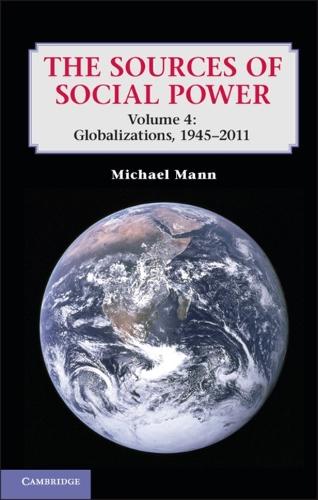
Full Product Details
Author: Michael Mann (University of California, Los Angeles)
Publisher: Cambridge University Press
Imprint: Cambridge University Press
Dimensions:
Width: 15.20cm
, Height: 2.60cm
, Length: 22.80cm
Weight: 0.670kg
ISBN: 9781107610415
ISBN 10: 1107610419
Pages: 496
Publication Date: 28 December 2012
Audience:
Professional and scholarly
,
Professional and scholarly
,
Professional & Vocational
,
Professional & Vocational
Format: Paperback
Publisher's Status: Active
Availability: Manufactured on demand

We will order this item for you from a manufactured on demand supplier.
Reviews
'No one is better than Michael Mann at synthesizing the best research and extracting key patterns, and no one is more interesting and informative at a high intellectual level. This volume explains why the World Wars were the structural turning points of the twentieth century; how the rise of identity politics and social movements defocused the class mobilization which most effectively produces universal social citizenship rights; why the crisis of climate change is very hard to stop because it is based on all the dominant institutions gone global - capitalism, autonomous nation states, and consumer rights. Mann also shows that atrocities caused by market transitions, in terms of deaths, are not very different from those of the most coercive ideological states. There is no better guide to our own times and future.' Randall Collins, University of Pennsylvania 'Globalizations, 1945-2011 brings together macrosociology and political economy, offering an encompassing perspective on the postwar world, concluding its author's enormously ambitious four-volume effort to explore the sources of social power, from the beginnings of civilization until today. Mann writes history as a sociologist, guided by an abiding interest in theory and structuring his narrative into a flexibly evolving analytical framework. Capitalism is at the center: the postwar settlement in the West and its neoliberal transformation since the 1970s, coinciding with the spread of markets around the globe, from the United States to Europe, Russia, and China.' Wolfgang Streeck, Max Planck Institute for the Study of Societies 'Mann comes closer to his 'history of power in human societies' in these two volumes than in the previous ones. It is hard to think of other works of this scope by social scientists. ... Readers looking for something like a truly global history of power over the past century and a half will find much to ponder here. The overarching result is predictable, considering the author: Mann tackles these topics masterfully. He explains each development with elan, sometimes upending dominant interpretations and often pushing at the edges of received wisdom ... These last two volumes, along with the previous two, will be read and reread for generations to come.' Julian Go, International Affairs 'With this volume, Mann, a renowned historical sociologist, completes his magisterial survey of power and society across human history, producing an almost breathtaking synthesis of modern history and social science that depicts the changing character of power and social relations in the post-1945 world system.' G. John Ikenberry, Foreign Affairs
'No one is better than Michael Mann at synthesizing the best research and extracting key patterns, and no one is more interesting and informative at a high intellectual level. This volume explains why the World Wars were the structural turning points of the twentieth century; how the rise of identity politics and social movements defocused the class mobilization which most effectively produces universal social citizenship rights; why the crisis of climate change is very hard to stop because it is based on all the dominant institutions gone global - capitalism, autonomous nation states, and consumer rights. Mann also shows that atrocities caused by market transitions, in terms of deaths, are not very different from those of the most coercive ideological states. There is no better guide to our own times and future.' Randall Collins, University of Pennsylvania 'Globalizations, 1945–2011 brings together macrosociology and political economy, offering an encompassing perspective on the postwar world, concluding its author's enormously ambitious four-volume effort to explore the sources of social power, from the beginnings of civilization until today. Mann writes history as a sociologist, guided by an abiding interest in theory and structuring his narrative into a flexibly evolving analytical framework. Capitalism is at the center: the postwar settlement in the West and its neoliberal transformation since the 1970s, coinciding with the spread of markets around the globe, from the United States to Europe, Russia, and China.' Wolfgang Streeck, Max Planck Institute for the Study of Societies 'Mann comes closer to his 'history of power in human societies' in these two volumes than in the previous ones. It is hard to think of other works of this scope by social scientists. … Readers looking for something like a truly global history of power over the past century and a half will find much to ponder here. The overarching result is predictable, considering the author: Mann tackles these topics masterfully. He explains each development with élan, sometimes upending dominant interpretations and often pushing at the edges of received wisdom … These last two volumes, along with the previous two, will be read and reread for generations to come.' Julian Go, International Affairs 'With this volume, Mann, a renowned historical sociologist, completes his magisterial survey of power and society across human history, producing an almost breathtaking synthesis of modern history and social science that depicts the changing character of power and social relations in the post-1945 world system.' G. John Ikenberry, Foreign Affairs
No one is better than Michael Mann at synthesizing the best research and extracting key patterns, and no one is more interesting and informative at a high intellectual level. This volume explains why the World Wars were the structural turning points of the 20th century; how the rise of identity politics and social movements defocused the class mobilization which most effectively produces universal social citizenship rights; why the crisis of climate change is very hard to stop because it is based on all the dominant institutions gone global - capitalism, autonomous nation states, and consumer rights. Mann also shows that atrocities caused by market transitions, in terms of deaths, are not very different from those of the most coercive ideological states. There is no better guide to our own times and future. - Randall Collins, University of Pennsylvania Globalizations, 1945-2011 brings together macrosociology and political economy, offering an encompassing perspective on the postwar world, concluding its author's enormously ambitious four-volume effort to explore the sources of social power, from the beginnings of civilization until today. Mann writes history as a sociologist, guided by an abiding interest in theory and structuring his narrative into a flexibly evolving analytical framework. Capitalism is at the center: the postwar settlement in the West and its neoliberal transformation since the 1970s, coinciding with the spread of markets around the globe, from the United States to Europe, Russia, and China. - Wolfgang Streeck, Max Planck Institute for the Study of Societies
'No one is better than Michael Mann at synthesizing the best research and extracting key patterns, and no one is more interesting and informative at a high intellectual level. This volume explains why the World Wars were the structural turning points of the twentieth century; how the rise of identity politics and social movements defocused the class mobilization which most effectively produces universal social citizenship rights; why the crisis of climate change is very hard to stop because it is based on all the dominant institutions gone global - capitalism, autonomous nation states, and consumer rights. Mann also shows that atrocities caused by market transitions, in terms of deaths, are not very different from those of the most coercive ideological states. There is no better guide to our own times and future.' Randall Collins, University of Pennsylvania 'Globalizations, 1945-2011 brings together macrosociology and political economy, offering an encompassing perspective on the postwar world, concluding its author's enormously ambitious four-volume effort to explore the sources of social power, from the beginnings of civilization until today. Mann writes history as a sociologist, guided by an abiding interest in theory and structuring his narrative into a flexibly evolving analytical framework. Capitalism is at the center: the postwar settlement in the West and its neoliberal transformation since the 1970s, coinciding with the spread of markets around the globe, from the United States to Europe, Russia, and China.' Wolfgang Streeck, Max Planck Institute for the Study of Societies
Author Information
Michael Mann is Distinguished Professor of Sociology at the University of California, Los Angeles. He is the author of Power in the 21st Century: Conversations with John Hall (2011), Incoherent Empire (2003) and Fascists (Cambridge University Press, 2004). His book The Dark Side of Democracy (Cambridge University Press, 2004) was awarded the Barrington Moore Award of the American Sociological Association for the best book in comparative and historical sociology in 2006.