Overview
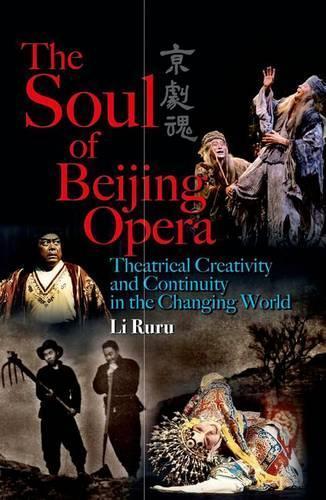
Any traditional theater has to engage the changing world to avoid becoming a living fossil. How has Beijing opera - a highly stylized theater with breath-taking acrobatics and martial arts, fabulous costumes and striking makeup - survived into the new millennium while coping with a century of great upheavals and competition from new entertainment forms? Li Ruru's The Soul of Beijing Opera answers that question, looking at the evolution of singing and performance styles, make-up and costume, audience demands, as well as stage and street presentation modes amid tumultuous social and political changes. Li's study follows a number of major artists' careers in mainland China and Taiwan, drawing on extensive primary print sources as well as personal interviews with performers and their cultural peers. One chapter focuses on the illustrious career of Li's own mother and how she adapted to changes in Communist ideology. In addition, she explores how performers as social beings have responded to conflicts between tradition and modernity, and between convention and innovation. Through performers' negotiation and compromises, Beijing opera has undergone constant re-examination of its inner artistic logic and adjusted to the demands of the external world.
Full Product Details
Author: Ruru Li ,
Eugenio Barba
Publisher: Hong Kong University Press
Imprint: Hong Kong University Press
Dimensions:
Width: 15.70cm
, Height: 3.10cm
, Length: 23.60cm
Weight: 0.818kg
ISBN: 9789622099944
ISBN 10: 9622099947
Pages: 368
Publication Date: 01 May 2010
Audience:
Professional and scholarly
,
Professional and scholarly
,
Professional & Vocational
,
Professional & Vocational
Format: Hardback
Publisher's Status: Unknown
Availability: In Print

Limited stock is available. It will be ordered for you and shipped pending supplier's limited stock.
Language: English
Reviews
This book will act as a powerful introduction to the story of Beijing Opera over the course of the twentieth century with a particularly strong emphasis on the Communist period and its influence on contemporary performance. Using excellent oral history research and with a strong focus on practice and performance techniques, Li Ruru places the genre in both its historical and global context: not a timeless Chinese tradition, but a product of China's turbulent twentieth century and the global interactions that were a key part of that history. -- Henrietta Harrison, Harvard University
This book will act as a powerful introduction to the story of Beijing Opera over the course of the twentieth century with a particularly strong emphasis on the Communist period and its influence on contemporary performance. Using excellent oral history research and with a strong focus on practice and performance techniques, Li Ruru places the genre in both its historical and global context: not a timeless Chinese tradition, but a product of China's turbulent twentieth century and the global interactions that were a key part of that history. - Henrietta Harrison, Harvard University
Author Information
Li Ruru is senior lecturer in the Department of East Asian Studies at the University of Leeds (UK). Brought up in a Beijing Opera actress family, she received some basic training when she was ten. She runs Chinese theatre workshops and regards regular contact with the theatre as essential to her academic work. Having written extensively on Shakespeare performance in China (including a monograph Shashibiya: Staging Shakespeare in China 2003) and on Chinese theatre (both modern and traditional), she has recently concentrated on performer and performance of Beijing Opera, publishing in both Chinese and English.