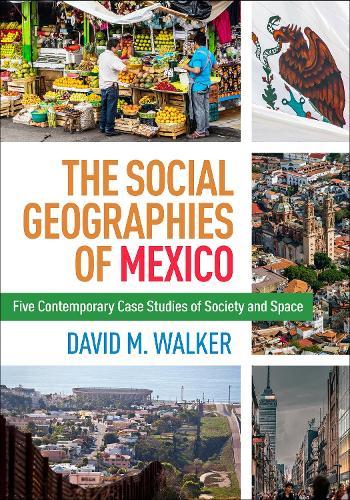
Full Product Details
Author: David M. Walker (College of Southern Maryland, United States)
Publisher: Guilford Publications
Imprint: Guilford Press
Weight: 0.540kg
ISBN: 9781462557776
ISBN 10: 1462557775
Pages: 214
Publication Date: 15 August 2025
Audience:
College/higher education
,
Tertiary & Higher Education
Format: Hardback
Publisher's Status: Active
Availability: Manufactured on demand

We will order this item for you from a manufactured on demand supplier.
Reviews
“The Social Geographies of Mexico is one of those rare books that manages to be both deeply thoughtful and highly readable. Through vivid case studies--from Tepito and Tijuana to the Costa Chica and Los Chimalapas--Walker brings to life the layered connections between people, place, identity, and power. The book doesn’t just teach students about Mexico; it teaches them how to think geographically, socially, and critically. I would absolutely recommend this text for undergraduate or graduate courses in geography, Latin American studies, anthropology, and urban studies. It invites meaningful conversations and offers new ways to understand inequality, resistance, and everyday life in contemporary Mexico. With its clear structure, engaging vignettes, and attention to theory and lived experience, this book is an invaluable resource for teaching and learning.”--Bertha A. Bermúdez Tapia, PhD, Department of Sociology, New Mexico State University “The rich empirical case studies in this useful book provide insights into the relationships between politics, economic change, and social differences in different Mexican locales. I will recommend this book to upper-level undergraduates and graduate students planning on doing field research in Mexico, both to learn about the country and as an example of how to produce ethnographic accounts that incorporate observation and interviews.”--Derek A. Smith, PhD, Department of Geography and Environmental Studies, Carleton University, Ottawa, Ontario, Canada ""This text provides compelling points of entry for the study of social and spatial dynamics of contemporary life in Mexico. Unique for its combined geographic and thematic focus, the book is especially well suited to introductory courses. Walker’s case studies encourage collective engagement, including through classroom-friendly features like discussion questions. More experienced readers in geography or interdisciplinary studies of Mexico will also find the book stimulating, as Walker’s place-specific case studies reflect more generalized political–economic and cultural–political transformations of Mexico. Selected chapters can be used on their own (for readers thematically focused on urban dynamics, or on regional processes of racialization, for example), but the book also rewards being read from beginning to end.""--Nicholas Jon Crane, PhD, School of Politics, Public Affairs, and International Studies, University of Wyoming “This compelling and timely text explores how identity and geography shape one another across Mexico's diverse landscapes. Through richly detailed case studies and a mix of ethnographic and archival methods, Walker unpacks the complex interrelations of society, space, and place. From Indigenous histories to neoliberal transformations, this book captures the local cultural and social responses to global structural forces. A valuable resource for students and scholars alike, it offers a nuanced introduction to Mexico’s geography, politics, and identity through the critical lens of social geography.”--Mark Overmyer-Velázquez, PhD, Dean and Chief Administrative Officer, and Professor of History and Latino Studies, University of Connecticut–Hartford-
“The rich empirical case studies in this useful book provide insights into the relationships between politics, economic change, and social differences in different Mexican locales. I will recommend this book to upper-level undergraduates and graduate students planning on doing field research in Mexico, both to learn about the country and as an example of how to produce ethnographic accounts that incorporate observation and interviews.”--Derek A. Smith, PhD, Department of Geography and Environmental Studies, Carleton University, Ottawa, Ontario, Canada ""This text provides compelling points of entry for the study of social and spatial dynamics of contemporary life in Mexico. Unique for its combined geographic and thematic focus, the book is especially well suited to introductory courses. Walker’s case studies encourage collective engagement, including through classroom-friendly features like discussion questions. More experienced readers in geography or interdisciplinary studies of Mexico will also find the book stimulating, as Walker’s place-specific case studies reflect more generalized political–economic and cultural–political transformations of Mexico. Selected chapters can be used on their own (for readers thematically focused on urban dynamics, or on regional processes of racialization, for example), but the book also rewards being read from beginning to end.""--Nicholas Jon Crane, PhD, School of Politics, Public Affairs, and International Studies, University of Wyoming “This compelling and timely text explores how identity and geography shape one another across Mexico's diverse landscapes. Through richly detailed case studies and a mix of ethnographic and archival methods, Walker unpacks the complex interrelations of society, space, and place. From Indigenous histories to neoliberal transformations, this book captures the local cultural and social responses to global structural forces. A valuable resource for students and scholars alike, it offers a nuanced introduction to Mexico’s geography, politics, and identity through the critical lens of social geography.”--Mark Overmyer-Velázquez, PhD, Dean and Chief Administrative Officer, and Professor of History and Latino Studies, University of Connecticut–Hartford-
Author Information
David M. Walker, PhD, is Professor of Geography at the College of Southern Maryland. His international research centers on neoliberal urban governance, nongovernmental organizations, economic policies, and urban change in Oaxaca, Mexico City, and Tijuana. In the United States, Dr. Walker analyzes immigrant urban revitalization of first-tier suburban neighborhoods, contrasted with formal government revitalization planning practices. He is a lifelong traveler who has lived for long periods in Mexico and Spain.