Overview
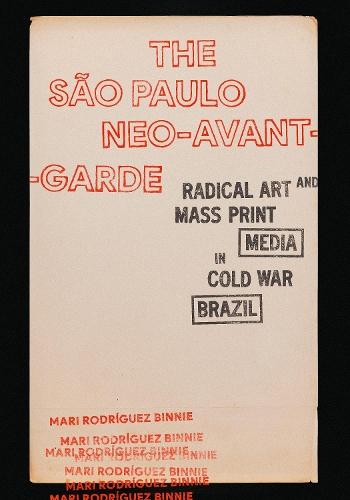
How artists challenged a military dictatorship through mass print technologies in 1970s and 1980s São Paulo. Throughout the 1970s and into the 1980s, during Brazil's military dictatorship, artists shifted their practices to critique the government and its sanitized images of Brazil, its use of torture, and its targeted persecutions. Mari Rodríguez Binnie's The São Paulo Neo-Avant-Garde examines these artworks and their engagement with politics and mainstream art institutions and practices. As Binnie skillfully shows, artists appropriated processes like photocopy, offset lithography, and thermal and heliographic printing, making newly available technologies of mass production foundational to their work of resistance against both the dictatorship and the established art world. Often working collaboratively, these artists established alternative networks of exchange locally and internationally to circulate their work. As democracy was reestablished in Brazil, and in the decades that followed, their works largely fell out of sight. Here, in the first English-language book to focus entirely on conceptual practices in São Paulo in the 1970s and 1980s, Binnie unearths a scene critical to the development of contemporary Brazilian Art.
Full Product Details
Author: Mari Rodríguez Binnie
Publisher: University of Texas Press
Imprint: University of Texas Press
Dimensions:
Width: 17.80cm
, Height: 2.60cm
, Length: 25.40cm
Weight: 0.680kg
ISBN: 9781477329863
ISBN 10: 1477329862
Pages: 216
Publication Date: 15 October 2024
Audience:
Professional and scholarly
,
Professional & Vocational
Format: Hardback
Publisher's Status: Active
Availability: In Print

This item will be ordered in for you from one of our suppliers. Upon receipt, we will promptly dispatch it out to you. For in store availability, please contact us.
Reviews
A timely book that will appeal to both researchers interested in this pivotal period of Latin American art history and anyone inspired by alternative methods of resistance as the specter of censorship grows more ominous with the rise of political authoritarianism worldwide. (Hyperallergic) [This book is] a groundbreaking exploration of the alternative art scene in Brazil’s largest metropolis during one of that country’s most politically turbulent periods in modern times...[and] makes a significant contribution by focusing on the young radical artists who defied traditional artistic boundaries and used new technologies to create a critical dialogue with Brazil’s military regime...[This is] a meticulous and thought-provoking work. (The Americas)
Author Information
Mari RodrÍguez Binnie is an assistant professor of art history at Williams College and at the Graduate Program in the History of Art at the Sterling and Francine Clark Art Institute.