Overview
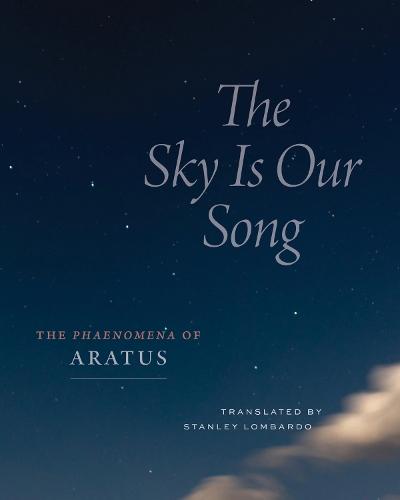
An ancient Greek guide to the heavens, translated in a new accessible modern English edition. A poetic guide to the heavens, the Phaenomena of Aratus—dating from around 270 BCE—was widely known across the ancient world, second only in fame to the works of Homer. Beginning with an invocation to Zeus, the poem describes the constellations of the northern and southern skies, the celestial sphere, and weather signs. Aratus's vivid work offered a complete handbook of astronomy, constellations, and weather, and this treatise on the night sky was later translated or adapted by luminaries including Cicero, Virgil, and Ovid. The Phaenomena remained popular throughout the Renaissance and had more than sixty printed editions by the early seventeenth century, but its fame has faded in the modern world. With this edition, renowned translator and amateur astronomer Stanley Lombardo renders Aratus's poem in reader-friendly vernacular English verse. Complete with endnotes, an accessible introduction, and astronomically accurate illustrations, The Sky Is Our Song brings this master poet's celebration of the sky to a twenty-first-century audience, inviting new readers to follow Aratus on a visual journey through star signs, moon phases, weather phenomena, and all wonders of the heavens.
Full Product Details
Author: Aratus ,
Stanley Lombardo ,
Cynthia C. Polsley ,
Walter Michener
Publisher: The University of Chicago Press
Imprint: University of Chicago Press
Edition: Second Edition
Dimensions:
Width: 15.20cm
, Height: 1.80cm
, Length: 19.10cm
Weight: 0.313kg
ISBN: 9780226836980
ISBN 10: 0226836983
Pages: 136
Publication Date: 13 February 2025
Audience:
Professional and scholarly
,
Professional & Vocational
Format: Hardback
Publisher's Status: Active
Availability: Available To Order

We have confirmation that this item is in stock with the supplier. It will be ordered in for you and dispatched immediately.
Reviews
"“I’m in awe of what Lombardo has achieved with this book. He has made Phaenomena readable and comprehensible by anyone. I shall gaze at the Greek night skies with new understanding.” -- Robin Waterfield, author of ""The Making of a King: Antigonus Gonatas of Macedon and the Greeks"" “Lombardo, who has established himself as one of the leading translator-poets of ancient Greek and Latin texts, has an astonishing gift for combining metrical form with the diction and rhythm of everyday speech. This edition opens up a full understanding of the Phaenomena as a didactic poem, with its astronomy, mythological references, weather lore, and literary context.” -- Mark Possanza, author of ""Translating the Heavens: Aratus, Germanicus, and the Poetics of Latin Translation"" ""Lombardo's Aratus is a work of deep artistry, learning, and love, easily the finest English version ever written of this key ancient poem. It is good to see it available again in a new and very handsomely designed edition."" -- William Levitan, coeditor of ""Tales of Dionysus: The Dionysiaca of Nonnus of Panopolis"""
""For this modern edition, which uses the first line of the poem for its title, Lombardo, an American classicist and amateur astronomer, has beautifully translated Phaenomena into vernacular English, making this poetic guide to the heavens accessible to all. . . . Written in such a simple but descriptive way, The Sky is Our Song is a delightful and less conventional way of learning about the night sky, evoking feelings of a deep connection with the heavens above, stirring our imagination and a longing to sit under the stars. . . . It really is something extraordinary."" -- Katrin Raynor * BBC Sky at Night Magazine * “I’m in awe of what Lombardo has achieved with this book. He has made Phaenomena readable and comprehensible by anyone. I shall gaze at the Greek night skies with new understanding.” -- Robin Waterfield, author of ""The Making of a King: Antigonus Gonatas of Macedon and the Greeks"" “Lombardo, who has established himself as one of the leading translator-poets of ancient Greek and Latin texts, has an astonishing gift for combining metrical form with the diction and rhythm of everyday speech. This edition opens up a full understanding of the Phaenomena as a didactic poem, with its astronomy, mythological references, weather lore, and literary context.” -- Mark Possanza, author of ""Translating the Heavens: Aratus, Germanicus, and the Poetics of Latin Translation"" ""Lombardo's Aratus is a work of deep artistry, learning, and love, easily the finest English version ever written of this key ancient poem. It is good to see it available again in a new and very handsomely designed edition."" -- William Levitan, coeditor of ""Tales of Dionysus: The Dionysiaca of Nonnus of Panopolis""
"""I'm in awe of what Lombardo has achieved with this book. He has made Phaenomena readable and comprehensible by anyone. I shall gaze at the Greek night skies with new understanding.""--Robin Waterfield, author of ""The Making of a King: Antigonus Gonatas of Macedon and the Greeks"" ""Lombardo, who has established himself as one of the leading translator-poets of ancient Greek and Latin texts, has an astonishing gift for combining metrical form with the diction and rhythm of everyday speech. This edition opens up a full understanding of the Phaenomena as a didactic poem, with its astronomy, mythological references, weather lore, and literary context.""--Mark Possanza, author of Translating the Heavens: Aratus, Germanicus, and the Poetics of Latin Translation"
"“I’m in awe of what Lombardo has achieved with this book. He has made Phaenomena readable and comprehensible by anyone. I shall gaze at the Greek night skies with new understanding.” -- Robin Waterfield, author of ""The Making of a King: Antigonus Gonatas of Macedon and the Greeks"" “Lombardo, who has established himself as one of the leading translator-poets of ancient Greek and Latin texts, has an astonishing gift for combining metrical form with the diction and rhythm of everyday speech. This edition opens up a full understanding of the Phaenomena as a didactic poem, with its astronomy, mythological references, weather lore, and literary context.” -- Mark Possanza, author of ""Translating the Heavens: Aratus, Germanicus, and the Poetics of Latin Translation"""
Author Information
Aratus (ca. 315–ca. 240 BCE) was a Greek didactic poet from Soloi. He composed the Phaenomena while he was a resident of the court of the Macedonian king Antigonus II Gonatas. Stanley Lombardo is a translator, former professor of classics at the University of Kansas, and amateur astronomer. He has published translations of works by Homer, Virgil, Horace, Ovid, Sappho, Plato, Hesiod, Statius, and Dante, among others.