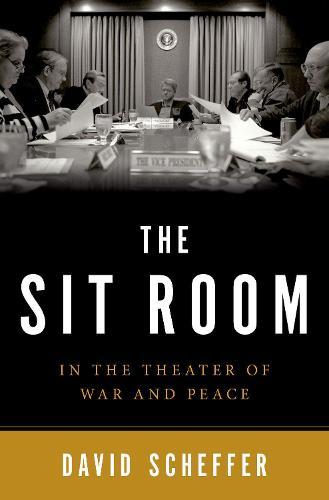
Full Product Details
Author: David Scheffer (Mayer Brown/Robert A. Helman Professor of Law, Mayer Brown/Robert A. Helman Professor of Law, Northwestern University Pritzker School of Law) ,
Christiane Amanpour
Publisher: Oxford University Press Inc
Imprint: Oxford University Press Inc
Dimensions:
Width: 23.60cm
, Height: 3.10cm
, Length: 16.30cm
Weight: 0.703kg
ISBN: 9780190860639
ISBN 10: 0190860634
Pages: 360
Publication Date: 21 December 2018
Audience:
Professional and scholarly
,
Professional & Vocational
Format: Hardback
Publisher's Status: Active
Availability: To order

Stock availability from the supplier is unknown. We will order it for you and ship this item to you once it is received by us.
Reviews
David Scheffer provides an objective, first-hand study of the extended policy debates in the White House Situation Room over resolving Bosnia. Intricate, intriguing details balanced with moments of deep drama punctuate a text whose value to the expert and history buff alike makes it a prime read. His trenchant conclusions on improving the Sit Room process are an added plus. -- Thomas Pickering, former U.S. Under Secretary of State and Ambassador to Russia, India, the United Nations, Israel, El Salvador, Nigeria, and Jordan For Secretary of State Warren Christopher, what to do about the shame of Bosnia was 'the problem from hell,' but it had to be answered. Thanks to David Scheffer's riveting behind-the-scenes ccount of the tortuous debates in the White House basement, we now know exactly what it took. This book will be a classic of diplomatic history. -- Tom Gjelten, NPR Correspondent This is a fascinating insider's account of one of the most momentous U.S. foreign policy decisions of recent decades - whether to intervene in the Bosnian conflict. With its level of detail, the vivid account of being inside the Sit Room at the moment when life-and-death choices can no longer be ducked, David Scheffer's impressive book helps provide a roadmap for tackling the dilemmas of humanitarian intervention. -- Julian Borger, World Affairs Editor, The Guardian This fly-on-the-wall account of the crafting of Balkans policy in Bill Clinton's first term opens slowly with top aides floundering over a genocidal war that's out of control, but it picks up steam as they spot the chance for a U.S. leadership role and climaxes with a gripping account of the run-up to the Dayton peace conference. One figure missing in their deliberations is the chief policy wonk himself, who rarely drops into the Situation Room. Great insights into how the foreign policy sausage is made. -- Roy Gutman, Freelance Correspondent, winner of the Pulitzer Prize for A Witness to Genocide For those who have never had the honor - and challenge - of sitting in the Situation Room, David Scheffer offers the closest thing: a vivid account of the human dimension of policymaking, the pressures of imperfect choices with imperfect information under extraordinary time pressures, and a timely reminder of the power and purpose of American diplomacy. -- William J. Burns, President, Carnegie Endowment for International Peace and former Deputy Secretary of State Scheffer ... offers an insider's detailed account of the three-year conversationA that took place in the White House situation room as policy makers tried to grapple with the early-1990s Balkans War. For Scheffer, deliberations in the sit room were characterized both by courageous, innovative thinking - in particular that of Scheffer's boss at the time, Madeleine Albright, U.S. permanent representative to the United Nations - and by procrastination, fear of the unknown, and a futile search for alternatives to bold action. Participants in these discussions found themselves negotiating ever-changing daily developments and a dizzying array of stakeholders, ultimately muddling through to secure what Scheffer calls a fragile peace. This account will doubtless be useful to scholars of U.S. foreign policy and the policy-making process ... [P]olicy scholars will be rewarded by the level of detail and the sharp character sketches of key figures ... -- Publishers Weekly A former U.S. diplomat offers an insider account of his time on the National Security Council during the first presidential term of Bill Clinton, when officials were trying to determine what to do about the genocidal war within the former Yugoslavia. Those officials debated whether the U.S. should do nothing, intervene alone, or build a coalition with European countries. Scheffer, who also served as America's first Ambassador at Large for War Crimes Issues, sided with Clinton's secretary of state, Madeleine Albright, who leaned toward immediate, decisive military intervention to halt the deaths of civilians and the genocidal aspects of the fighting involving the unstable, Balkanized nations of Serbia-Montenegro, Croatia, and Bosnia-Herzegovina ... Scheffer felt compelled to recount the give-and-take of his time in the Sit Room as a result of the brutal genocide in Syria. -- Kirkus Reviews
A former U.S. diplomat offers an insider account of his time on the National Security Council during the first presidential term of Bill Clinton, when officials were trying to determine what to do about the genocidal war within the former Yugoslavia. Those officials debated whether the U.S. should do nothing, intervene alone, or build a coalition with European countries. Scheffer, who also served as America's first Ambassador at Large for War Crimes Issues, sided with Clinton's secretary of state, Madeleine Albright, who leaned toward immediate, decisive military intervention to halt the deaths of civilians and the genocidal aspects of the fighting involving the unstable, Balkanized nations of Serbia-Montenegro, Croatia, and Bosnia-Herzegovina ... Scheffer felt compelled to recount the give-and-take of his time in the Sit Room as a result of the brutal genocide in Syria. * Kirkus Reviews * Scheffer ... offers an insider's detailed account of the three-year conversation that took place in the White House situation room as policy makers tried to grapple with the early-1990s Balkans War. For Scheffer, deliberations in the sit room were characterized both by courageous, innovative thinking - in particular that of Scheffer's boss at the time, Madeleine Albright, U.S. permanent representative to the United Nations - and by procrastination, fear of the unknown, and a futile search for alternatives to bold action. Participants in these discussions found themselves negotiating ever-changing daily developments and a dizzying array of stakeholders, ultimately muddling through to secure what Scheffer calls a fragile peace. This account will doubtless be useful to scholars of U.S. foreign policy and the policy-making process ... [P]olicy scholars will be rewarded by the level of detail and the sharp character sketches of key figures ... * Publishers Weekly * For those who have never had the honor - and the challenge - of sitting in the Situation Room, David Scheffer offers the closest thing: a vivid account of the human dimension of policymaking, the pressures of imperfect choices with imperfect information under extraordinary time pressures, and a timely reminder of the power and purpose of American diplomacy. * William J. Burns, President, Carnegie Endowment for International Peace and former Deputy Secretary of State * This fly-on-the-wall account of the crafting of Balkans policy in Bill Clinton's first term opens slowly with top aides floundering over a genocidal war that's out of control, but it picks up steam as they spot the chance for a U.S. leadership role and climaxes with a gripping account of the run-up to the Dayton peace conference. One figure missing in their deliberations is the chief policy wonk himself, who rarely drops into the Situation Room. Great insights into how the foreign policy sausage is made. * Roy Gutman, Freelance Correspondent, winner of the Pulitzer Prize for A Witness to Genocide * This is a fascinating insider's account of one of the most momentous U.S. foreign policy decisions of recent decades - whether to intervene in the Bosnian conflict. With its level of detail, the vivid account of being inside the Sit Room at the moment when life-and-death choices can no longer be ducked, David Scheffer's impressive book helps provide a roadmap for tackling the dilemmas of humanitarian intervention. * Julian Borger, World Affairs Editor, The Guardian * For Secretary of State Warren Christopher, what to do about the shame of Bosnia was 'the problem from hell,' but it had to be answered. Thanks to David Scheffer's riveting behind-the-scenes account of the tortuous debates in the White House basement, we now know exactly what it took. This book will be a classic of diplomatic history. * Tom Gjelten, NPR Correspondent * David Scheffer provides an objective, first-hand study of the extended policy debates in the White House Situation Room over resolving Bosnia. Intricate, intriguing details balanced with moments of deep drama punctuate a text whose value to the expert and history buff alike makes it a prime read. His trenchant conclusions on improving the Sit Room process are an added plus. * Thomas Pickering, former U.S. Under Secretary of State and Ambassador to Russia, India, the United Nations, Israel, El Salvador, Nigeria, and Jordan *
A former U.S. diplomat offers an insider account of his time on the National Security Council during the first presidential term of Bill Clinton, when officials were trying to determine what to do about the genocidal war within the former Yugoslavia. Those officials debated whether the U.S. should do nothing, intervene alone, or build a coalition with European countries. Scheffer, who also served as America's first Ambassador at Large for War Crimes Issues, sided with Clinton's secretary of state, Madeleine Albright, who leaned toward immediate, decisive military intervention to halt the deaths of civilians and the genocidal aspects of the fighting involving the unstable, Balkanized nations of Serbia-Montenegro, Croatia, and Bosnia-Herzegovina ... Scheffer felt compelled to recount the give-and-take of his time in the Sit Room as a result of the brutal genocide in Syria. * Kirkus Reviews * Scheffer ... offers an insider's detailed account of the three-year conversation that took place in the White House situation room as policy makers tried to grapple with the early-1990s Balkans War. For Scheffer, deliberations in the sit room were characterized both by courageous, innovative thinking - in particular that of Scheffer's boss at the time, Madeleine Albright, U.S. permanent representative to the United Nations - and by procrastination, fear of the unknown, and a futile search for alternatives to bold action. Participants in these discussions found themselves negotiating ever-changing daily developments and a dizzying array of stakeholders, ultimately muddling through to secure what Scheffer calls a fragile peace. This account will doubtless be useful to scholars of U.S. foreign policy and the policy-making process ... [P]olicy scholars will be rewarded by the level of detail and the sharp character sketches of key figures ... * Publishers Weekly * For those who have never had the honor - and the challenge - of sitting in the Situation Room, David Scheffer offers the closest thing: a vivid account of the human dimension of policymaking, the pressures of imperfect choices with imperfect information under extraordinary time pressures, and a timely reminder of the power and purpose of American diplomacy. * William J. Burns, President, Carnegie Endowment for International Peace and former Deputy Secretary of State * This fly-on-the-wall account of the crafting of Balkans policy in Bill Clinton's first term opens slowly with top aides floundering over a genocidal war that's out of control, but it picks up steam as they spot the chance for a U.S. leadership role and climaxes with a gripping account of the run-up to the Dayton peace conference. One figure missing in their deliberations is the chief policy wonk himself, who rarely drops into the Situation Room. Great insights into how the foreign policy sausage is made. * Roy Gutman, Freelance Correspondent, winner of the Pulitzer Prize for A Witness to Genocide * This is a fascinating insider's account of one of the most momentous U.S. foreign policy decisions of recent decades - whether to intervene in the Bosnian conflict. With its level of detail, the vivid account of being inside the Sit Room at the moment when life-and-death choices can no longer be ducked, David Scheffer's impressive book helps provide a roadmap for tackling the dilemmas of humanitarian intervention. * Julian Borger, World Affairs Editor, The Guardian * For Secretary of State Warren Christopher, what to do about the shame of Bosnia was 'the problem from hell,' but it had to be answered. Thanks to David Scheffer's riveting behind-the-scenes account of the tortuous debates in the White House basement, we now know exactly what it took. This book will be a classic of diplomatic history. * Tom Gjelten, NPR Correspondent * David Scheffer provides an objective, first-hand study of the extended policy debates in the White House Situation Room over resolving Bosnia. Intricate, intriguing details balanced with moments of deep drama punctuate a text whose value to the expert and history buff alike makes it a prime read. His trenchant conclusions on improving the Sit Room process are an added plus. * Thomas Pickering, former U.S. Under Secretary of State and Ambassador to Russia, India, the United Nations, Israel, El Salvador, Nigeria, and Jordan *
Author Information
David Scheffer worked in the Deputies Committee of the National Security Council during the early 1990's when the Balkans War raged. He then became America's first Ambassador at Large for War Crimes Issues (1997-2001). A graduate of Harvard, Oxford, and Georgetown universities, he is the Mayer Brown/Robert A. Helman Professor of Law at Northwestern University Pritzker School of Law and is widely published in international law and politics. Ambassador Scheffer was one of Foreign Policy Magazine's ""Top Global Thinkers of 2011,"" won the Berlin Prize in 2013, and received the Champion of Justice Award from the Center for Justice and Accountability in 2018.