Overview
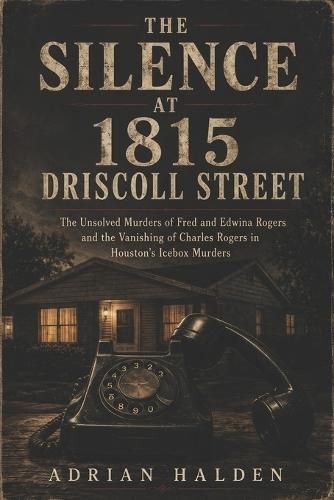
A brutal Houston true crime case. A missing son. A record that still refuses easy answers. The Silence at 1815 Driscoll Street revisits one of Houston's most enduring unsolved murder cases: the June 1965 deaths of Fred and Edwina Rogers and the disappearance of their adult son, Charles Rogers. What began as a welfare check in Montrose became a cold case investigation defined by a disturbing crime scene, a vanished suspect, and a question that has never stopped echoing through Houston true crime history: what really happened inside that house? This historical true crime account follows the case with restraint, precision, and a constant distinction between evidence, inference, and myth. The book opens with the discovery at 1815 Driscoll Street, then moves through the lives of Fred and Edwina Rogers, the household context, the timeline before and after the murders, and the investigative response that quickly focused attention on Charles Rogers. He was widely identified as the central suspect, yet he was never arrested, never tried, and never publicly heard from again. At the center of the book is the tension that makes this unsolved homicide so difficult to close. Reported blood evidence, tools believed connected to the dismemberment, the cleaned house, and Charles's sudden absence all gave investigators a powerful direction. But suspicion is not proof, and disappearance is not a verdict. Without a confession, a trial, or courtroom-tested evidence, the Rogers case remains suspended between strong practical suspicion and unresolved legal reality. The book also examines how a real family tragedy became the ""Icebox Murders,"" a phrase that preserved the case in public memory while risking the loss of its human center. Rather than leaning into rumor, it separates what is confirmed from what remains unclear: the alleged motive, the role of domestic and financial conflict, the forensic limitations of 1965, the claims later attached to Charles Rogers, and the enduring difference between responsible reconstruction and speculation. The deeper inquiry moves beyond the shock of the crime scene into the questions that still define the case: how a private household became a public mystery, why the evidence appeared to point so strongly in one direction, and why the law never reached the finality that readers often expect from a murder investigation. It is a true crime book about violence, yes, but also about record gaps, public memory, and the danger of mistaking a compelling theory for a verdict. For readers drawn to true crime cold cases, historical murder investigations, and unsolved cases where the facts are more haunting than the legends, this book offers a careful path through a story that has often been retold with too much certainty. It does not pretend the record is complete. It asks why the gaps matter. Because some cases are not remembered because they were solved. They are remembered because the silence never ended. At 1815 Driscoll Street, the law found horror, suspicion, and absence-but not final answers. Step into the case that Houston never fully closed.
Full Product Details
Author: Adrian Halden
Publisher: Independently Published
Imprint: Independently Published
Dimensions:
Width: 15.20cm
, Height: 1.40cm
, Length: 22.90cm
Weight: 0.363kg
ISBN: 9798198411326
Pages: 270
Publication Date: 24 May 2026
Audience:
General/trade
,
General
Format: Paperback
Publisher's Status: Active
Availability: Available To Order

We have confirmation that this item is in stock with the supplier. It will be ordered in for you and dispatched immediately.