Overview
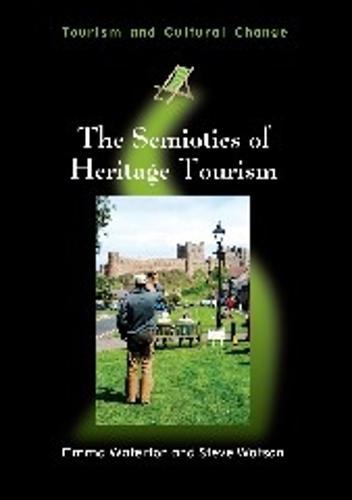
This book is a fast-paced and thorough re-evaluation of what heritage tourism means to the people who experience it. It draws on contemporary thinking in human geography and heritage studies, and applies it to a sector of tourism that is both pervasive yet poorly researched in terms of the perspective of tourists themselves. In a series of lucid and tightly argued chapters, it traces the use of semiotics as an analytical tool from its theoretical origins in text, through the all-important dynamics of visuality into an expanded realm of feeling and sensuality. Challenging assumptions about the way that heritage is experienced, this book uses examples from around the world to explore the semiotic landscape that surrounds heritage sites, linking what is represented about the past and how it feels to be there.
Full Product Details
Author: Emma Waterton ,
Steve Watson
Publisher: Channel View Publications Ltd
Imprint: Channel View Publications
Volume: 35
Dimensions:
Width: 14.80cm
, Height: 0.90cm
, Length: 21.00cm
Weight: 0.206kg
ISBN: 9781845414207
ISBN 10: 1845414209
Pages: 152
Publication Date: 20 January 2014
Audience:
Professional and scholarly
,
Professional & Vocational
Format: Paperback
Publisher's Status: Active
Availability: In Print

This item will be ordered in for you from one of our suppliers. Upon receipt, we will promptly dispatch it out to you. For in store availability, please contact us.
Reviews
Semiotics is most usually conceptualized as a theoretical abstraction about an indivisible signifier/signified integer. Waterton and Watson go much further by considering the semiotics of heritage tourism as a sense-making process that is embodied, performed, felt and emotionally charged. In so doing, they begin to shift the ocular-centrism and the logo-centrism of heritage tourism theoretically and as a practice. This is a considerable achievement and demands our attention. Russell Staiff, University of Western Sydney, Australia This rare and wonderfully accessible book represents one of the finest pieces of theoretical scholarship in the heritage field. Waterton and Watson advance a theory of semiotics that goes beyond the visual to embody emergent fields of research in the realms of the representational and non-representational. The book represents a key text in heritage studies and is an exemplary landmark in heritage scholarship. Divya Tolia-Kelly, Durham University, UK Waterton and Watson skilfully integrate several emergent dialogues in critical heritage studies and tourism studies centred on theories of affect, the senses, memory, and meaning-making. The authors make a most extraordinary contribution to evolving conceptualizations of tourists as sensing, performing, subjectively situated agents engaged in inter-subjective, embodied encounters with the institutionalized semiotics of authorized and commodified heritage discourses, not passive consumers of such. Joy Sather-Wagstaff, North Dakota State University, USA
It is an ambitious, seemingly impossible, task the authors set themselves. Within the narrow space of mere 123 pages the authors review classic perspectives on visuality and representation, discuss them against recent critical positions, and develops their own position that leaves room for embodiment, affect, and performance as a way into exploring the processes and spaces between performance and representation. They also propose a research agenda for heritage/tourism research. All in all, the authors meet the challenges brilliantly. The ambitions of the book combined with the clear and fast-paced style of argumentation and writing provides the reader with a book that easily can be used in graduate/postgraduate courses as well as short welcome reviews of the state-of-the-art of semiotic approaches to heritage, leisure, tourism with a focus on performance, affect and embodiment. -- Maximiliano E. Korstanje, University of Palermo, Argentina Annals of Tourism Research 50 (2015) 173-181 Semiotics is most usually conceptualized as a theoretical abstraction about an indivisible signifier/signified integer. Waterton and Watson go much further by considering the semiotics of heritage tourism as a sense-making process that is embodied, performed, felt and emotionally charged. In so doing, they begin to shift the ocular-centrism and the logo-centrism of heritage tourism theoretically and as a practice. This is a considerable achievement and demands our attention. Russell Staiff, University of Western Sydney, Australia This rare and wonderfully accessible book represents one of the finest pieces of theoretical scholarship in the heritage field. Waterton and Watson advance a theory of semiotics that goes beyond the visual to embody emergent fields of research in the realms of the representational and non-representational. The book represents a key text in heritage studies and is an exemplary landmark in heritage scholarship. Divya Tolia-Kelly, Durham University, UK Waterton and Watson skilfully integrate several emergent dialogues in critical heritage studies and tourism studies centred on theories of affect, the senses, memory, and meaning-making. The authors make a most extraordinary contribution to evolving conceptualizations of tourists as sensing, performing, subjectively situated agents engaged in inter-subjective, embodied encounters with the institutionalized semiotics of authorized and commodified heritage discourses, not passive consumers of such. Joy Sather-Wagstaff, North Dakota State University, USA The timely and provocative contribution made by Waterton and Watson to the general re-theorisation of heritage and tourism will doubtless find this concise volume a place on most reading lists and bibliographies across the discipline. Colin Sterling, UCL, in Papers from the Institute of Archaeology 24(1):8
Author Information
Emma Waterton is a Senior Lecturer at the Institute for Culture and Society, University of Western Sydney, Australia. Her interests include unpacking the discursive constructions of 'heritage'; community involvement in the management of heritage; the divisions implied between tangible and intangible heritage; and the role played by visual media. Publications include Politics, Policy and the Discourses of Heritage in Britain (2010) and Heritage, Communities and Archaeology (2009, with Laurajane Smith). Steve Watson is Principal Lecturer in Tourism at York St John University in the UK. His research is focused on the ways in which heritage is constructed and understood in tourism and the way that tourism acts as a vector for various social and cultural meanings. He has published widely in the field of heritage tourism and recent co-edited books include The Cultural Moment in Tourism (2012, with Laurajane Smith and Emma Waterton) and Heritage and Tourism: Place, Encounter, Engagement (2012, with Robyn Bushell and Russell Staiff).