Overview
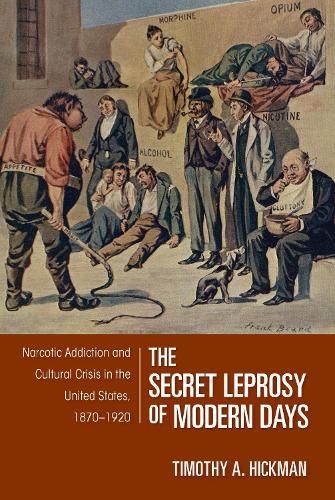
Although the topic of habitual narcotic use first surfaced in the United States during the 1820s, it was not until after the Civil War that it became a subject of widespread public attention. Beginning in the 1870s, an increasingly urgent discussion of what some described as a national epidemic of """"drug addiction"""" could be found in both medical journals and the popular press. Today, nearly a century and a halflater, the term is so commonplace we speak of people being """"addicted"""" to just about anything. Yet, as Timothy A. Hickman argues in this revealing interdisciplinary study, the meaning of addiction has always been as much cultural as scientific and never fixed. In """"The Secret Leprosy of Modern Days"""", Hickman resituates the idea of addiction within its original late nineteenth- and early twentieth-century context. Through close readings of a broad range of literary, medical, and legal texts, he shows how Americans of that era conceptualized the dangers of drug addiction in terms of other preoccupations and fears. Anxieties about the accelerating pace of technological change, the loss of personal autonomy, and the degeneration of society attributed to both foreign influences and a decline of manliness all fed into a widespread sense of cultural crisis - a crisis of which the spiraling """"drug problem"""" was seen as both contributing cause and consequence. Not surprisingly, Hickman points out, deeply held assumptions of class, race, and gender also figured into the popular understanding of addiction. While white middle-class addicts were often depicted as helpless victims of the social and economic pressures of modern life, their less privileged and nonwhite counterparts were regarded as morally weak. Over time the distinction between """"addict as patient"""" and """"addict as criminal"""" came to be accepted by the emerging medical establishment and codified into law, eventually finding expression in the Harrison Narcotics Act of 1914, the first national anti-narcotic legislation in the history of the United States - and the basis for much thinking about addiction and drug policy ever since.
Full Product Details
Author: Timothy A. Hickman
Publisher: University of Massachusetts Press
Imprint: University of Massachusetts Press
Dimensions:
Width: 15.40cm
, Height: 1.50cm
, Length: 22.60cm
Weight: 0.310kg
ISBN: 9781558495661
ISBN 10: 1558495665
Pages: 200
Publication Date: 30 May 2007
Audience:
General/trade
,
General
Format: Paperback
Publisher's Status: Active
Availability: Temporarily unavailable

The supplier advises that this item is temporarily unavailable. It will be ordered for you and placed on backorder. Once it does come back in stock, we will ship it out to you.
Reviews
"""Hickman does a terrific job of positioning narcotic intoxication in relation to abolitionist thought, temperance, and nervousness. . . .These are themes that always exist in awkward relation with the drug literature, which tends toward narrower dualisms--vice versus disease, criminal versus medical, and so on. Hickman draws us beyond those dualisms and situates drugs in a much more complicated, but interesting, context.""--Joseph F. Spillane, author of Cocaine: From Medical Marvel to Modern Menace in the United States, 1884-1920 ""The book's strengths lie in the variety of cultural commentators on which Hickman draws in each chapter, his straightforward writing style, his clear organizational structure and the subtlety of his arguments concerning addiction's double meanings.""--Journal of American History ""Timothy Hickman has written a welcome addition to the growing body of scholarship that examines the history of addiction as a social and cultural phenomenon. Hickman's work pushes the study of addiction in an important new direction . . . Hickman's work offers both interesting interpretations of key text and fresh insights on the attitudes of drug reformers during the late nineteenth and early twentieth centuries; if taken seriously, it also promises to move the field toward the fundamental question of what it meant to be modern.""--Journal of the History of Medicine"
Hickman does a terrific job of positioning narcotic intoxication in relation to abolitionist thought, temperance, and nervousness. . . .These are themes that always exist in awkward relation with the drug literature, which tends toward narrower dualisms--vice versus disease, criminal versus medical, and so on. Hickman draws us beyond those dualisms and situates drugs in a much more complicated, but interesting, context.--Joseph F. Spillane, author of Cocaine: From Medical Marvel to Modern Menace in the United States, 1884-1920The book's strengths lie in the variety of cultural commentators on which Hickman draws in each chapter, his straightforward writing style, his clear organizational structure and the subtlety of his arguments concerning addiction's double meanings.--Journal of American HistoryTimothy Hickman has written a welcome addition to the growing body of scholarship that examines the history of addiction as a social and cultural phenomenon. Hickman's work pushes the study of addiction in an important new direction . . . Hickman's work offers both interesting interpretations of key text and fresh insights on the attitudes of drug reformers during the late nineteenth and early twentieth centuries; if taken seriously, it also promises to move the field toward the fundamental question of what it meant to be modern.--Journal of the History of Medicine
Hickman does a terrific job of positioning narcotic intoxication in relation to abolitionist thought, temperance, and nervousness. . . .These are themes that always exist in awkward relation with the drug literature, which tends toward narrower dualisms--vice versus disease, criminal versus medical, and so on. Hickman draws us beyond those dualisms and situates drugs in a much more complicated, but interesting, context. -- Joseph F. Spillane
Hickman does a terrific job of positioning narcotic intoxication in relation to abolitionist thought, temperance, and nervousness. . . .These are themes that always exist in awkward relation with the drug literature, which tends toward narrower dualisms--vice versus disease, criminal versus medical, and so on. Hickman draws us beyond those dualisms and situates drugs in a much more complicated, but interesting, context.--Joseph F. Spillane, author of Cocaine: From Medical Marvel to Modern Menace in the United States, 1884-1920 The book's strengths lie in the variety of cultural commentators on which Hickman draws in each chapter, his straightforward writing style, his clear organizational structure and the subtlety of his arguments concerning addiction's double meanings.--Journal of American History Timothy Hickman has written a welcome addition to the growing body of scholarship that examines the history of addiction as a social and cultural phenomenon. Hickman's work pushes the study of addiction in an important new direction . . . Hickman's work offers both interesting interpretations of key text and fresh insights on the attitudes of drug reformers during the late nineteenth and early twentieth centuries; if taken seriously, it also promises to move the field toward the fundamental question of what it meant to be modern.--Journal of the History of Medicine
Hickman does a terrific job of positioning narcotic intoxication in relation to abolitionist thought, temperance, and nervousness. . . .These are themes that always exist in awkward relation with the drug literature, which tends toward narrower dualisms--vice versus disease, criminal versus medical, and so on. Hickman draws us beyond those dualisms and situates drugs in a much more complicated, but interesting, context. -- Joseph F. Spillane Hickman does a terrific job of positioning narcotic intoxication in relation to abolitionist thought, temperance, and nervousness. . . .These are themes that always exist in awkward relation with the drug literature, which tends toward narrower dualisms--vice versus disease, criminal versus medical, and so on. Hickman draws us beyond those dualisms and situates drugs in a much more complicated, but interesting, context. -- Joseph F. Spillane
Author Information
TIMOTHY A. HICKMAN is lecturer in history at Lancaster University in the United Kingdom.