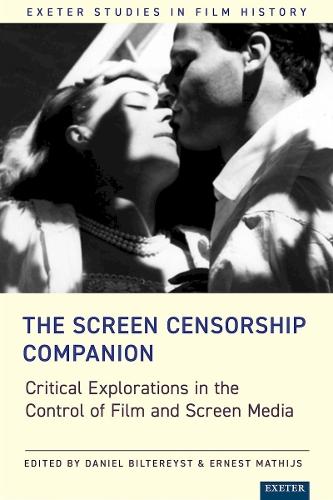
The Screen Censorship Companion: Critical Explorations in the Control of Film and Screen Media

Author:   Daniel Biltereyst ,  Ernest Mathijs
Publisher:   University of Exeter Press
ISBN:  

9781804130667


Pages:   410
Publication Date:   26 November 2024
Format:   Hardback
Availability:   In Print   Availability explained
This item will be ordered in for you from one of our suppliers. Upon receipt, we will promptly dispatch it out to you. For in store availability, please contact us.

Our Price $245.81 Quantity:  
Add to Cart

Share |

The Screen Censorship Companion: Critical Explorations in the Control of Film and Screen Media


Overview

Throughout the history of film, censorship has existed everywhere—in all shapes, colours, and dimensions. The act of restricting the free production, circulation, screening, and consumption of movies was never unique to authoritarian regimes. Censorship has had far-reaching implications for filmmakers, distributors, exhibitors, and audiences across generations and across genres, including the self-censorship of audiences disciplined into particular viewership positions. Today, soft and hard censorship coexist in ever-more fluid forms; the banning, regulating, trimming, and tailoring of films for ‘harmless’ consumption all exemplify wider debates about access to media. This companion brings together contemporary and historical views on censorship, covering Argentina, Canada, Chile, Colombia, Denmark, France, Germany, Italy, Japan, Norway, Poland, Sweden, Turkey, the United Kingdom, and the United States. The book considers Hollywood’s practices and the United States’ legislative context as important frames of reference for the study of filmed entertainment censorship, be they concerned with obscene materials or plain mainstream movie fare. American cinema remains a wider compass, as evidenced by how studies in this companion, which deal with local and regional censorship, appear to have American movies as their targets. This volume showcases the broad international scope of censorship through detailed examinations of censorship practices. The diversity of case studies is an indication of the global reach of censorship—nothing can escape its grasp. Ultimately, the censorship of screen access is a struggle for power and control; this book demonstrates how intense this struggle can become, and how compromises and solutions are found.

Full Product Details

Author:   Daniel Biltereyst ,  Ernest Mathijs
Publisher:   University of Exeter Press
Imprint:   University of Exeter Press
Dimensions:   Width: 15.60cm , Height: 2.80cm , Length: 23.40cm
Weight:   0.805kg
ISBN:  

9781804130667


ISBN 10:   1804130664
Pages:   410
Publication Date:   26 November 2024
Audience:   Professional and scholarly ,  Professional & Vocational
Format:   Hardback
Publisher's Status:   Active
Availability:   In Print   Availability explained
This item will be ordered in for you from one of our suppliers. Upon receipt, we will promptly dispatch it out to you. For in store availability, please contact us.

Table of Contents

Cinema, Screen Media and Censorship: An Introduction Daniel Biltereyst and Ernest Mathijs DOI:10.47788/RSDL4520 1. ‘Forestalling Controversy’: The Production Code Administration and the Mediation of Political Censorship Richard Maltby DOI:10.47788/AJXR2557 2. A Philosovietic Mode of Film Censorship: A Supplement to Studies of Cold War Italian Film Culture Karol Jóźwiak DOI:10.47788/HHUW8463 3. Censorship of Foreign Films in People’s Poland in the Late 1960s and Early 1970s: A Case Study of Films about Hippie Subculture Konrad Klejsa DOI:10.47788/MWLP4097 4. Sex, Drugs, Violence and/or Nudity: Differences in Film Age Rating Practices and Rationales in Denmark, France, Japan, Norway and the UK Elisabeth Staksrud and Marita Eriksen Haugland DOI:10.47788/FTMX2611 5. The Last Convulsions of Democracy: Wolfgang Petzet’s Pamphlet Verbotene Filme and the Censorship Debate at the Close of the Weimar Republic Viola Rühse DOI:10.47788/ODXR8776 6. Party Apparatchiks as Filmmakers: The Film Approval Commissions in Communist Poland, 1955–1970 Mikołaj Kunicki DOI:10.47788/SNGT2135 7. Majors, Adults, Sex and Violence: Film Censorship under Military Dictatorship in Chile, 1973–1989 Jorge Iturriaga Echeverría DOI:10.47788/NOXF9829 8. Fighting for a Free Cinema in a Country That Is Not Free: Film Censorship Abolitionism in Argentina (1978–1983) Fernando Ramírez Llorens DOI:10.47788/XCJE5862 9. Censorship, Criticism and Notions of Quality in Post-War French Cinema Daniel Morgan DOI:10.47788/RFGD3515 10. Hopes and Fears of Transformation: FOCINE and Informal Practices of Film Censorship in Colombia (1978–1993) Karina Aveyard and Karol Valderrama-Burgos DOI:10.47788/BEZG4529 11. State Censorship of Debut Films in the 1980s People’s Republic of Poland: The Example of the Irzykowski Film Studio Emil Sowiński DOI:10.47788/SVEO2240 12. Banned in Detroit: The Interconnectedness of Film, Literary and Media Censorship Ben Strassfeld DOI:10.47788/HBSC1824 13. Splicing Back against the Censors: How Archive/ Counter-Archive Saved the Ontario Board of Censors’ Film Censorship Records from Destruction Michael Marlatt DOI:10.47788/XLVW2388 14. Italian Film Censorship (1948–1976): A Quantitative Analysis Mauro Giori and Tomaso Subini DOI:10.47788/HIIB3780 15. Historicizing the Censor: Path-Dependent Patterns of Film Censorship in Turkey İlke Şanlıer and Aydın Çam DOI:10.47788/PRKT5596 16. Don’t Be Afraid, It’s Only Business: Rethinking the Video Nasties Moral Panic in Thatcher’s Britain Mark McKenna DOI:10.47788/GTGZ8668 17. The Ontario Film Review Board Meets the New French Extremity Daniel Sacco DOI:10.47788/HJES6116 18. Invisible Censors, Opaque Laws and Surveilled Subjects Julian Petley DOI:10.47788/EUHI2366 19. What Is a Hard Core? Obscenity, Pornography and Censorship Linda Williams DOI:10.47788/TMRX1263

Reviews

The Screen Censorship Companion provides an engaging overview of historical and contemporary censorship, effectively balances New Censorship Theory and recognition of the realities of institutional censorship and provides several starting points for future research. -- Amanda Konkle * Historical Journal of Film, Radio and Television *


Author Information

Daniel Biltereyst is Professor in Film and Media Studies at Ghent University, Belgium. He is the (co-)editor of several volumes on cinema audiences and censorship. In 2020 he published a monograph on the history of film/cinema censorship in Belgium, Verboden Beelden, and made a documentary with Bruno Mestdagh on film cuttings (Ongezien/invisible, 2020, Cinematek). Ernest Mathijs is Professor of Cinema and Media Studies at the University of British Columbia, Vancouver. He has written on cult cinema, the reception of Canadian and European genre cinema, The Lord of the Rings, reality-TV, Thomas Pynchon, and on Delphine Seyrig. In 2020 he co-wrote the two-part documentary The Quiet Revolution.

Tab Content 6

Author Website:  

Countries Available

All regions
Latest Reading Guide

NOV RG 20252


Shopping Cart
Your cart is empty
Shopping cart
Mailing List