Overview
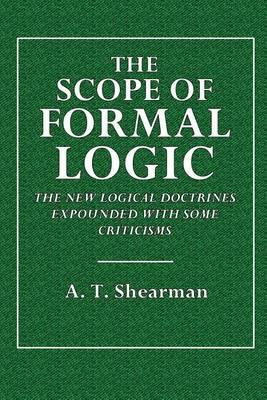
The present gives a brief exposition of the logical work of Frege, Peano, and Bertrand Russell. For by Formal Logic Mr. Shearman means here what has been variously designated by the names symbolic logic, mathematical logic, algebra of logic, symbol logic (Mrs. Ladd-Franklin), logistic (Couturat). This kind of logic has not yet found its fitting name; but it is making history. The purpose of The Scope of Formal Logic is to convince the reader of the importance of the work in this field, and, without presupposing any familiarity with the writings of Frege, Peano, Russell, to lead the uninitiated to these fountain-heads of modern logical thought. In the first chapter a number of important terms, such as propositional function, variable, etc., are elucidated. In the second chapter Frege's, Peano's, and Russell's symbols, or at least some of the more frequent among them, are explained by translating several propositions, some simple, some more complex, from their symbolic statements into English. This is continued in the third chapter which exhibits the methods of proof in Formal Logic. Chapter IV. is devoted to a treatment, by means of these symbolic methods, of opposition, conversion, syllogism, etc., t. e., the usual subject-matter of ordinary logic. Chapter V. shows (1) that arithmetical notions and processes may be replaced by logical notions and processes, (2) that geometrical notions and processes may be similarly replaced, and (3) that general logic ought. for scientific purposes, or to enable us to reach conclusions that have always been supported by common sense, to be regarded as lying at the basis of pure mathematics (p. 130). The remaining two chapters are given over to a philosophical treatment of number and of space. The author has given here more of his own thoughts, though he makes acknowledgement to Frege in the discussion of number, to Russell in that of space; he tries to indicate in a concrete manner the fact that the treatment of number in the preceding chapters implicitly rests upon that conception of number which is here set forth (p. 131) [and similarly in the next chapter with reference to the nature of space]. But the account is vague, and, as it stands, has little direct connection with Formal Logic. It is a presentation of views concerning number that are unfolded by philosophy (p. 143) rather than a development of the subject by the methods expounded in the previous chapters. The modern logician will, no doubt, be greatly relieved to learn that his procedure is in accordance with the dictates of philosophy, that his propositions imply nothing at variance with the teaching that is unfolded by philosophy (p. 150), that the modern treatment of spatial problems... proceeds along the lines which philosophy sets forth as those which should be followed.ni But one would like to know what this mysterious and imperious philosophy is, and whence it gets an authority over the results of logic. The reviewer misses in these chapters a clean separation of logical from psychological problems. Take, for example, such statements as the following: Number is conceptual because, amongst other reasons, we are able to deal with numbers in propositions without being able either to perceive or to have a mental picture of any corresponding entities (p. 132). If a concept possesses these three attributes I shall, since no other species of mental entities or act of attention possesses them, take the three to constitute the definition of a concept. A concept, that is to say, is a mental entity or act of attention which (1) is such that we can ask concerning it if there exist corresponding objects, (2) is not necessarily accompanied by corresponding perceptual objects, and (3) may exist without the possibility of there being corresponding percepts or images (p. 133, note).... - The Journal of Philosophy, Psychology and Scientific Methods [1912]
Full Product Details
Author: A T Shearman
Publisher: Createspace
Imprint: Createspace
Dimensions:
Width: 15.20cm
, Height: 1.00cm
, Length: 22.90cm
Weight: 0.249kg
ISBN: 9781516875474
ISBN 10: 1516875478
Pages: 180
Publication Date: 12 August 2015
Audience:
General/trade
,
General
Format: Paperback
Publisher's Status: Active
Availability: Available To Order

We have confirmation that this item is in stock with the supplier. It will be ordered in for you and dispatched immediately.