Overview
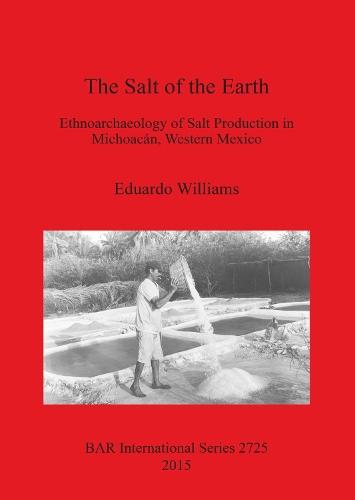
The present study offers new information on salt production in Michoacan, broadening our perspectives on the role played by common salt, or sodium chloride, in the cultural development of the pre-Hispanic Tarascan state. The research on which this book is based began in 1996 with an interdisciplinary perspective that combines archaeological, ethnographic, and ethnohistorical approaches, as well as oral history. The geographical areas where fieldwork was conducted by the author were the eastern part of the Lake Cuitzeo Basin, and the northern area of the Michoacan coast with the adjoining coastal strip in southern Colima. In these areas one can still find saltworks that employ traditional production techniques, similar to those utilized in pre-Hispanic times, as reported in 16th century sources. The research focused on the cultural and technological processes and the material culture associated with salt-making, especially the artefacts and techniques used by the salt-makers, and their archaeological visibility. We also used ethnohistorical information to document the ancient salt-making techniques in Michoacan and neighbouring areas. The main goal of this research was thus to obtain, through ethnographic observation, processual information that would aid in the interpretation of the archaeological record by means of analogy.
Full Product Details
Author: Eduardo Williams
Publisher: BAR Publishing
Imprint: BAR Publishing
Volume: 2725
Dimensions:
Width: 21.00cm
, Height: 1.30cm
, Length: 29.70cm
Weight: 0.614kg
ISBN: 9781407313801
ISBN 10: 1407313800
Pages: 154
Publication Date: 30 June 2015
Audience:
Professional and scholarly
,
College/higher education
,
Professional & Vocational
,
Postgraduate, Research & Scholarly
Format: Paperback
Publisher's Status: Active
Availability: Available To Order

We have confirmation that this item is in stock with the supplier. It will be ordered in for you and dispatched immediately.
Reviews
'The fourth chapter is an excellent data set on the production of salt in the Tarascan area and its hinterland. Eduardo Williams's book illustrates the long history of salt production in the region in a coherent way, and the documentation of ethnographic examples provides data for comparisons with the archaeological record anywhere in the world where salt production is documented.' Barbara Arroyo, Latin American Antiquity, Vol. 28, No. 1, 2017
<p class=MsoNormal style='margin-bottom:0cm;margin-bottom:.0001pt;line-height: normal;mso-layout-grid-align:none;text-autospace:none'><span style='font-size: 12.0pt;font-family: Times New Roman ,serif'>'The fourth chapter is an excellent data set on the production of salt in the Tarascan area and its hinterland. Eduardo Williams's book illustrates the long history of salt production in the region in a coherent way, and the documentation of ethnographic examples provides data for comparisons with the archaeological record anywhere in the world where salt production is documented.' <p class=MsoNormal style='margin-bottom:0cm;margin-bottom:.0001pt;line-height: normal;mso-layout-grid-align:none;text-autospace:none'><span style='font-size: 12.0pt;font-family: Times New Roman ,serif'>Barbara Arroyo, Latin American Antiquity, Vol. 28, No. 1, 2017<span lang=EN-GB style='font-size:8.5pt; font-family: Verdana ,sans-serif;mso-bidi-font-family:Verdana;mso-ansi-language: EN-GB'>