Overview
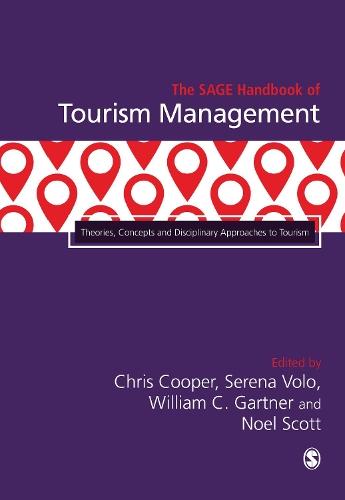
The SAGE Handbook of Tourism Management is a critical, state-of-the-art and authoritative review of tourism management, written by leading international thinkers and academics in the field. With a strong focus on theories, concepts and disciplinary approaches to tourism studies, the chapters in this volume are framed as critical synoptic pieces covering key developments, current issues and debates, and emerging trends and future considerations for the field. Part One: Researching Tourism Part Two: Social Analysis Part Three: Economic Analysis Part Four: Technological Analysis Part Five: Environmental Analysis Part Six: Political Analysis This handbook offers a fresh, contemporary and definitive look at tourism management, making it an essential resource for academics, researchers and students.
Full Product Details
Author: Chris Cooper ,
Serena Volo ,
William C. Gartner ,
Noel Scott
Publisher: SAGE Publications Ltd
Imprint: SAGE Publications Ltd
Weight: 1.250kg
ISBN: 9781526461124
ISBN 10: 1526461129
Pages: 616
Publication Date: 28 August 2018
Audience:
Professional and scholarly
,
College/higher education
,
Adult education
,
Professional & Vocational
,
Postgraduate, Research & Scholarly
Format: Hardback
Publisher's Status: Active
Availability: Manufactured on demand

We will order this item for you from a manufactured on demand supplier.
Reviews
The two volume SAGE Handbook of Tourism Management is an ambitious and monumental contribution to the practices and applications of tourism scholarship. The impact of tourism on the planet, on business and on humanity are accelerating. Hence, it is timely to undertake a systematic analysis of the best knowledge about the field through the eyes of leading scholars. The Handbook starts with fundamental theories, concepts, methods and disciplinary perspectives, and proceeds to the most recent developments and thinking. I particularly welcome the equal attention that the two-volume format gives to theories and applications. -- Professor Brian King These two volumes are a rich repository of tourism knowledge. The editors have assembled a stellar cast of experts in the field to write state-of-the-art chapters on both traditional and cutting edge topics in tourism management. The volumes will be important resources for researchers and students in the future, as they seek to help tourism find its place in this ever changing world. -- Professor Pauline Sheldon The SAGE Handbook of Tourism Management brings together a collection of state of the art chapters in tourism management to explore and reflect on theories, concepts, and the practice of tourism. A global panel of Tourism expert contributors ensure that chapters are critical and forward looking. The Handbook will be a good addition to any library that supports Tourism undergraduate and postgraduate students and researchers. In this volume, The SAGE Handbook of Tourism Management shares directions for the future of this multifaceted discipline. -- Professor Dimitrios Buhalis
Author Information
Professor Chris Cooper was Professor in the Carnegie School of Sport, Leeds Beckett University in the UK. He had a PhD in Geography from University College London. Chris worked as a researcher and teacher in every region of the world and had extensive publishing experience. He gained experience in tour operation before returning to academic life. Chris worked with international agencies including the United Nations World Tourism Organization (UNWTO). He held the Chair of the UNWTO’s Education Council from 2005 to 2007 and was awarded the United Nations Ulysses Medal for contributions to tourism education and policy in 2009. William B. Gartner is the Arthur M. Spiro Professor of Entrepreneurship at Clemson University. Prior to joining Clemson he was on the faculty at Georgetown University, the University of Virginia, San Francisco State University, and the University of Southern California. He is one of the co-founders of the Entrepreneurship Research Consortium, which initiated, developed and managed the Panel Study of Entrepreneurial Dynamics. His service to the entrepreneurship field has included two consecutive terms as Chair of the Academy of Management Entrepreneurship Division (1985 + 1986), special issue editorships for the Journal of Business Venturing (JBV) and Entrepreneurship Theory and Practice (ETP), and Editorial Board memberships with the Academy of Management Review (AMR), Journal of Management (JOM), JBV, ETP, and the Journal of Small Business Management (JSBM). His research has: been published in AMR, JBV, ETP, JOM and JSBM; won awards from the Academy of Management, ETP, and the Babson-Kauffman Entrepreneurship Research Conference; and has been funded by the Kauffman Center for Entrepreneurial Leadership, Coleman Foundation, U.S. Department of Education, Small Business Foundation of America, the Los Angeles Times, the Pacific Gas and Electric Company, the Corporate Design Foundation and the National Endowment for the Arts. His research on nascent entrepreneurs explores how they: find and identify opportunities, recognize and solve startup problems, and undertake actions to successfully launch new ventures. He is also collecting and analyzing the stories entrepreneurs tell about their entrepreneurial adventures.