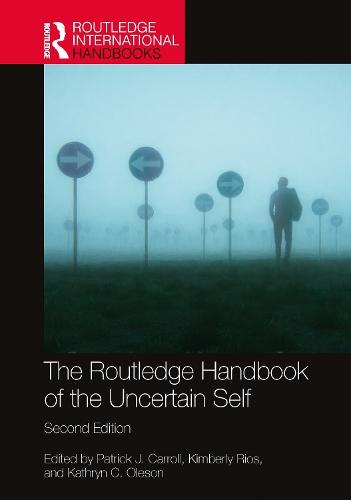
|
Overview
Full Product Details
Author: Patrick J. Carroll (The Ohio State University-Lima) , Kimberly Rios , Kathryn C. Oleson (Reed College)
Publisher: Taylor & Francis Ltd
Imprint: Routledge
Edition: 2nd edition
Weight: 0.870kg
ISBN: 9781032425917
ISBN 10: 1032425911
Pages: 362
Publication Date: 25 February 2025
Audience:
College/higher education
,
Postgraduate, Research & Scholarly
,
Undergraduate
Format: Hardback
Publisher's Status: Active
Availability: In Print 
This item will be ordered in for you from one of our suppliers. Upon receipt, we will promptly dispatch it out to you. For in store availability, please contact us.
Table of Contents
About the editors List of contributors Preface INTRODUCTION Chapter 1: Introduction Kim Rios, Kathryn C. Oleson, and Patrick J. Carroll PART I. META-COGNITION & UNCERTAINTY IN SELF Chapter 2: Multiple Effects of Discarding Thoughts through Invalidation: Attenuation, Elimination, Reversals, and Compensation Pablo Briñol and Richard Petty Chapter 3: The Case of Confidence in Eyewitness Testimony Kyros Shen, Allan Lam, & John Wixted Chapter 4: Be Careful What You Wish For: The Dark Side of Freedom Nate Cheek and Barry Schwartz Chapter 5: Antecedents and Consequences of Identity: A Meta-Cognitive Model Borja Paredes, Pablo Briñol, and Richard Petty Chapter 6: Self-Uncertainty as Cause and Consequence of Possible Self-Revision Patrick J. Carroll, Radhika Kothari, and Rease Haley Chapter 7: The Social Psychology of Fairness and the Regulation of Personal Uncertainty: Implications for Understanding the Role of Trust in Society Kees van den Bos and E. Allan Lind Chapter 8: An Antidote to Self-Uncertainty: Nostalgia Prevents Self-Uncertainty from Lowering Self-Continuity Constantine Sedikides, Marios Biskas, Jacob Juhl, and Tim Wildschut Chapter 9: Jumping to Conclusions Carmen Sanchez, Steffen Moritz, and David Dunning Chapter 10: Inauthentic or Merely Uncertain: When do People Tolerate Situations of Identity Misfit? Yingchi Guo and Toni Schmader PART II: MOTIVATION and UNCERTAINTY IN SELF Chapter 11: Why is Existential Uncertainty Distressing and Persistent? A Terror Management Perspective Mark Landau, Young Ju Ryu Jeff Greenberg, Marcus Chur, and Tom Pyszczynski Chapter 12: The Integrated Causal Uncertainty Model Jae-Eun Namkoong, Marlone Henderson, and Stephanie Tobin Chapter 13: Toward Love or Hate and Meaning Either Way: From Anxious Uncertainty to Proactive or Reactive Approach Motivation Ian McGregor and Denise C. Marigold Chapter 14: Prototypicality Threat and Self-uncertainty Motivate Group Behavior Olivia Kuljian and Zachary Hohman Chapter 15: The Uncertainty Surrounding Ostracism: A Systematic Review and Future Directions Zhansheng Chen, Fiona Yunqian Tian, Andrew Hales, and Kipling Williams Chapter 16: Certainty through Social Connection? Protecting the Self in an Uncertain Social World Sandra Murray PART III: CLINICAL and APPLIED IMPLICATIONS OF THE UNCERTAIN SELF Chapter 17: Social Identity Uncertainty and COVID-19 Erica Molinario, Molly Ellenberg, and Laura Prislie Chapter 18: When Political and Religious Belief Systems Conflict Kimberly Rios and Alexis Morales Chapter 19: Managing Acute Uncertainty Kate Sweeny and Jennifer Howell Chapter 20: The Unsettled Questions of Belonging Uncertainty Shannon Brady, Gregg Muragishi, and Rebecca Getu Chapter 21: Doubt as a Form of Spiritual Struggle Julie Exline, Yehudis Keller, Andrew C. Moffitt, and Kenneth I. Pargament General Commentary Chapter 22: Michael Hogg
Reviews
In an era in which misinformation and “alternative facts” abound, it is difficult to know what to believe anymore. The resulting uncertainty has seeped into all corners of human consciousness, including the self. The second edition of the Handbook of the Uncertain Self brings together a distinguished group of scientists who grapple with the key issues within this domain. Their insights crystalize what is known and lay out the agenda for future work on this topic, making this volume essential reading for anyone interested in this topic. William Swann, Professor of Psychology, University of Texas-Austin Uncertainty is the ubiquitous feature of the fast-changing world we live in. It is about the only thing one can be certain about. This important volume illuminates the varied ways in which uncertainty affects people’s lives for good or ill, and offers useful insights about coping with uncertainty's inevitable reality. Arie Kruglanski, Distinguished University Professor of Psychology, University of Maryland-College Park The book takes on a major challenge of our time—uncertainty about who we are and who we want to be in a rapidly changing world. A stellar lineup of authors take on this challenge through a wide range of lenses, including cognitive, intergroup, and relationship processes. For those who want to understand self-doubt and self-uncertainty, this book is a must read. Jennifer Crocker, Emeritus Professor and Ohio Eminent Scholar in Psychology, The Ohio State University
''In an era in which misinformation and “alternative facts” abound, it is difficult to know what to believe anymore. The resulting uncertainty has seeped into all corners of human consciousness, including the self. The second edition of the Handbook of the Uncertain Self brings together a distinguished group of scientists who grapple with the key issues within this domain. Their insights crystalize what is known and lay out the agenda for future work on this topic, making this volume essential reading for anyone interested in this topic.'' William Swann, Professor of Psychology, University of Texas, Austin ''Uncertainty is the ubiquitous feature of the fast-changing world we live in. It is about the only thing one can be certain about. This important volume illuminates the varied ways in which uncertainty affects people’s lives for good or ill, and offers useful insights about coping with uncertainty's inevitable reality.'' Arie Kruglanski, Distinguished University Professor of Psychology, University of Maryland, College Park ''The book takes on a major challenge of our time—uncertainty about who we are and who we want to be in a rapidly changing world. A stellar lineup of authors take on this challenge through a wide range of lenses, including cognitive, intergroup, and relationship processes. For those who want to understand self-doubt and self-uncertainty, this book is a must read.'' Jennifer Crocker, Emeritus Professor and Ohio Eminent Scholar in Psychology, The Ohio State University
Author Information
Patrick J. Carroll is Professor of Psychology at The Ohio State University‑Lima, USA. Kimberly Rios is Professor of Psychology at the University of Illinois‑Urbana Champaign, USA. Kathryn C. Oleson is Professor of Psychology at Reed College, USA.
Tab Content 6
Author Website:
Countries Available
All regions
|