Overview
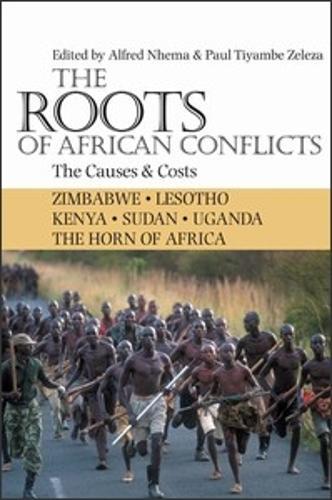
This book presents African scholars' views of why conflicts start in their continent. Violent conflicts have exacted a heavy toll on Africa's societies, polities and economies. The causes of conflict are too often examined by scholars from the countries that run the proxy wars and sell the arms to fuel them. This volume offers theoretically sophisticated, empirically grounded and compelling analyses of the roots of African conflicts. '...The studies in these two books seek to advance our understanding of African conflicts by going beyond the conventional and fashionable analyses of Africanist scholarship, often inflected with, if not infected by, Afropessimism, or the simplistic stereotypes conveyed in the western media that is infused with Afrophobia....these conflicts must be understood in comparative perspective, not in isolation. Violent conflict in Africa is indeed part of the human drama, but the tendency to impose universalist models of conflict driven from stylized westernexperiences or faddish theorising must be resisted... such paradigms lead to poor analysis and bad policy. Conflict is too serious a matter, and its costs too grave, for glib modeling or lazy journalistic speculation uninformed by the histories of, and unmindful of the concrete conditions in, the societies under scrutiny.' - From the introduction by Paul Tiyambe Zeleza Published in association with OSSREA North America: Ohio U Press; South Africa: Unisa Press
Full Product Details
Author: Professor Alfred Nhema ,
Paul Tiyambe Zeleza (Author) ,
Paul Tiyambe Zeleza (Author)
Publisher: James Currey
Imprint: James Currey
Dimensions:
Width: 15.20cm
, Height: 1.50cm
, Length: 22.80cm
Weight: 0.398kg
ISBN: 9781847013002
ISBN 10: 1847013007
Pages: 256
Publication Date: 17 January 2008
Audience:
College/higher education
,
Professional and scholarly
,
Undergraduate
,
Postgraduate, Research & Scholarly
Format: Paperback
Publisher's Status: Active
Availability: Manufactured on demand

We will order this item for you from a manufactured on demand supplier.
Reviews
'...Africa is no more prone to violent conflicts than other regions. Indeed, Africa's share of the more than 180 million people who died from conflicts and atrocities in the twentieth century is relatively modest... This is not to underestimate the immense impact of violent conflicts on Africa; it is merely to emphasize the need for more balanced debate and commentary. The studies in these two books seek to advance our understanding of African conflicts by going beyond the conventional and fashionable analyses of Africanist scholarship, often inflected with, if not infected by, Afropessimism, or the simplistic stereotypes conveyed in the western media that is infused with Afrophobia.... '...these conflicts must be understood in comparative perspective, not in isolation. Violent conflict in Africa is indeed part of the human drama, but the tendency to impose universalist models of conflict driven from stylized western experiences or faddish theorising must be resisted... such paradigms lead to poor analysis and bad policy. Conflict is too serious a matter, and its costs too grave, for glib modeling or lazy journalistic speculation uninformed by the histories of, and unmindful of the concrete conditions in, the societies under scrutiny.' From the introduction by Paul Tiyambe Zeleza
By putting together these two comprehensive and well-researched volumes, Nhema and Zeleza have done a great service to the Africanist community as well as to interested laypersons. (They) should be commended for selecting and editing twenty well-researched and thoughtfully argued contributions to provide us with what is arguably one of the most comprehensive and perceptive treatments to date of conflict and conflict resolution in Africa from both a historical and contemporary perspective. AFRICAN STUDIES REVIEWThe ambitious task established by the editors of uncovering the roots and the solutions to the current conflicts in Africa is excellently addressed by the contributors (...) the variety of views is actually one of the volumes' strengths, providing the reader with a wide spectrum of approaches to the issues at hand, enhanced by the variety of research methods used by the contributors. JOURNAL OF INTERVENTION & STATEBUILDING Nhema and Zeleza have assembled in these two extraordinary companion volumes (The Roots of African Conflicts and The Resolution of African Conflicts), one of the most comprehensive treatments of conflicts in Africa. The two volumes, with admirable competence, address the multiple causes of conflicts from a historical and contemporary perspective, and creatively attempt to offer solutions to these conflicts that go beyond most contemporary analyses. In the end, both the editors and the contributors point to democratic governance as the best solution to African conflicts. (...) A must read for anyone interested in Africa's peaceas the best solution to African conflicts. (...) A must read for anyone interested in Africa's peaceful development. - Julius E. Nyang'oro,
By putting together these two comprehensive and well-researched volumes, Nhema and Zeleza have done a great service to the Africanist community as well as to interested laypersons. (They) should be commended for selecting and editing twenty well-researched and thoughtfully argued contributions to provide us with what is arguably one of the most comprehensive and perceptive treatments to date of conflict and conflict resolution in Africa from both a historical and contemporary perspective. AFRICAN STUDIES REVIEWThe ambitious task established by the editors of uncovering the roots and the solutions to the current conflicts in Africa is excellently addressed by the contributors (...) the variety of views is actually one of the volumes' strengths, providing the reader with a wide spectrum of approaches to the issues at hand, enhanced by the variety of research methods used by the contributors. JOURNAL OF INTERVENTION & STATEBUILDING Nhema and Zeleza have assembled in these two extraordinary companion volumes (The Roots of African Conflicts and The Resolution of African Conflicts), one of the most comprehensive treatments of conflicts in Africa. The two volumes, with admirable competence, address the multiple causes of conflicts from a historical and contemporary perspective, and creatively attempt to offer solutions to these conflicts that go beyond most contemporary analyses. In the end, both the editors and the contributors point to democratic governance as the best solution to African conflicts. (...) A must read for anyone interested in Africa's peaceful development. - Julius E. Nyang'oro, Professor and Chair, African and Afro-American Studies, University of North Carolina at Chapel Hill
Author Information
Professor Alfred G. Nhema is the Director of the School of Government. His research interests are in the areas of Democracy and Governance, Public Administration, Public Policy, Peace and Conflict. He is the Editor of The Resolution of African Conflicts: the Management of Conflict Resolution and Post-Conflict Reconstruction (2008) and The Roots of African Conflicts: the Causes and Costs (2008). Paul Tiyambe Zeleza is Vice Chancellor at United States International University-Africa. Paul Tiyambe Zeleza is Vice Chancellor at United States International University-Africa.