Overview
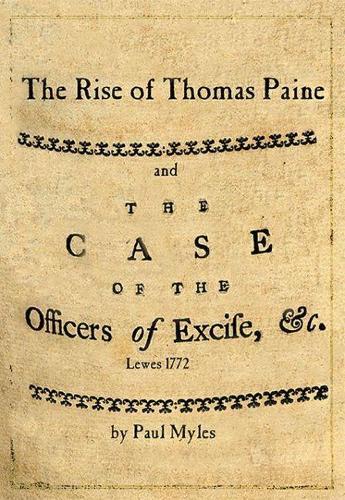
This is the story of how an unknown and lowly Englishman came to be thrust onto the international stage with world-changing effect. While Thomas Paine is known by all Americans as one of their founding fathers, he remains relatively obscure in Great Britain. Thomas Paine's skill as a writer was recognised by George Lewis Scott, a commissioner of Excise, who was at the height of English society. Scott had been trying to reduce the corruption that was endemic in the Excise Service, Paine had suffered it at first hand. This was in 1772 in Lewes, the County town of East Sussex while Paine was still just an outrider of Excise. Paine articulated the argument in his first pamphlet, but despite 4000 copies being printed the four years-long campaign came to nought. It was this effort that exposed the bungling and corrupt ministry and convinced Paine to try his hand in the North American Colonies, which was already aflame from the poor treatment by the United Kingdom. Paine left England with a letter of introduction from Benjamin Franklin. Within a year Paine had written Common Sense, the document that kindled the War of Independence. Paine followed this with 13 Crisis papers that were highly influential in steadying the American troops in the fight against their mother country. This story uses previously unseen documents from the Treasury boxes in the National Archives in Kew. Several strands have been drawn together that show that the United Kingdom was in deep disarray and that it was these factors that drove the emergent United States of America to break free from the United Kingdom.
Full Product Details
Author: Paul Myles
Publisher: The Thomas Paine Society UK
Imprint: The Thomas Paine Society UK
ISBN: 9781999326302
ISBN 10: 199932630
Pages: 114
Publication Date: 11 November 2018
Audience:
General/trade
,
General
Format: Paperback
Publisher's Status: Active
Availability: Available To Order

We have confirmation that this item is in stock with the supplier. It will be ordered in for you and dispatched immediately.
Reviews
This original and scholarly work explains the rise of Thomas Paine, who was chosen by a Commissioner of Excise, George Lewis Scott, to write The Case of the Officers of Excise, a work which identified and condemned the deep corruption within the English excise service, and called for the organization of workers to improve their pay and conditions. The origins of Paine's links with figures such as Benjamin Franklin, so important when Paine moved to North America, is thereby explained. From Professor Richard Whatmore University of St Andrews School of History
Author Information
Paul is a fellow of St Andrews Institute of Intellectual History. He has acted on the committee of the Thomas Paine Society UK since 2009. He was born in 1954 in Lewes and spent his early life in business, principally in Structural Steel and construction but also Arts, Property and Accommodation business. In 2001 he turned to academia, gaining two degrees in Psychology and then studying Intellectual History. Paul also teaches part-time at the Brighton and Sussex Medical School. He has been married for 43 years to Kathy and has two children and four grandchildren.