Overview
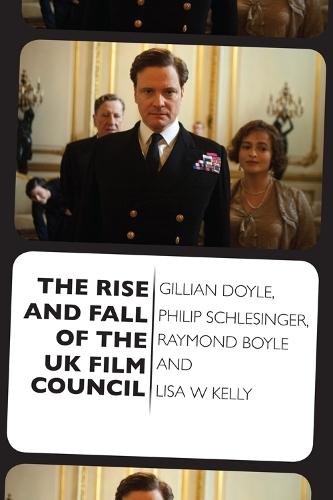
Drawing on interviews with leading film executives, politicians and industry stakeholders, including Alan Parker, Stewart Till and Tim Bevan, this book provides an empirically grounded analysis of the rise and unexpected fall of the UK Film Council, the key strategic body responsible for supporting film in the UK for over a decade. As well as offering a critical overview of the political, policy and technological contexts which framed the organisation's creation, existence and eventual demise, the book provides a probing analysis of the tensions between national and global interests in an increasingly transnational film industry, not least underlining how both US and EU interests and pressures have played themselves out. It therefore provides a timely and significant investigation into the contemporary policy environment for film in the 21st century.
Full Product Details
Author: Gillian Doyle ,
Philip Schlesinger (Professor of Film and Media Studies, Stirling Media Research Institute at the University of Stirling) ,
Raymond Boyle (Senior Lecturer, University of Glasgow) ,
Lisa Kelly (University of Glasgow)
Publisher: Edinburgh University Press
Imprint: Edinburgh University Press
Dimensions:
Width: 15.60cm
, Height: 2.00cm
, Length: 23.40cm
Weight: 0.476kg
ISBN: 9780748698233
ISBN 10: 074869823
Pages: 224
Publication Date: 18 August 2015
Audience:
ELT/ESL
,
College/higher education
,
ELT Advanced
,
Postgraduate, Research & Scholarly
Format: Hardback
Publisher's Status: Active
Availability: Temporarily unavailable

The supplier advises that this item is temporarily unavailable. It will be ordered for you and placed on backorder. Once it does come back in stock, we will ship it out to you.
Reviews
An in-depth study of the only period when the UK had a government for whom film policy did matter... A cogent, lucid account of what the Film Council achieved in its short life, how it did it, under what constraints. -- Geoffrey Nowell-Smith, LSE British Politics and Policy Blog A highly readable academic study has arrived to assess the birth, life and death of the UKFC... It's a logical approach handled with crisp thoroughness. -- Stephen Mayne, PopMatters
An in-depth study of the only period when the UK had a government for whom film policy did matter... A cogent, lucid account of what the Film Council achieved in its short life, how it did it, under what constraints. -- Geoffrey Nowell-Smith, LSE British Politics and Policy Blog A highly readable academic study has arrived to assess the birth, life and death of the UKFC... It's a logical approach handled with crisp thoroughness. -- Stephen Mayne, PopMatters An in-depth study of the only period when the UK had a government for whom film policy did matter... A cogent, lucid account of what the Film Council achieved in its short life, how it did it, under what constraints. -- Geoffrey Nowell-Smith, LSE British Politics and Policy Blog A highly readable academic study has arrived to assess the birth, life and death of the UKFC... It's a logical approach handled with crisp thoroughness. -- Stephen Mayne, PopMatters
Author Information
Gillian Doyle is Professor of Media Economics and Director of the Centre for Cultural Policy Research (CCPR) at the University of Glasgow where she directs Glasgow’s MSc in Media Management. She has led a number of RCUK funded projects on media economics and policy and conducted studies for the Council of Europe, the European Commission and the OECD and her research has been translated and published in several languages. Gillian is former President of the Association for Cultural Economics International (ACEI). Philip Schlesinger is Professor in Cultural Policy at the University of Glasgow and Deputy Director of CREATe, the RCUK Centre for Copyright and New Business Models in the Creative Economy. Author of Putting Reality Together and Media, State and Nation, his latest, co-authored, book is Curators of Cultural Enterprise. A Fellow of the RSE and the Academy of Social Sciences, and an editor of Media, Culture & Society, he is presently researching EU cultural policy and also developments in British film policy. Raymond Boyle is Professor of Communications based within the Centre for Cultural Policy Research at the University of Glasgow. He has published widely on media and sports issues. His most recent books include The Television Entrepreneurs (2012) with Lisa Kelly and PowerPlay: Sport the Media and Popular Culture (2009) with Richard Haynes. He also sits on the editorial board of Media, Culture and Society. Lisa Kelly graduated in Communication and Mass Media (BA Hons) from Glasgow Caledonian University and completed an MPhil and PhD in Theatre, Film and Television Studies at the University of Glasgow. She is a former Research Associate at the Centre for Cultural Policy Research and is now Lecturer in Television Studies at the University of Glasgow