Overview
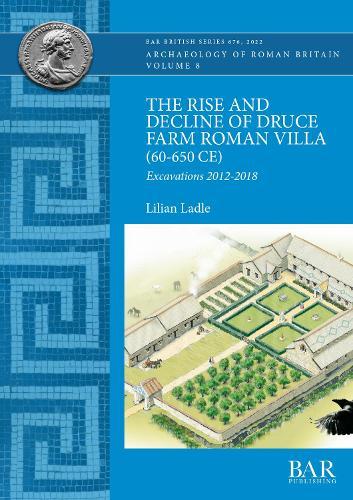
Results from the excavation of this high-status Roman villa confirm its occupation throughout the Roman period and beyond, illuminating lifestyle and landscape through detailed analysis of its architecture, finds and environmental remains. This site includes rectilinear enclosures and associated Roman style buildings dating from the mid-1st century, and represents the earliest known proto-villa in Dorset. The buildings resemble those excavated in the south-east of Britain, with the acquisition of building materials, pottery, glassware, household, personal items and coinage confirming the economic vitality and wealth needed to sustain an elite lifestyle. Phases of construction and demolition are discussed, highlighting dramatic changes in the use of the site. There is also significant evidence of metalworking, textile production and hunting activities across the period of occupation. Discussion is supported throughout by comprehensive site plans, photographs and artefact illustrations. This excavation presents unparalleled evidence for villa development and decline, with relevance not only to those interested in Roman Britain, but also Northwest Europe more generally.
Full Product Details
Author: Lilian Ladle
Publisher: BAR Publishing
Imprint: BAR Publishing
Edition: Revised edition
Weight: 1.946kg
ISBN: 9781407360010
ISBN 10: 1407360019
Pages: 488
Publication Date: 30 September 2022
Audience:
Professional and scholarly
,
Professional & Vocational
Format: Paperback
Publisher's Status: Active
Availability: Available To Order 
We have confirmation that this item is in stock with the supplier. It will be ordered in for you and dispatched immediately.
Table of Contents
List of figures List of tables Preface Summary Résumé Zusammenfassung 1. Environment and project background Location Landscape and geology - Andrew Morgan The site Project background Geophysical surveys The excavations Archaeological methodology Local community outreach Funding Project aims Summary of Periods Period 1: Prehistoric up to 43 CE (Fig. 1.7) Period 2.1: 43-70 CE (Fig. 1.8) Period 2.2: 70-120 CE (Fig. 1.9) Period 3.1: 120-200 CE (Fig. 1.10) Period 3.2: 200-250 CE (Fig.1.11) Period 4.1: 250-300 CE (Fig. 1.12) Period 4.2: 300-350/70 CE (Fig. 1.13) Period 5: 350/70-430 CE Period 6: 430-650 CE (Fig. 1.14) Period 7: 650+ CE Radiocarbon dating Introduction Sampling strategy Results and Calibration Deposition and further work 2. The Prehistoric background Early Neolithic activity The features Pre-Roman ditches Ditch 878 Ditch 1291 Ditch 1325 Ditch 1752 Flint and chert - Katherine Walker Introduction Methodology Raw material Description of the total assemblage Cores and core reduction techniques Flakes and blades Chips and shatter Tools Distribution of the assemblage across the site Discussion Illustrated flint and chert artefacts Prehistoric pottery Fabric Code Discussion Conclusion 3. Enclosures, ditches and middens The Early Roman enclosure system The outer enclosure (ditches 1604, 309, 313, 311 and 312) The inner enclosure (ditches 308, 314 and 1605) Southern outliers (Ditches 1504 and 310) Structures associated with a south entrance to the villa Conclusions Other ditch systems Ditches 1641/1644 Ditches 1459/1510 Gullies 372 and 384 Ditches 1260/1305 Eastern enclosure Ditch 1262 Ditch 1412 Ditch 1410 Ditch 1411 Conclusions The midden deposits Midden 315 T2 Midden 1529 T24, T41 and T46 (Fig. 3.15/1) Midden 1355 T59 Midden 1528 T14 and T52 (Fig. 3.17) Conclusion 4. Early Roman activity outside the villa complex Early Roman activity in Lower Limepits field Pit 1399 T14 (Fig. 4.1/1) Pit 643 T21 (Fig. 4.1/2) Activity pre-dating the East Range Early Roman activity in Eleven Acres The Ancillary Building Room AB1 (pits 2015, 1996, 2008, 1991, 2032, 2008 and 1994) Pit 2015 (Fig 4.7/1) Pit 1996 (Fig. 4.7/2) Pit 1991 (Fig. 4.7/3) Pit 2031 (Fig. 4.7/4) Pit 2032 (Fig. 4.7/7) Room AB2 (pits 2000, 2017 and 2036) Pit 2000 (Fig, 4.7/8) Pit 2017 (Fig. 4.7/10) Room AB3 (pits 2295/2020/2038, 2050 and 2052) Pit 2295 cut by pits 2020 and 2038 (Fig. 4.7/11) Pit 1735 Occupation Area T82 Pit 1800 (Figs. 4.9/2 and 4.12) Deposit 1795 (Fig. 4.10) Pit 1845 (Fig. 4.9/3) 5. The North Range Phasing Phase 1: Early Roman, Period 2.2 (c. 70-120 CE) (Fig. 5.4 Phase1) Room N10 Pit 643 (Fig. 4.1/2) Pit 644 (Figs 5.10/3 and 5.11) Conclusions Phase 2: Middle Roman, Period 3.1 (c. 120-200 CE) (Fig. 5.4 Phase 2) Room N12 Room N1 Conclusions Phase 3: Middle Roman Period 3.2 (c. 200-250 CE) (Fig. 5.4 Phase 3) The west extension (Fig. 5.13) Room N2 Room N5 Extension of the original building (Figs. 5.4/3 and 5.17) Room N3 (Fig. 5.12) Room N6 Room N8 Room N7 Room N10 Corridor N11 Conclusions Phase 4: Late Roman Period 4.2 (c. 300-350/70 CE) (Fig. 5.4 Phase 4) The west wing Room N1 Room N2 Room N4 Paved area and potential building Room N5 The north wing Room N3 Room N10 Room N9 Pit 798 Corridor N11 Gully 407 Conclusions Phase 5: Final Roman Period 5 (c. 350/370-430 CE) Room N1 Room N3 Room N7 Room N10 (plan Fig. 5.42) Room N9 (Fig. 5.37/1) Room N11 Conclusions Phase 6: Post-Roman Period 6 (c. 430-650 CE) (Fig. 5.4 Phase 5) Activity south of Room N3 Room N1 Room N3 Room N9 Corridor N11 Collapse south of the North Range Conclusions General conclusions 6. The East Range Phase 1: Early Roman, Period 2.2 (c. 70-120 CE) The first rectangular building Features relating to this phase Conclusion Phase 2: Middle Roman, Period 3.1 (c. 120-200 CE) (Fig. 6.8) Extension of the rectangular building and associated features Tank 778 and associated features Pit 381 (Figs 6.11/2 and 6.12). Pit 1149 /1181 (Figs 6.13 and 6.14/1) Pit 896 Pit 209 (Fig. 6.14/2) Phase 3a: Late Roman, Period 4.1 (c. 300 CE) The Aisled Hall Flint-packed pit 638 (Fig. 6.19/1) Flint-packed pit 648 (Fig. 6.19/2 and 6.20) Deposit 1269 (Fig. 6.21) Pit 1077 (Figs 6.19/3 and 6.22) Phase 3b: Late Roman, Period 4.1 (c. 350 CE) Fire damage and site preparation for re-building Phase 4: Late Roman, Period 4.2 (c. 350/70 CE) (Fig. 6.23) Extension of the Aisled Hall The flint-packed pits Internal walls Floor surfaces Deposit 556 (Fig. 6.24) Oven 207 (Figs 6.23, 6.25-28). Structure 1203 (Fig. 6.29) Pit 823 (Fig. 6.30) Phase 5: Final Roman and Post-Roman, Periods 5 and 6 (c. 430-650+ CE) Collapse of the building Material over the collapsed building Collapse sequence The roof Collapse of the north wall 559 (Fig. 6.31) (Period 6 c. 430-650 CE) Phase 6: Early Medieval, Period 6 (c. 430-650 CE) Post-collapse activity
Reviews
'This is investigative and research work of the highest quality. It will be an essential book for anyone studying Roman archaeology, the archaeology of the NW Roman provinces and Roman acculturation, villas and rural settlement.' Dr Miles Russell, Bournemouth University 'This report is one of the building blocks for the study of Roman Britain. It sets high standards for others to follow.' Sir Barry Cunliffe, Emeritus Professor of Archaeology, Oxford University
'This is investigative and research work of the highest quality. It will be an essential book for anyone studying Roman archaeology, the archaeology of the NW Roman provinces and Roman acculturation, villas and rural settlement.' Dr Miles Russell, Bournemouth University 'This report is one of the building blocks for the study of Roman Britain. It sets high standards for others to follow.' Sir Barry Cunliffe, Emeritus Professor of Archaeology, Oxford University
'This is investigative and research work of the highest quality. It will be an essential book for anyone studying Roman archaeology, the archaeology of the NW Roman provinces and Roman acculturation, villas and rural settlement.' Dr Miles Russell, Bournemouth University 'This report is one of the building blocks for the study of Roman Britain. It sets high standards for others to follow.' Sir Barry Cunliffe, Emeritus Professor of Archaeology, Oxford University
Author Information
Lilian Ladle is an independent archaeologist and a Visiting Fellow in the Department of Archaeology and Anthropology, Bournemouth University. She directed excavations at the multi-period sites of Football Field, Worth Matravers and Bestwall Quarry, Wareham. She was awarded the MBE for services to archaeology in 2008 and was elected a Fellow of the Society of Antiquaries in 2021.
Tab Content 6
Author Website:
Countries Available
All regions
|