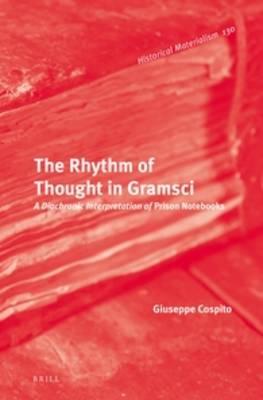
The Rhythm of Thought in Gramsci: A Diachronic Interpretation of Prison Notebooks

Author:   Giuseppe Cospito
Publisher:   Brill
Volume:   130
ISBN:  

9789004266322


Pages:   262
Publication Date:   29 September 2016
Format:   Hardback
Availability:   Manufactured on demand   Availability explained
We will order this item for you from a manufactured on demand supplier.

Our Price $514.80 Quantity:  
Add to Cart

Share |

The Rhythm of Thought in Gramsci: A Diachronic Interpretation of Prison Notebooks


Overview

Full Product Details

Author:   Giuseppe Cospito
Publisher:   Brill
Imprint:   Brill
Volume:   130
Dimensions:   Width: 15.50cm , Height: 2.00cm , Length: 23.50cm
Weight:   0.531kg
ISBN:  

9789004266322


ISBN 10:   9004266321
Pages:   262
Publication Date:   29 September 2016
Audience:   Professional and scholarly ,  Professional & Vocational
Format:   Hardback
Publisher's Status:   Active
Availability:   Manufactured on demand   Availability explained
We will order this item for you from a manufactured on demand supplier.
Language:   Italian

Table of Contents

A Note on the Text Preface: Questions of Method PART ONE: PHILOSOPHY-POLITICS-ECONOMICS 1. Structure and Superstructures 1.1. Working hypothesis 1.2. The 'Bukharin' phase (from the party school to Notebook 4, 12 and 15: 1925-30) 1.3. The 'centrist' thesis from the end of 1930 (Notebook 4, 38) 1.4. The 'crisis' of 1931 (Notebook 7) 1.5. Moving beyond the architectural metaphor (Notebook 8: end of 1931 - beginning of 1932) 1.6. The 'inertia' of the old formulations (Notebooks 10, 11 and 13: 1932-3) 1.7. 'Unended Quest' (Notebooks 10, 11, 14, 15 e 17: 1932-35) 1.8 Provisional conclusions 2. Hegemony 2.1. Introduction 2.2. 'Posing the issue' 2.3. Hegemony and civil society 2.4. Hegemony and the intellectuals 2.5. Hegemony and the party 2.6. The sources of Gramsci's concept of hegemony 2.7. A (re)definition of Gramsci's concept of hegemony 3. Regulated Society 3.1. Philosophy-Politics-Economics 3.2. 'Importuning the texts' 3.3. The regulated society 'from Utopia to science' 3.4. Towards a new Reformation? 3.5. Gramsci as critic of the 'critical economy' 3.6. Toward 'a new economic science' PART TWO: THE ANALYSIS OF SEVERAL INTERNAL DYNAMICS OF THE NOTEBOOKS 4. The 'Alternatives' to Structure-Superstructure 4.1. 'Quantity and quality' 4.2. 'Content and form' 4.3. 'Objective and subjective' 4.4. 'Historical bloc' 5. The Gradual Transformation in Gramsci's Categories 5.1. Methodological premise 5.2. Organic centralism; Postilla 5.3. Common sense and/or good sense 5.4. Civil society 6. Gramsci and the Marxist Tradition 6.1. 'Marx, the author of concrete political and historical works': Caesarism and Bonapartism 6.2. Engels and the Marxist vulgate 6.3. Conclusion: Gramsci, from Lenin to Marx Bibliography Index

Reviews

Author Information

Giuseppe Cospito, Ph.D. (1999), University of Turin, is Assistant Professor of History of Philosophy at the University of Pavia. He has published monographs and a number of articles on Niccolò Machiavelli, Giambattista Vico, Carlo Cattaneo and Antonio Gramsci.

Tab Content 6

Author Website:  

Countries Available

All regions
Latest Reading Guide

NOV RG 20252


Shopping Cart
Your cart is empty
Shopping cart
Mailing List