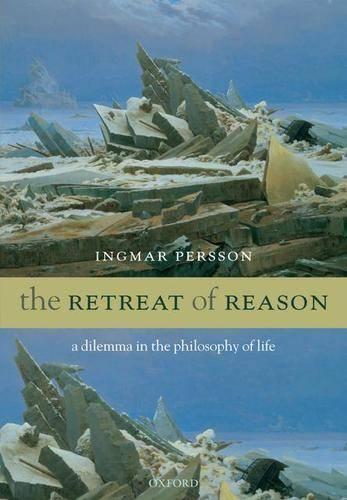
The Retreat of Reason: A dilemma in the philosophy of life

Author:   Ingmar Persson (University of Lund, Sweden)
Publisher:   Oxford University Press
ISBN:  

9780199543960


Pages:   504
Publication Date:   10 April 2008
Format:   Paperback
Availability:   To order   Availability explained
Stock availability from the supplier is unknown. We will order it for you and ship this item to you once it is received by us.

Our Price $102.95 Quantity:  
Add to Cart

Share |

The Retreat of Reason: A dilemma in the philosophy of life


Overview

One of the main original aims of philosophy was to give us guidance about how to live our lives. The ancient Greeks typically assumed that a life led in accordance with reason, a rational life, would also be the happiest or most fulfilling. Ingmar Persson's book resumes this project, which has been largely neglected in contemporary philosophy. But his conclusions are very different; by exploring the irrationality of our attitudes to time, our identity, and our responsibility, Persson shows that the aim of living rationally conflicts not only with the aim of leading the most fulfilling life, but also with the moral aim of promoting the maximization and just distribution of fulfilment for all. Persson also argues that neither the aim of living rationally nor any of the fulfilment aims can be rejected as less rational than any other. We thus face a dilemma of either having to enter a retreat of reason, insulated from everyday attitudes, or making reason retreat from its aspiration to be the sole controller of our attitudes. The Retreat of Reason explores three areas in which there is a conflict between the rational life and a life dedicated to maximization of fulfilment. Persson contends that living rationally requires us to give up, first, our temporal biases; secondly, our bias towards ourselves; and, thirdly, our responsibility to the extent that it involves the notion of desert and desert-entailing notions. But giving up these attitudes is so overwhelmingly hard that the effort to do so not only makes our own lives less fulfilling, but also obstructs our efficient pursuit of the moral aim of promoting a maximum of justly distributed fulfilment. Ingmar Persson brings back to philosophy the ambition of offering a broad vision of the human condition. The Retreat of Reason challenges and disturbs some of our most fundamental ideas about ourselves.

Full Product Details

Author:   Ingmar Persson (University of Lund, Sweden)
Publisher:   Oxford University Press
Imprint:   Oxford University Press
Dimensions:   Width: 17.50cm , Height: 3.00cm , Length: 25.00cm
Weight:   0.887kg
ISBN:  

9780199543960


ISBN 10:   0199543968
Pages:   504
Publication Date:   10 April 2008
Audience:   Professional and scholarly ,  Professional & Vocational ,  Postgraduate, Research & Scholarly
Format:   Paperback
Publisher's Status:   Active
Availability:   To order   Availability explained
Stock availability from the supplier is unknown. We will order it for you and ship this item to you once it is received by us.

Table of Contents

Introduction I. The nature of para-cognitive attitudes 1: Pain as a sensory quality 2: Pleasure as a sensory quality 3: Beyond hedonism 4: An analysis of desire 5: The concept of emotion 6: A typology of emotion II. Reason and value 7: Introduction: subjectivism and objectivism 8: The structure of reasons: internalism 9: An objective requirement? 10: The desire relativity of value 11: The rationality of para-cognitive attitudes 12: Weakness of will 13: Representational mechanisms III. Rationality and temporal neutrality 14: The nature of a temporal bias 15: The irrationality of the bias towards the near 16: The irrationality of the bias towards the future 17: The dilemma as regards temporal neutrality IV. Rationality and personal neutrality 18: Introduction: the bias towards oneself 19: Self and body 20: Psychological theories of our identity 21: Somatist theories of our identity 22: The identity of material bodies 23: The rational insignificance of identity and continuity 24: Self-concern and self-approval 25: Concern for and approval of others 26: Prudence: maximization or idealism? 27: The requirement of personal neutrality 28: Moral individualism: autonomy and agreement 29: The dilemma as regards personal neutrality V. Rationality and responsibility 30: Introduction 31: Predictability and freedom 32: Compatibilist freedom of action 33: Compatibilist freedom of will 34: Responsibility and desert 35: The deontological element of responsibility 36: The emotive genesis of desert 37: The dilemma as regards responsibility Conclusion Appendix: On being out of touch

Reviews

excellent new book...anyone who makes the effort to read this book is likely to be rewarded with many new insights. Bart Streumer, Times Literary Supplement


Author Information

Tab Content 6

Author Website:  

Countries Available

All regions
Latest Reading Guide

NOV RG 20252


Shopping Cart
Your cart is empty
Shopping cart
Mailing List