Overview
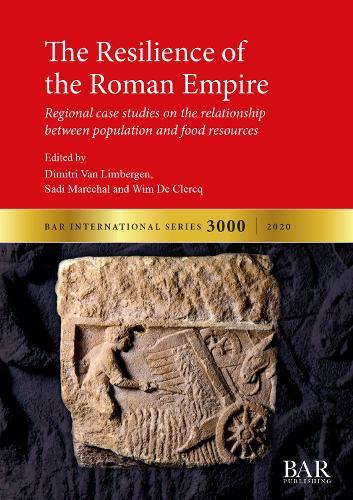
The Resilience of the Roman Empire discusses the relationship between population and regional development in the Roman world from the perspective of archaeology. By adapting a comparative approach, the focus of the volume lies on exploring the various ways in which regional communities actively responded to population growth or decline in order to keep going on the land available to them. The starting point of the theoretical framework for the case studies is the agricultural intensification models developed by Thomas Malthus and Ester Boserup. In order to advance the debate on the validity of these models for identifying the societal and economic pathways of the Roman world, the contributors incorporate the concepts of resilience and diversity into their approach, and shift attention from the longue-durée to how people managed to sustain themselves over shorter periods of time. The aim of the volume is not to discard the theories of Malthus and Boserup, but rather to deconstruct overly strict Malthusian or Boserupian scenarios, and as such introduce novel and more layered ways of thinking by exploring resilience and variability in human responses to population growth/decline in the Roman world.
Full Product Details
Author: Sadi Maréchal ,
Wim De Clercq ,
Dimitri Van Limbergen
Publisher: BAR Publishing
Imprint: BAR Publishing
Weight: 0.606kg
ISBN: 9781407356945
ISBN 10: 1407356941
Pages: 152
Publication Date: 29 September 2020
Audience:
Professional and scholarly
,
Professional & Vocational
Format: Paperback
Publisher's Status: Active
Availability: Available To Order

We have confirmation that this item is in stock with the supplier. It will be ordered in for you and dispatched immediately.
Reviews
{\rtf1\ansi\ansicpg1252\deff0\deflang2057{\fonttbl{\f0\fswiss\fprq2\fcharset0 Calibri;}{\f1\fnil\fcharset0 Verdana;}} \viewkind4\uc1\pard\sa160\sl252\slmult1\f0\fs22\lquote The volume\rquote s greatest strength is without doubt its fresh and thorough methodological approach to aspects of regionalism and localism in Roman agricultural production, ranging from the landscapes of the Mediterranean to Northwestern Europe. \'85 The discussion of major case studies is extremely meticulous and grounded in an expert understanding of both the literary and the archaeological evidence.\rquote Dr Dominik Maschek, University of Oxford\par \lquote This is an original and very welcome contribution to the study of agricultural practices in the Roman World in relation to economic developments. It complements well current synthetic ancient historical scholarship on agricultural innovation and its role in economic and demographic expansion with solid archaeological case studies.\rquote Dr Tymon de Haas, Universiteit Leiden\par \pard\f1\fs17\par }
{\rtf1\ansi\ansicpg1252\deff0\deflang2057{\fonttbl{\f0\fswiss\fprq2\fcharset0 Calibri;}{\f1\fnil\fcharset0 Verdana;}} \viewkind4\uc1\pard\sa160\sl252\slmult1\f0\fs22\lquote The volume\rquote s greatest strength is without doubt its fresh and thorough methodological approach to aspects of regionalism and localism in Roman agricultural production, ranging from the landscapes of the Mediterranean to Northwestern Europe. \'85 The discussion of major case studies is extremely meticulous and grounded in an expert understanding of both the literary and the archaeological evidence.\rquote Dr Dominik Maschek, University of Oxford\par \lquote This is an original and very welcome contribution to the study of agricultural practices in the Roman World in relation to economic developments. It complements well current synthetic ancient historical scholarship on agricultural innovation and its role in economic and demographic expansion with solid archaeological case studies.\rquote Dr Tymon de Haas, Universiteit Leiden\par \pard\f1\fs17\par }
Author Information
Dimitri Van Limbergen is currently a Senior Postdoctoral Fellow of the Research Foundation - Flanders (FWO) at Ghent University. His main areas of research are Roman archaeology and economic history. He has published widely on viticulture and olive cultivation, trade, demography, landscape use and diet in Roman Italy. Sadi Maréchal is a postdoctoral researcher in Roman Archaeology of the Research Foundation Flanders (FWO). He wrote his doctoral dissertation on baths in Late Antiquity (published as a monograph by Brill, 2020). His current research interest lies in Roman baths and bathing habits in Northwestern Gaul. Wim De Clercq lectures on Historical Archaeology in Northwestern Europe at Ghent University. His research interests include in particular morphology and transformations in historical (Roman to early-Modern) rural occupation, landscape and material culture in historic Flanders, and the landscape and socio-economic dynamic of Bruges' Late Medieval harbour network. List of contributors: César Carreras Monfort, Wim De Clercq, Emlyn K. Dodd, Maaike Groot, Sadi Maréchal, Antoni Martín i Oliveras, Pierre Ouzoulias, José Remesal Rodríguez, Víctor Revilla Calvo, Dimitri Van Limbergen, Rinse Willet.