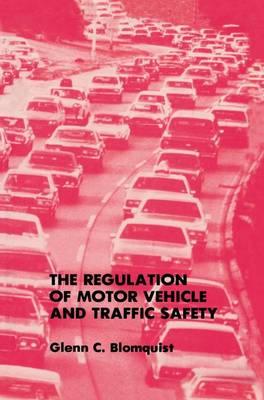
The Regulation of Motor Vehicle and Traffic Safety

Author:   Glenn C. Blomquist
Publisher:   Kluwer Academic Publishers
Edition:   1988 ed.
ISBN:  

9780898382808


Pages:   138
Publication Date:   31 August 1988
Format:   Hardback
Availability:   In Print   Availability explained
This item will be ordered in for you from one of our suppliers. Upon receipt, we will promptly dispatch it out to you. For in store availability, please contact us.

Our Price $385.44 Quantity:  
Add to Cart

Share |

The Regulation of Motor Vehicle and Traffic Safety


Overview

Decisions twenty years ago during the fIrst generation of modern traffIc safety policymaking were easier than today. Afterall, the mandate for specifIc mandatory motor vehicle safety standards was dermed rather clearly during legislative hearings. Since the initial standards, decisions have been based on the more general guidelines of ""practicality"" and avoiding ""unreasonable risks. "" Now, with more diffIcult decisions pending, the demand for analysis is greater. My purpose in writing this book is to promote second generation policymaking in traffic safety. The dominant theme is that an ""individual net benefIt approach"" is useful in the design, evaluation and improvement of traffic safety policy. Hopefully, this book provides some guidance for today's tougher decisions. Evaluative review of modern traffic safety policy, especially automobile safety standards, yields several results. The technological approach, the basis for the 1966 legislation, is shown to produce mistakes. Benefits are overestimated and endangerment of nonoccupants is ignored. The risk homeostatic approach, the devil's idea to some in the safety community, is shown to be a limiting case of the more general individual net benefIt approach. Rationality and competency in travelers' safety decisions are reviewed in a broad context. Evidence beyond the realm of behavioral ix x The Regulation of Motor Vehicle and Traffic Safety psychology indicates considerable, albeit imperfect, competency in traffic safety decisions. Conventional benefit-cost analysis is critiqued. Existing studies of passive restraints are shown to overestimate net benefits because travelers' responses and costs are ignored.

Full Product Details

Author:   Glenn C. Blomquist
Publisher:   Kluwer Academic Publishers
Imprint:   Kluwer Academic Publishers
Edition:   1988 ed.
Dimensions:   Width: 15.50cm , Height: 1.10cm , Length: 23.50cm
Weight:   0.880kg
ISBN:  

9780898382808


ISBN 10:   0898382807
Pages:   138
Publication Date:   31 August 1988
Audience:   College/higher education ,  Professional and scholarly ,  Postgraduate, Research & Scholarly ,  Professional & Vocational
Format:   Hardback
Publisher's Status:   Active
Availability:   In Print   Availability explained
This item will be ordered in for you from one of our suppliers. Upon receipt, we will promptly dispatch it out to you. For in store availability, please contact us.

Table of Contents

1: The Motor Vehicle and Traffic Safety Mandate.- Fatalities in Traffic Accidents—Trends and Incidence.- Early Congressional Hearings on Traffic Safety.- The Traffic Safety Acts of 1966.- Federal Motor Vehicle Safety Standards.- Standards for Highway Safety Programs.- Other Safety Activities.- Perspectives.- Notes.- 2: A Framework for Thinking About Traffic Safety Policy.- The Nature of the Mandate.- The Technological Approach.- The Risk Homeostatic Approach.- A General Framework: The Individual Benefit-Cost Approach.- Potential Imperfections in Motorist Decisions: Types and Evidence.- Traffic Safety Problems: A Matter of Degree.- Notes.- Appendix: Mathmatical Exposition of the Individual Benefit-Cost Approach.- 3: The Contribution of Vehicle Safety Standards to Traffic Safety.- Changes in Traffic Fatality Rates.- Evidence on the Safety Effects.- Interpreting the Evidence.- Notes.- 4: Economics of Mandatory Passive Restraints: Benefit-Cost Analysis, Rulemaking and Court Decisions.- Background for Crash Protection Rules and Court Decisions.- Benefit—Cost Studies of Mandatory Passive Restraints.- Critique of the Benefit-Cost Analysis.- Perspective on Regulatory and Legal Decisions.- The Dole Rule—Economic Critique of the Current Standard.- Notes.- 5: Improving Traffic Safety Policy.- Immediate Causes of Imperfections.- Nonmarket Failure: An Obstacle to Policy Perfection.- Correcting Policy Imperfections with a Better Framework.- Notes.- 6: Summary Remarks and Recommendations.- Summary Remarks.- Recommendations for Improving Traffic Safety Policy.- List of Tables And Figures Table 1-1 Causes of Death, 1984.- Table 1–2 Incidence of Motor Vehicle Fatalities, by Age Group.- Table 1–3 Traffic Fatalities and Fatality Rates, 1947–1986.- Figure 1–1 Annual TrafficFatalities and Fatality Rates, 1947–1986.- Table 1–4 Federal Motor Vehicle Safety Standards.- Table 1–5 Standards for Highway Safety Programs.- Table 2–1 Representative Evidence on the Individual Benefit Cost Approach.- Table 3–1 Impact of Vehicle Safety Standards on Traffic Fatality Rates and Lives Saved.- Table 4–1 Benefit-Cost Studies of Mandatory Passive Restraints.- Table 5–1 Ranking of National Problems.

Reviews

Author Information

Tab Content 6

Author Website:  

Countries Available

All regions
Latest Reading Guide

NOV RG 20252


Shopping Cart
Your cart is empty
Shopping cart
Mailing List