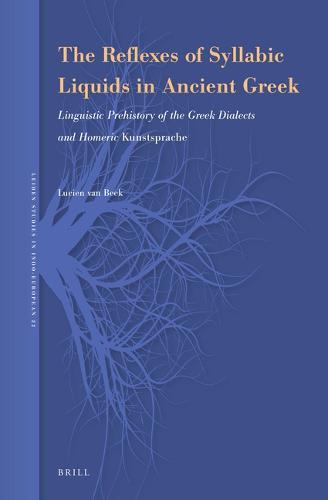
The Reflexes of Syllabic Liquids in Ancient Greek: Linguistic Prehistory of the Greek Dialects and Homeric Kunstsprache

Author:   Lucien van Beek
Publisher:   Brill
Volume:   22
ISBN:  

9789004469730


Pages:   586
Publication Date:   11 November 2021
Format:   Hardback
Availability:   Manufactured on demand   Availability explained
We will order this item for you from a manufactured on demand supplier.

Our Price $596.64 Quantity:  
Add to Cart

Share |

The Reflexes of Syllabic Liquids in Ancient Greek: Linguistic Prehistory of the Greek Dialects and Homeric Kunstsprache


Overview

How can we explain metrical irregularities in Homeric phrases like ἀνδροτῆτα καὶ ἥβην? What do such phrases tell us about the antiquity of the epic tradition? And how did doublet forms such as τέτρατος beside τέταρτος originate? In this book, you will find the first systematic and complete account of the syllabic liquids in Ancient Greek. It provides an up-to-date, comprehensive and innovative etymological treatment of material from all dialects, including Mycenaean. A new model of linguistic change in the epic tradition is used to tackle two hotly-debated problems: metrical irregularities in Homer (including muta cum liquida) and the double reflex. The proposed solution has important consequences for Greek dialect classification and the prehistory of Epic language and meter.

Full Product Details

Author:   Lucien van Beek
Publisher:   Brill
Imprint:   Brill
Volume:   22
Dimensions:   Width: 15.50cm , Height: 4.20cm , Length: 23.50cm
Weight:   1.098kg
ISBN:  

9789004469730


ISBN 10:   9004469737
Pages:   586
Publication Date:   11 November 2021
Audience:   Professional and scholarly ,  Professional & Vocational
Format:   Hardback
Publisher's Status:   Active
Availability:   Manufactured on demand   Availability explained
We will order this item for you from a manufactured on demand supplier.

Table of Contents

Acknowledgments Preface List of Tables Abbreviations and Conventions 1 The Greek Reflexes of *r and *l Introduction 1.1 The Problem and Its Relevance 1.2 Environments with a Common Greek or Proto-Greek Reflex , 1.3 The o- and u-Colored Reflexes of *r and *l in the Environment *C_T 1.4 Previous Accounts of - versus - in Ionic-Attic 1.5 Accounting for *r > - 1.6 Outlook 2 Mycenaean Reflexes of *r and the Numeral 'Four' Introduction 2.1 Preliminary Remarks on the Use of Personal Names 2.2 An a-Colored Reflex in Mycenaean? 2.3 Evidence for an o-Colored Reflex 2.4 o-Series versus a-Series Spellings 2.5 Explaining the Orthographic Variation between Co- and Co-ro- 2.6 Ion.-Att. and an Early Simplification of *-tu - before *r 2.7 A New Account of Myc. qe-to-ro- and Ion.-Att. 2.8 Conclusions regarding Mycenaean 3 Reflexes of *r in the Alphabetic Dialects Introduction 3.1 The Alleged Cretan Liquid Metathesis 3.2 Other West Greek Dialects 3.3 The Aeolic Dialects 3.4 Arcado-Cyprian 3.5 Pamphylian 3.6 Conclusions 4 Reflexes of *r and *l in 'Caland' Formations Introduction 4.1 The Root Vocalism of Caland Formations in Greek and PIE 4.2 Analogical Reshaping and Re-derivation 4.3 Reflexes of *r and *l in the u-Stem Adjectives 4.4 * versus 4.5 versus 4.6 Conclusions 5 Reflexes of *r in , and Related Forms Introduction 5.1 Semantics and Etymology 5.2 The Allomorphy of - and - in Homer and Classical Greek 5.3 Conclusions concerning the Vocalization of *r 6 Reflexes of *r and muta cum liquida in Epic Greek Introduction 6.1 The Reflex - and the Metrical Behavior of 6.2 Muta cum liquida Scansions in Homer 6.3 Wathelet's Proposal for the Origin of McL in Homer 6.4 Criticism of Wathelet's Scenario 6.5 Quantitative and Qualitative Evidence for McL in Homer 6.6 Avoidance of McL Scansion in Epic Greek 6.7 Epic *r : - Is the Regular Reflex of Artificially Retained *r 6.8 The Evidence for - from Epic *r 6.9 Less Certain Evidence for Epic *r 6.10 Nonce Formations with - in Epic Greek 6.11 Conclusions 7 Epic Forms with - Introduction 7.1 The Dialectal Origin of Forms with - 7.2 - - as a Conditioned Reflex of Epic *r 7.3 Other Forms with - 7.4 Conclusions 8 The Reflexes - and - in Aorist Stems Introduction 8.1 The Evidence 8.2 The Regular Development *r > - in the Thematic Aorist 8.3 The Pattern of Attestation of the Thematic Aorists with - 8.4 Epic *r in the Thematic Aorist? 8.5 Pindaric - 8.6 Conclusions 9 Remaining Issues Concerning *r Introduction 9.1 The Development of *-r s- in Ionic-Attic 9.2 Verbs with a Non-ablauting Root CraC- 9.3 An o-Colored Reflex in Attic? 9.4 The Development of *r n 9.5 Word-Final *-r 9.6 Further Potential Evidence for - < *r 9.7 Evidence for - and - Left out of Consideration 10 The Reflexes of *l Introduction 10.1 Unknown, Doubtful, or Uncertain Etymologies 10.2 Cases of - and - Influenced by a Full Grade Form 10.3 The Pre-form Did Not Necessarily Contain *l 10.4 Promising Evidence for *l > - 10.5 The Development of *l n 10.6 Dialectal Evidence 10.7 Conclusions on *l 11 Relative Chronology Introduction 11.1 The Vocalization of *r as a late and dialectally different development 11.2 Dating the Vocalization of *r in Ionic-Attic 11.3 Dating the Elimination of Epic *r 11.4 Relative Chronology: Other Sound Changes 11.5 Conclusions 12 Conclusion Introduction 12.1 Philological Results and New Etymologies 12.2 Regular Reflexes of PGr. *r in Dialects Other than Ionic and Attic 12.3 Special Reflexes of Proto-Greek *r 12.4 The Reflexes of Proto-Greek *l 12.5 The Double Reflex versus in Ionic-Attic 12.6 The Prehistory of the Epic Tradition 12.7 Relative Chronology and Subgrouping Bibliography Index

Reviews

Author Information

Lucien van Beek, Ph.D. (2013), Leiden University, is Assistant Professor at Leiden University Centre for Linguistics. He has assisted in Beekes’ Etymological Dictionary of Greek (Brill, 2010) and published extensively on Ancient Greek and Indo-European linguistics, etymology, and lexicography.

Tab Content 6

Author Website:  

Countries Available

All regions
Latest Reading Guide

NOV RG 20252


Shopping Cart
Your cart is empty
Shopping cart
Mailing List