Overview
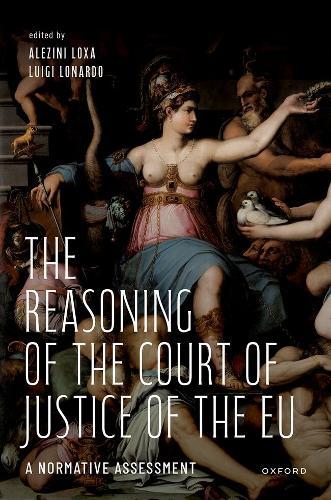
This edited volume offers a groundbreaking contribution to the study of the Court of Justice of the European Union (CJEU) by shifting the focus from descriptive accounts of its jurisprudence to normative evaluations of its legal reasoning. Building on a shared conceptual foundation derived from the Court's adjudicative practices, the book brings together a diverse array of scholarly perspectives that critically assess the CJEU's reasoning both in abstract terms and within specific doctrinal contexts.The volume is structured around two complementary approaches: one that examines the Court's techniques of adjudication across policy areas through a horizontal, theoretical lens, and another that engages deeply with specific aspects of case law, offering alternative interpretations grounded in distinct normative frameworks. This dual structure enables a rich and pluralistic exploration of what constitutes sound judicial reasoning in the EU legal order.Unlike previous scholarship that has either endorsed the Court's approach or critiqued it from isolated perspectives-constitutional, democratic, or social-this volume uniquely integrates theoretical abstraction with doctrinal specificity, all while maintaining a coherent conceptual unity. The contributors rigorously engage with the text of judicial decisions, articulating their assessments through clearly stated normative assumptions, theoretical grounding, and an appreciation of the institutional constraints under which the Court operates. While The Reasoning of the Court of Justice of the EU does not seek to define a singular model of a 'good' judgment, it advances the debate by offering methodologically robust and normatively transparent analyses. This is an open access title available under the terms of a CC BY-NC-ND 4.0 International licence. It is free to read on Oxford Scholarship Online and offered as a free PDF download from OUP and selected open access locations.
Full Product Details
Author: Luigi Lonardo (Lecturer in EU Law, Lecturer in EU Law, University College Cork) ,
Alezini Loxa (2025-2026 Emile Noël Fellow, 2025-2026 Emile Noël Fellow, NYU)
Publisher: Oxford University Press
Imprint: Oxford University Press
ISBN: 9780198982982
ISBN 10: 0198982984
Pages: 448
Publication Date: 23 April 2026
Audience:
College/higher education
,
Postgraduate, Research & Scholarly
Format: Hardback
Publisher's Status: Forthcoming
Availability: To order

Author Information
Alezini Loxa is a 2025-2026 Emile Noël Fellow at NYU and a Post-doctoral Research Fellow in EU law at Lund University, Sweden. She is the managing editor of the Nordic Journal of European Law and a board member of the European Law Moot Court Society. She has published widely in the field of migration law and EU social rights, and she is the author of the monograph Sustainability and EU Migration Law: Tracing the History of a Contemporary Concept (Cambridge University Press 2025). At Lund University, she has been teaching courses on EU Constitutional Law and European Fundamental Rights. Luigi Lonardo is a Lecturer in EU law at University College Cork and adjunct faculty at Sciences Po Paris. His areas of expertise and research are the law and politics of EU foreign policy, as well as EU constitutional law more broadly. He is the author of two monographs, EU Common Foreign and Security Policy after Lisbon: Between Law and Geopolitics (Springer 2022) and Russia's 2022 War against Ukraine and the Foreign Policy Reaction of the EU: Context, Diplomacy, Law (Palgrave 2023).