Overview
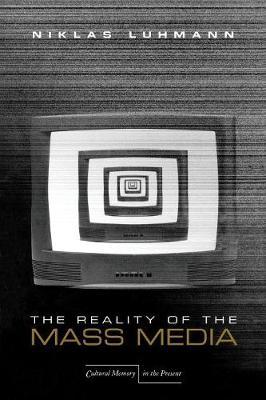
In The Reality of the Mass Media, Luhmann extends his theory of social systems applied in his earlier works to the economy, the political system, art, religion, the sciences, and law to an examination of the role of mass media in the construction of social reality. Luhmann argues that the system of mass media is a set of recursive, self-referential programs of communication, whose functions are not determined by the external values of truthfulness, objectivity, or knowledge, nor by specific social interests or political directives. Rather, he contends that the system of mass media is regulated by the internal code information/noninformation, which enables the system to select its information (news) from its own environment and to communicate this information in accordance with its own reflexive criteria.
Full Product Details
Author: Niklas Luhmann ,
Kathleen Cross
Publisher: Stanford University Press
Imprint: Stanford University Press
Dimensions:
Width: 15.20cm
, Height: 1.30cm
, Length: 22.90cm
Weight: 0.249kg
ISBN: 9780804740777
ISBN 10: 0804740771
Pages: 160
Publication Date: 01 July 2000
Audience:
College/higher education
,
Professional and scholarly
,
General/trade
,
Undergraduate
,
Postgraduate, Research & Scholarly
Format: Paperback
Publisher's Status: Active
Availability: In Print

This item will be ordered in for you from one of our suppliers. Upon receipt, we will promptly dispatch it out to you. For in store availability, please contact us.
Language: German
Reviews
In his work on social complexity, Niklas Luhmann always gave to symbolic communication a central, indeed pivotal place. Yet he had never written a systematic theoretical statement about mass media and communication. Only now, posthumously, in these late lectures from the very end of his extremely productive life, do we have finally such a statement. It is written with all the conceptual elegance and the supple empirical intuition that we came always to expect from this great German master, whose presence in contemporary intellectual life is already sorely missed. --Jeffrey C. Alexander, University of California, Los Angeles
This brilliant book is of interest both as an insightful contribution to media studies theory and as a lively and readable application of Luhmann's ingenious and influential system, which neatly describes the paradoxes of media(ted)) reality. -William Outhwaite,School of European Studies, University of Sussex In his work on social complexity, Niklas Luhmann always gave to symbolic communication a central, indeed pivotal place. Yet he had never written a systematic theoretical statement about mass media and communication. Only now, posthumously, in these late lectures from the very end of his extremely productive life, do we have finally such a statement. It is written with all the conceptual elegance and the supple empirical intuition that we came always to expect from this great German master, whose presence in contemporary intellectual life is already sorely missed. -Jeffrey C. Alexander,University of California, Los Angeles
In his work on social complexity, Niklas Luhmann always gave to symbolic communication a central, indeed pivotal place. Yet he had never written a systematic theoretical statement about mass media and communication. Only now, posthumously, in these late lectures from the very end of his extremely productive life, do we have finally such a statement. It is written with all the conceptual elegance and the supple empirical intuition that we came always to expect from this great German master, whose presence in contemporary intellectual life is already sorely missed. Jeffrey C. Alexander, University of California, Los Angeles
Author Information
Niklas Luhmann was Professor Emeritus of Sociology at the University of Bielefeld.