Overview
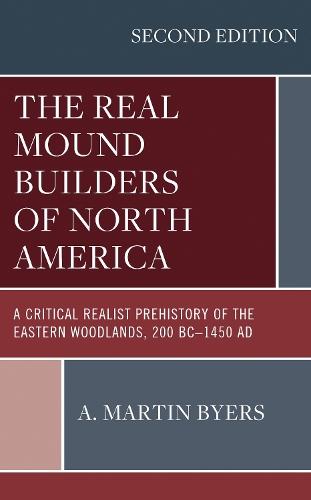
The Real Mound Builders of North America takes the standard position that the cultural communities of the Late Woodland period hiatus—when little or no transregional monumental mound building and ceremonialism existed—were the linear cultural and social ancestors of the communities responsible for the monumental earthworks of the unique Mississippian ceremonial assemblage, and further, these Late Woodland communities were the direct linear cultural and social descendants of those communities responsible for the great Hopewellian earthwork mounds and embankments and its associated unique ceremonial assemblage. Byers argues that these communities persisted largely unchanged in terms of their essential social structures and cultural traditions while varying only in terms of their ceremonial practices and their associated sodality organizations that manifested these deep structures. This continuist historical trajectory view stands in contrast to the current dominant evolutionary view that emphasizes abrupt social and cultural discontinuities with the Hopewellian ceremonial assemblage and earthworks, mounds and embankments.
Full Product Details
Author: A. Martin Byers
Publisher: Bloomsbury Publishing Plc
Imprint: Lexington Books
Edition: 2nd edition
Dimensions:
Width: 15.80cm
, Height: 2.50cm
, Length: 23.70cm
Weight: 0.644kg
ISBN: 9781666901276
ISBN 10: 166690127
Pages: 332
Publication Date: 08 January 2024
Audience:
Professional and scholarly
,
Professional & Vocational
Format: Hardback
Publisher's Status: Active
Availability: Manufactured on demand

We will order this item for you from a manufactured on demand supplier.
Reviews
In what may be the most accessible introduction to his thinking, this posthumous volume from Martin Byers summarizes his views on the nature of the social systems behind the earthwork and mound centers of eastern North America. Addressing the same archaeologically-revealed Middle Woodland and Mississippian landscapes as those who view them as the product of competitive and territorial hierarchically-organized societies, he tells us in a brilliant exposition why he believes those same groups were communal and custodial heterarchies. -- Robert Riordan, Wright State University This final edition of The Real Mound Builders of North America presents the clearest and most comprehensive overview of Martin Byers’ unique understanding of the last two millennia of Native American history in the Eastern Woodlands of North America prior to the arrival of Europeans. Rather than a linear, evolutionary trajectory, Byers sees a spiraling, repeating pattern of interactions within heterarchical societies based on clans and sodalities inhabiting a world shared with immanent deities. The book is a fundamental challenge to the core assumptions of most North American archaeologists. -- Douglas K. Charles, Wesleyan University
In what may be the most accessible introduction to his thinking, this posthumous volume from Martin Byers summarizes his views on the nature of the social systems behind the earthwork and mound centers of eastern North America. Addressing the same archaeologically-revealed Middle Woodland and Mississippian landscapes as those who view them as the product of competitive and territorial hierarchically-organized societies, he tells us in a brilliant exposition why he believes those same groups were communal and custodial heterarchies. --Robert Riordan, Wright State University This final edition of The Real Mound Builders of North America presents the clearest and most comprehensive overview of Martin Byers' unique understanding of the last two millennia of Native American history in the Eastern Woodlands of North America prior to the arrival of Europeans. Rather than a linear, evolutionary trajectory, Byers sees a spiraling, repeating pattern of interactions within heterarchical societies based on clans and sodalities inhabiting a world shared with immanent deities. The book is a fundamental challenge to the core assumptions of most North American archaeologists. --Douglas K. Charles, Wesleyan University
Author Information
A. Martin Byers (1937-2021) was professor emeritus at Vanier College and research associate at McGill University in the Department of Anthropology.