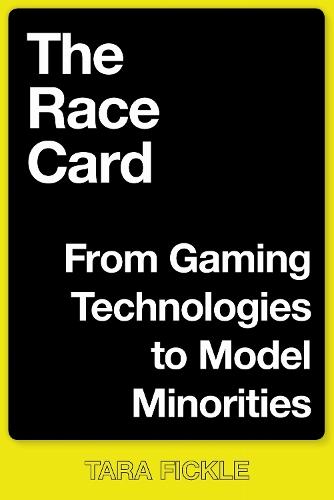
Full Product Details
Author: Tara Fickle
Publisher: New York University Press
Imprint: New York University Press
ISBN: 9781479805952
ISBN 10: 1479805955
Pages: 272
Publication Date: 19 November 2019
Audience:
Professional and scholarly
,
Professional & Vocational
Format: Paperback
Publisher's Status: Active
Availability: Manufactured on demand

We will order this item for you from a manufactured on demand supplier.
Reviews
Revealing the orientalist origins of game studies and locating the very tenants of game theory in Japanese internment, Tara Fickle engages racialization as game-play itself. In doing so, Fickle explodes our understanding of economic survival and success by revealing the centrality of gambling rhetoric-and a willingness for risk-taking-in the appraisal of Japanese Americans as the ultimate model minority. An original and timely intervention that at last accounts for the dominant representation of Asian Americans as both the hard-worker and the obsessed gamer. -- Wendy Hui Kyong Chun, author of <i>Updating to Remain the Same: Habitual New Media</i> Revealing the mutual constitution of gaming and racialization, The Race Card's concept of 'ludo-Orientalism' offers a significant new way of understanding the historical discourse of Asian exclusionism, as well as more subtle forms of post-1960s anti-Asian racism. Focusing on representations of Asian Americans as pathological players, Fickle shows how racial discourse is linked to the speculative logic of American exceptionalism. -- Colleen Lye, author of <i>America's Asia: Racial Reform and American Literature, 1893-1945</i>
Revealing the orientalist origins of game studies and locating the very tenants of game theory in Japanese internment, Tara Fickle engages racialization as game-play itself. In doing so, Fickle explodes our understanding of economic survival and success by revealing the centrality of gambling rhetoric-and a willingness for risk-taking-in the appraisal of Japanese Americans as the ultimate model minority. An original and timely intervention that at last accounts for the dominant representation of Asian Americans as both the hard-worker and the obsessed gamer. -- Wendy Hui Kyong Chun, author of <i>Updating to Remain the Same: Habitual New Media</i> Revealing the mutual constitution of gaming and racialization, The Race Card's concept of 'ludo-Orientalism' offers a significant new way of understanding the historical discourse of Asian exclusionism, as well as more subtle forms of post-1960s anti-Asian racism. Focusing on representations of Asian Americans as pathological players, Fickle shows how racial discourse is linked to the speculative logic of American exceptionalism. -- Colleen Lye, author of <i>America's Asia: Racial Reform and American Literature, 1893-1945</i> Games of chance, video games, and game theory converge in this examination of the relationship between gamification and racialization in exploring the Asian American experience. ... argues that games are used as a form of soft power geared toward advancing an exclusionary view of national identity. * CHOICE *
Revealing the mutual constitution of gaming and racialization, The Race Card's concept of 'ludo-Orientalism' offers a significant new way of understanding the historical discourse of Asian exclusionism, as well as more subtle forms of post-1960s anti-Asian racism. Focusing on representations of Asian Americans as pathological players, Fickle shows how racial discourse is linked to the speculative logic of American exceptionalism. -- Colleen Lye, author of <i>America's Asia: Racial Reform and American Literature, 1893-1945</i> Revealing the orientalist origins of game studies and locating the very tenants of game theory in Japanese internment, Tara Fickle engages racialization as game-play itself. In doing so, Fickle explodes our understanding of economic survival and success by revealing the centrality of gambling rhetoric-and a willingness for risk-taking-in the appraisal of Japanese Americans as the ultimate model minority. An original and timely intervention that at last accounts for the dominant representation of Asian Americans as both the hard-worker and the obsessed gamer. -- Wendy Hui Kyong Chun, author of <i>Updating to Remain the Same: Habitual New Media</i>
Author Information
Tara Fickle is Assistant Professor of English at the University of Oregon and an affiliated faculty in Ethnic Studies, the Center for Asian and Pacific Studies, and the New Media & Culture certificate.