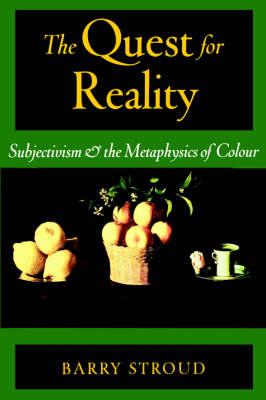
Full Product Details
Author: Barry Stroud (Mills Professor of Metaphysics and Epistemology, Mills Professor of Metaphysics and Epistemology, University of California, Berkeley)
Publisher: Oxford University Press Inc
Imprint: Oxford University Press Inc
Edition: New edition
Dimensions:
Width: 16.40cm
, Height: 2.00cm
, Length: 22.60cm
Weight: 0.390kg
ISBN: 9780195151886
ISBN 10: 0195151887
Pages: 256
Publication Date: 04 April 2002
Audience:
Professional and scholarly
,
Professional & Vocational
Format: Paperback
Publisher's Status: Active
Availability: To order

Stock availability from the supplier is unknown. We will order it for you and ship this item to you once it is received by us.
Reviews
This strange and absorbing book sets out to undermine the central metaphysical ambition which has dominated philosophy since the 17th century - that of reachinga comprehensive understanding of the world, consistent with modern science, which distinguishes between what exists objectively, independent of our minds, and what is merely subjective - due to the effects of the world on our minds and our responses to it.<br> Barry Stroud writes against the temper of the times. [His] style is clear, explicit, methodical and relentless. He tries to block every exit. The Quest for Reality displays a profound grasp of the history and logical structure of philosophical problems and theories, and a feeling for the derangement of thought that underlies them.<br> Whatever one thinks of the conclusion, it is illuminating to think through the argument. This is philosophy of an exemplary purity, tenacity, and depth. -- Thomas Nagel, The London Review of Books<br>
<br> This strange and absorbing book sets out to undermine the central metaphysical ambition which has dominated philosophy since the 17th century - that of reachinga comprehensive understanding of the world, consistent with modern science, which distinguishes between what exists objectively, independent of our minds, and what is merely subjective - due to the effects of the world on our minds and our responses to it. <br>Barry Stroud writes against the temper of the times. [His] style is clear, explicit, methodical and relentless. He tries to block every exit. The Quest for Reality displays a profound grasp of the history and logical structure of philosophical problems and theories, and a feeling for the derangement of thought that underlies them. <br>Whatever one thinks of the conclusion, it is illuminating to think through the argument. This is philosophy of an exemplary purity, tenacity, and depth. -- Thomas Nagel, The London Review of Books<p><br>
<br> This strange and absorbing book sets out to undermine the central metaphysical ambition which has dominated philosophy since the 17th century - that of reachinga comprehensive understanding of the world, consistent with modern science, which distinguishes between what exists objectively, independent of our minds, and what is merely subjective - due to the effects of the world on our minds and our responses to it. <br>Barry Stroud writes against the temper of the times. [His] style is clear, explicit, methodical and relentless. He tries to block every exit. The Quest for Reality displays a profound grasp of the history and logical structure of philosophical problems and theories, and a feeling for the derangement of thought that underlies them. <br>Whatever one thinks of the conclusion, it is illuminating to think through the argument. This is philosophy of an exemplary purity, tenacity, and depth. -- Thomas Nagel, The London Review of Books<br>
Author Information
Barry Stroud is Mills Professor of Metaphysics and Epistemology at the University of California, Berkeley, and author of Hume (1977) and The Significance of Philosophical Scepticism (1984).