Overview
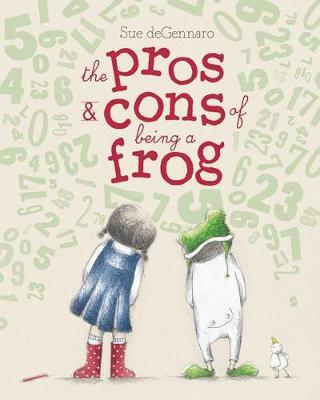
""This celebration of differences displays great respect for readers' intelligence and yields more with each reading. --Kirkus Reviews (starred review) Two shy kids discover the power of friendship in this charming picture book that celebrates being different. A boy likes to dress as a cat, but his best friend's dog objects. What will he dress as now? A giraffe? A fox? A shark? When his best friend, Camille, suggests a frog, they work together to make the frog costume...until Camille runs out of patience. So the boy makes a list of the pros and cons of being a frog: Pros: 1. My friend Camille gave me the idea 2. I'm less likely to be chased by a dog 3. Being in a frog costume makes me feel brave Cons: 1. Not everyone loves wearing a frog costume as much as me 2. If you start getting bossy about your frog costume then your friend will get up and leave 3. A frog is NOT a solitary creature so it is no fun for a frog if his friend gets up and leaves Luckily, he won't have to choose, because true friendship means accepting each other's differences: he can be himself and have his friend Camille.
Full Product Details
Author: Sue Degennaro ,
Sue Degennaro
Publisher: Simon & Schuster/Paula Wiseman Books
Imprint: Simon & Schuster/Paula Wiseman Books
Dimensions:
Width: 23.60cm
, Height: 1.30cm
, Length: 28.70cm
Weight: 0.476kg
ISBN: 9781481471305
ISBN 10: 1481471309
Pages: 40
Publication Date: 30 August 2016
Recommended Age: From 4 to 8 years
Audience:
Children/juvenile
,
Children / Juvenile
Format: Hardback
Publisher's Status: Active
Availability: Available To Order

We have confirmation that this item is in stock with the supplier. It will be ordered in for you and dispatched immediately.
Reviews
In this playful, multilayered story about friendship, a boy who likes to dress up as animals meets a girl who loves numbers. When our narrator first meets Camille, he's dressed as a cat and is being chased by a dog (""It was more attention than I wanted""). Camille, who ""loves math so much that some days she only talks in numbers,"" suggests he try a new animal, and the two forge a friendship as they try to make a perfect frog costume. When the frustrations of the task lead to a spat, the boy drafts an apology via a list of the pros and cons of being a frog. The collage illustrations are detailed and whimsical. Math-loving Camille is often depicted against a backdrop of graphs and numbers. ""I've worked out that 23 is yes and 17 is no,"" says the boy, and when the two fight, Camille storms off the page, a cluster of 17s floating along behind her. Lively, visually appealing, and an ultimately affirming tale of friendship.--Booklist ""7/7/16"" Set against a soothing beige backdrop, the illustrations are rendered in collage, Conte crayon, and pencil and ink. They are detailed yet playful and invite readers to linger over each page. Marvelous images of numbers and graphs are peppered throughout, and the sketches of frogs beg to be closely examined.--School Library Journal This celebration of differences displays great respect for readers' intelligence and yields more with each reading.--Kirkus, STARRED REVIEW The boy's costume-making and Camille's fondness for math defy gender stereotypes, while Camille's quirks are typical of children whose intellectual abilities outstrip their social skills. Their mutual recognition of each other's gifts and habits should be a welcome example for children forging their own friendships. --Publishers Weekly
In this playful, multilayered story about friendship, a boy who likes to dress up as animals meets a girl who loves numbers. When our narrator first meets Camille, he's dressed as a cat and is being chased by a dog (-It was more attention than I wanted-). Camille, who -loves math so much that some days she only talks in numbers,- suggests he try a new animal, and the two forge a friendship as they try to make a perfect frog costume. When the frustrations of the task lead to a spat, the boy drafts an apology via a list of the pros and cons of being a frog. The collage illustrations are detailed and whimsical. Math-loving Camille is often depicted against a backdrop of graphs and numbers. -I've worked out that 23 is yes and 17 is no,- says the boy, and when the two fight, Camille storms off the page, a cluster of 17s floating along behind her. Lively, visually appealing, and an ultimately affirming tale of friendship.--Booklist -7/7/16 -
The amphibian in this Australian import isactually a child who likes to dress as something else because it makes mefeel brave. The child had tried being a cat, but good friend Camillediscreetly suggested (after watching a friend run repeatedly from a dog) that adifferent animal might work better. DeGennaro's introduction places the two onopposite sides of the gutter, highlighting their differences. The narratorsports one-piece pajamas, green slippers, and a green, knitted cap with twofroglike bulges on top. Behind the narrator are collages of the tadpole's lifecycle. Camille, wearing her signature red polka-dot boots, is surrounded bygraphs and numbers. Although the protagonist knows that when Camille recitesthe six times table it signals hunger, her repetition and wriggling during measurementsfor a matching costume are maddening; the narrator's frustrated outburst causesher to walk off the page. These rosy-cheeked white children, created on thetaupe pages with ink, pencil, and Conte crayons, exude personality throughlopsided goggles and smiles, gentle gestures, and bodies that relate to eachother as if through gravitational pull. Sequential panels, thought bubbles, andbackgrounds are expertly designed with mathematical symbols and frogs, enhancing comprehension of the characters' interior worlds. The visualssurrounding their endearing embrace show how unspoken layers contribute tocommunication and reconciliation. This celebration of differences displaysgreat respect for readers' intelligence and yields more with each reading. (Picturebook. 5-8)--Kirkus, STARRED REVIEW 5/15/16 This celebration of differences displays great respect for readers' intelligence and yields more with each reading.--Kirkus, STARRED REVIEW Set against a soothing beige backdrop, the illustrations are rendered in collage, Conte crayon, and pencil and ink. They are detailed yet playful and invite readers to linger over each page. Marvelous images of numbers and graphs are peppered throughout, and the sketches of frogs beg to be closely examined.--School Library Journal In this playful, multilayered story about friendship, a boy who likes to dress up as animals meets a girl who loves numbers. When our narrator first meets Camille, he's dressed as a cat and is being chased by a dog ( It was more attention than I wanted ). Camille, who loves math so much that some days she only talks in numbers, suggests he try a new animal, and the two forge a friendship as they try to make a perfect frog costume. When the frustrations of the task lead to a spat, the boy drafts an apology via a list of the pros and cons of being a frog. The collage illustrations are detailed and whimsical. Math-loving Camille is often depicted against a backdrop of graphs and numbers. I've worked out that 23 is yes and 17 is no, says the boy, and when the two fight, Camille storms off the page, a cluster of 17s floating along behind her. Lively, visually appealing, and an ultimately affirming tale of friendship.--Booklist 7/7/16 The boy's costume-making and Camille's fondness for math defy gender stereotypes, while Camille's quirks are typical of children whose intellectual abilities outstrip their social skills. Their mutual recognition of each other's gifts and habits should be a welcome example for children forging their own friendships. --Publishers Weekly The boy s costume-making and Camille s fondness for math defy gender stereotypes, while Camille s quirks are typical of children whose intellectual abilities outstrip their social skills. Their mutual recognition of each other s gifts and habits should be a welcome example for children forging their own friendships. --Publishers Weekly
Set against a soothing beige backdrop, the illustrations are rendered in collage, Conte crayon, and pencil and ink. They are detailed yet playful and invite readers to linger over each page. Marvelous images of numbers and graphs are peppered throughout, and the sketches of frogs beg to be closely examined.--School Library Journal
The amphibian in this Australian import isactually a child who likes to dress as something else because it makes mefeel brave. The child had tried being a cat, but good friend Camillediscreetly suggested (after watching a friend run repeatedly from a dog) that adifferent animal might work better. DeGennaro's introduction places the two onopposite sides of the gutter, highlighting their differences. The narratorsports one-piece pajamas, green slippers, and a green, knitted cap with twofroglike bulges on top. Behind the narrator are collages of the tadpole's lifecycle. Camille, wearing her signature red polka-dot boots, is surrounded bygraphs and numbers. Although the protagonist knows that when Camille recitesthe six times table it signals hunger, her repetition and wriggling during measurementsfor a matching costume are maddening; the narrator's frustrated outburst causesher to walk off the page. These rosy-cheeked white children, created on thetaupe pages with ink, pencil, and Conte crayons, exude personality throughlopsided goggles and smiles, gentle gestures, and bodies that relate to eachother as if through gravitational pull. Sequential panels, thought bubbles, andbackgrounds are expertly designed with mathematical symbols and frogs, enhancing comprehension of the characters' interior worlds. The visualssurrounding their endearing embrace show how unspoken layers contribute tocommunication and reconciliation. This celebration of differences displaysgreat respect for readers' intelligence and yields more with each reading. (Picturebook. 5-8)--Kirkus, STARRED REVIEW 5/15/16
Author Information
Sue deGennaro is the illustrator of eleven picture books. The Pros & Cons of Being a Frog is the first picture book that she also wrote. It was shortlisted for the Childrens Book Council's Book of the Year Award and received a Notable Award in the picture book category in her native Australia. Visit her online at SuedeGennaro.com. Sue deGennaro is the illustrator of eleven picture books. The Pros & Cons of Being a Frog is the first picture book that she also wrote. It was shortlisted for the Childrens Book Council's Book of the Year Award and received a Notable Award in the picture book category in her native Australia. Visit her online at SuedeGennaro.com.