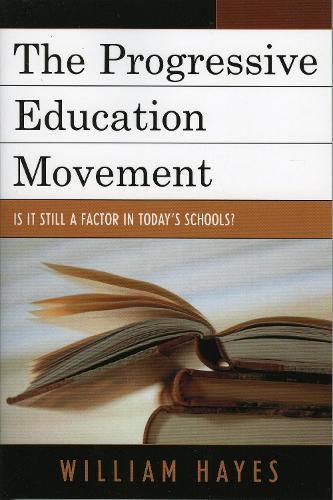
Full Product Details
Author: William Hayes
Publisher: Bloomsbury Publishing Plc
Imprint: Rowman & Littlefield
Dimensions:
Width: 15.40cm
, Height: 1.50cm
, Length: 22.60cm
Weight: 0.286kg
ISBN: 9781578865222
ISBN 10: 1578865220
Pages: 182
Publication Date: 24 October 2006
Audience:
General/trade
,
General
Format: Paperback
Publisher's Status: Active
Availability: Manufactured on demand

We will order this item for you from a manufactured on demand supplier.
Reviews
William Hayes... takes us on a journey through the history of progressive education from its inception up to the present-day dilemmas facing our society. In The Progressive Education Movement he explores the role of progressive education in many of the key movements and events in public schooling in the twentieth century. Hayes also challenges us to consider the future of progressive education in today's political and cultural climate. These are important and useful questions for educators, parents, and citizens of a democracy to seriously consider.--Peter W. Knapp, Ed. D.
The author of nine other books, Hayes (Roberts Wesleyan College) provides an admirably clear account of the history of progressive education and its prospects in today's schools. The early chapters trace progressive education from its roots in Rousseau and Pestalozzi, through Dewey and into the first half of the twentieth century, and into more recent times by focusing on such legislation as A Nation at Risk and No Child Left Behind. Then the aim is to detail progressive tendencies in modern teacher education programs, choice movements, and gifted and talented education. Two final chapters describe progressive education today and assay the future of progressive education. The book clearly is intended for teacher education students, but it would also interest a general audience. Recommended. * Choice Reviews * William Hayes... takes us on a journey through the history of progressive education from its inception up to the present-day dilemmas facing our society. In The Progressive Education Movement he explores the role of progressive education in many of the key movements and events in public schooling in the twentieth century. Hayes also challenges us to consider the future of progressive education in today's political and cultural climate. These are important and useful questions for educators, parents, and citizens of a democracy to seriously consider. -- Peter W. Knapp, Ed. D., associate professor of education, Roberts Wesleyan College
The author of nine other books, Hayes (Roberts Wesleyan College) provides an admirably clear account of the history of progressive education and its prospects in today's schools. The early chapters trace progressive education from its roots in Rousseau and Pestalozzi, through Dewey and into the first half of the twentieth century, and into more recent times by focusing on such legislation as A Nation at Risk and No Child Left Behind. Then the aim is to detail progressive tendencies in modern teacher education programs, choice movements, and gifted and talented education. Two final chapters describe progressive education today and assay the future of progressive education. The book clearly is intended for teacher education students, but it would also interest a general audience. Recommended. * CHOICE * William Hayes... takes us on a journey through the history of progressive education from its inception up to the present-day dilemmas facing our society. In The Progressive Education Movement he explores the role of progressive education in many of the key movements and events in public schooling in the twentieth century. Hayes also challenges us to consider the future of progressive education in today's political and cultural climate. These are important and useful questions for educators, parents, and citizens of a democracy to seriously consider. -- Peter W. Knapp, Ed. D., associate professor of education, Roberts Wesleyan College
The author of nine other books, Hayes (Roberts Wesleyan College) provides an admirably clear account of the history of progressive education and its prospects in today's schools. The early chapters trace progressive education from its roots in Rousseau and Pestalozzi, through Dewey and into the first half of the twentieth century, and into more recent times by focusing on such legislation as A Nation at Risk and No Child Left Behind. Then the aim is to detail progressive tendencies in modern teacher education programs, choice movements, and gifted and talented education. Two final chapters describe progressive education today and assay the future of progressive education. The book clearly is intended for teacher education students, but it would also interest a general audience. Recommended. Choice William Hayes... takes us on a journey through the history of progressive education from its inception up to the present-day dilemmas facing our society. In The Progressive Education Movement he explores the role of progressive education in many of the key movements and events in public schooling in the twentieth century. Hayes also challenges us to consider the future of progressive education in today's political and cultural climate. These are important and useful questions for educators, parents, and citizens of a democracy to seriously consider. -- Peter W. Knapp, Ed. D.
Author Information
William Hayes is associate professor of teacher education at Roberts Wesleyan College. During his forty-five years in education, he has worked as a high school teacher, department chairman, assistant principal, both a junior and senior high school principal, superintendent, college division chairman, and professor.