Awards
- Winner of 2021 Outstanding Publication of the Year Award by the Narrative Research Special Interest Group of the American Educational Research Association Recipient of the 2021 Daniel E. Griffiths Research Award.
Overview
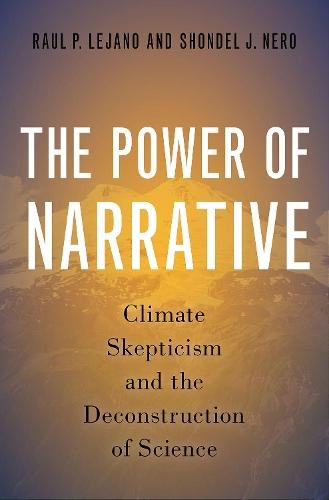
There is an ideological war of words waging in America, one that speaks to a new fundamentalism rising not just within the American public, but across other ideologically-torn nations around the globe as well. At its heart is climate skepticism, an ideological watershed that has become a core belief for millions of people despite a large scientific consensus supporting the science of anthropogenic climate change. While many scholars have examined the role of lobbyists and conservative think tanks in fueling the climate skepticism movement, there has not yet been a systematic analysis of why the narrative itself has resonated so powerfully with the public.Pulling from science and technology studies, narrative and discourse theory, and public policy, The Power of Narrative examines the strength of climate skepticism as a story, offering a thoughtful analysis and comparison of anti-climate science narratives over time and across geographic boundaries. This book provides fresh insight into the rhetorical and semantic properties on both sides of the climate change debate that preclude dialogue around climate science, and proposes a means for moving beyond ideological entrenchment through language mediation, further ethnographic study, and research-informed teaching. The Power of Narrative culminates in the revelation of a parallel between narratives about climate skepticism and those in other issue areas (e.g., gun rights, immigration, health crises), exposing a genetic meta-narrative of public distrust and isolation.Ultimately, The Power of Narrative is not a book about climate change in itself: it is, instead, a book about how our society understands and interacts with science, how a social narrative becomes ideology, and how we can move beyond personal and political dogma to arrive at a sense of collective rapprochement.
Full Product Details
Author: Raul P. Lejano (Professor, Professor, New York University, School of Culture, Education, and Human Development) ,
Shondel J. Nero (Professor of Language Education, Professor of Language Education, New York University, Steinhardt School of Culture, Education, and Human Development)
Publisher: Oxford University Press Inc
Imprint: Oxford University Press Inc
Dimensions:
Width: 16.30cm
, Height: 1.70cm
, Length: 24.20cm
Weight: 0.446kg
ISBN: 9780197542101
ISBN 10: 0197542107
Pages: 204
Publication Date: 10 December 2020
Audience:
Professional and scholarly
,
Professional & Vocational
Format: Hardback
Publisher's Status: Active
Availability: Manufactured on demand

We will order this item for you from a manufactured on demand supplier.
Reviews
The Power of Narrative examines the ways in which narrative contributes to the cultural divide over climate change. While political actors can promote the climate skeptical narrative as motivated by self-interest, its meaning for members of the general public is quite different, often weaving experience and ideology into a sense of personal identity and group solidarity. This book offers valuable insights for improving the efficiency of efforts to make headway on climate policy - any climate scientist or activist could benefit from the fundamental perspectives offered here by Lejano and Nero. * James S. Clark, Nicholas Professor of Environment, Duke University * Lejano and Nero bring the full power of narrative analysis to bear in explaining how and why the storytelling of groups and organizations rejecting the reality and seriousness of climate change has been so strongly embraced in the American public. Indeed, their signature contribution is explaining how the evolving ideological narrative of climate change disbelief and the coalitions promoting this narrative are co-constituted, resulting in greater political polarization on climate change and the rise of echo chambers over time. Their work on the cultural resonance of climate change disbelief is an essential complement to other bodies of work that have documented the financial resources, organizational structure, and political strategies of the climate change denial machine. * Aaron M. McCright, Professor and Chairperson of the Department of Sociology, Michigan State University * If you have wondered how the science of climate change became a hot-button political question deeply embedded in the Left-Right polarization in the United States, this book is for you: The Power of Narrative explains the history of climate change skepticism and offers clues for resolving our current dilemma. * Anne H. Ehrlich, Senior Research Scientist, Emerita, Center for Conservation Biology, Department of Biology, Stanford University *
Author Information
Raul P. Lejano is Professor at New York University where he teaches environmental policy and sustainability education. He applies his expertise in the complex logics of collective action to problems of designing the resilient city, addressing vulnerabilities of the marginalized to climate change and environmental hazards, and environmental justice. One of the analytic tools he employs is narrative analysis. Shondel J. Nero is Professor of Language Education at New York University. Her primary research focus is on language variation and its relationship to identity and education, especially for minoritized populations in the US and the Anglophone Caribbean. She employs ethnographic and critical discourse analytic methods to examine the language and education of speakers of nonstandardized varieties of English, World Englishes, and Caribbean Creoles. A Fulbright scholar, Nero is the inaugural recipient of the James E. Alatis Prize for an outstanding article on language education policy in educational contexts.