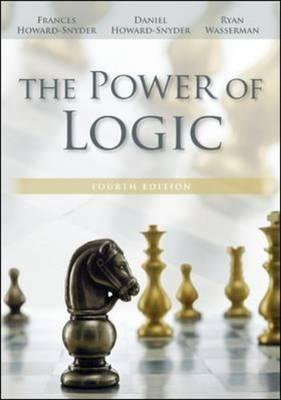
The Power of Logic

Author:   Frances Howard-Snyder ,  Daniel Howard-Snyder ,  Ryan Wasserman
Publisher:   McGraw-Hill Education - Europe
Edition:   4th Revised edition
ISBN:  

9780073407371


Pages:   688
Publication Date:   01 October 2008
Format:   Paperback
Availability:   In Print   Availability explained
Limited stock is available. It will be ordered for you and shipped pending supplier's limited stock.

Our Price $398.38 Quantity:  
Add to Cart

Share |

The Power of Logic


Overview

This brief and flexible introductory level text is designed to illustrate the power of logic as a tool for critical thinking in various facets of life by increasing students' ability to understand, analyze, evaluate, and construct arguments. The Power of Logic provides balanced coverage of informal logic, traditional categorical logic, and modern symbolic logic. The authors' direct and accessible writing style, along with a wealth of relevant examples and imaginative exercises, make this an ideal text for today's logic classes.

Full Product Details

Author:   Frances Howard-Snyder ,  Daniel Howard-Snyder ,  Ryan Wasserman
Publisher:   McGraw-Hill Education - Europe
Imprint:   McGraw Hill Higher Education
Edition:   4th Revised edition
Dimensions:   Width: 17.00cm , Height: 3.30cm , Length: 23.60cm
Weight:   1.020kg
ISBN:  

9780073407371


ISBN 10:   0073407372
Pages:   688
Publication Date:   01 October 2008
Audience:   College/higher education ,  Tertiary & Higher Education
Format:   Paperback
Publisher's Status:   Out of Print
Availability:   In Print   Availability explained
Limited stock is available. It will be ordered for you and shipped pending supplier's limited stock.

Table of Contents

Chapter 1. Basic Concepts 1.1 Validity and Soundness 1.2 Forms and Validity 1.3 Counterexamples and Invalidity 1.4 Strength and Cogency Chapter 2. Identifying Arguments 2.1 Arguments and Nonarguments 2.2 Well-Crafted Arguments 2.3 Argument Diagrams Chapter 3. Logic and Language 3.1 Logic, Meaning, and Emotive Force 3.2 Definitions 3.3 Using Definitions to Evaluate Arguments Chapter 4. Informal Fallacies 4.1 Fallacies of Irrelevance 4.2 Fallacies Involving Ambiguity 4.3 Fallacies Involving Unwarranted Assumptions Chapter 5. Categorical Logic: Statements 5.1 Standard Forms of Categorical Statements 5.2 The Traditional Square of Opposition 5.3 Further Immediate Inferences Chapter 6. Categorical Logic: Syllogisms 6.1 Standard Form, Mood, and Figure 6.2 Venn Diagrams and Categorical Statements 6.3 Venn Diagrams and Categorical Syllogisms 6.4 The Modern Square of Opposition 6.5 Enthymemes 6.6 Sorites and Removing Term-Complements 6.7 Rules for Evaluating Syllogisms Chapter 7. Statement Logic: Truth Tables 7.1 Symbolizing English Arguments 7.2 Truth Tables 7.3 Using Truth Tables to Evaluate Arguments 7.4 Abbreviated Truth Tables 7.5 Logically Significant Categories and Relationships Chapter 8. Statement Logic: Proofs 8.1 Implicational Rules of Inference 8.2 Five Equivalence Rules 8.3 Five More Equivalence Rules 8.4 Conditional Proof 8.5 Reductio ad Absurdum 8.6 Proving Theorems Chapter 9. Predicate Logic 9.1 Predicates and Quantifiers 9.2 Demonstrating Invalidity 9.3 Constructing Proofs 9.4 Quantifier Negation, RAA, and CP 9.5 The Logic of Relations: Symbolizations 9.6 The Logic of Relations: Proofs 9.7 Identity: Symbolizations 9.8 Identity: Proofs Chapter 10. Induction 10.1 Inductive and Deductive Logic: Contrasts and Clarifications 10.2 Arguments from Authority and Induction by Enumeration 10.3 Mill's Methods and Scientific Reasoning 10.4 Arguments from Analogy Chapter 11. Probability 11.1 Three Theories of Probability 11.2 The Rules of Probability 11.3 Bayes' Theorem

Reviews

Author Information

Tab Content 6

Author Website:  

Countries Available

All regions
Latest Reading Guide

NOV RG 20252


Shopping Cart
Your cart is empty
Shopping cart
Mailing List