Awards
- Winner of American Academy of Religion Award for Excellence in the Study of Religion in Historical Studies 2015
- Winner of American Academy of Religion Award for Excellence in the Study of Religion in Historical Studies 2015.
- Winner of Award for Excellence in the Study of Religion in the category of Historical Studies, American Academy of Religion 2015 (United States)
- Winner of Award for Excellence in the Study of Religion in the category of Historical Studies, American Academy of Religion 2015 (United States)
Overview
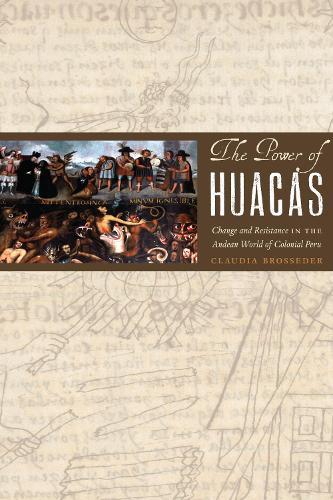
Based on extensive archival research, The Power of Huacas is the first book to take account of the reciprocal effects of religious colonization as they impacted Andean populations and, simultaneously, dramatically changed the culture and beliefs of Spanish Christians. Winner, Award for Excellence in the Study of Religion in the category of Historical Studies, American Academy of Religion, 2015 The role of the religious specialist in Andean cultures of the sixteenth, seventeenth, and eighteenth centuries was a complicated one, balanced between local traditions and the culture of the Spanish. In The Power of Huacas, Claudia Brosseder reconstructs the dynamic interaction between religious specialists and the colonial world that unfolded around them, considering how the discourse about religion shifted on both sides of the Spanish and Andean relationship in complex and unexpected ways. In The Power of Huacas, Brosseder examines evidence of transcultural exchange through religious history, anthropology, and cultural studies. Taking Andean religious specialists-or hechizeros (sorcerers) in colonial Spanish terminology-as a starting point, she considers the different ways in which Andeans and Spaniards thought about key cultural and religious concepts. Unlike previous studies, this important book fully outlines both sides of the colonial relationship; Brosseder uses extensive archival research in Bolivia, Chile, Ecuador, Peru, Spain, Italy, and the United States, as well as careful analysis of archaeological and art historical objects, to present the Andean religious worldview of the period on equal footing with that of the Spanish. Throughout the colonial period, she argues, Andean religious specialists retained their own unique logic, which encompassed specific ideas about holiness, nature, sickness, and social harmony. The Power of Huacas deepens our understanding of the complexities of assimilation, showing that, within the maelstrom of transcultural exchange in the Spanish Americas, European paradigms ultimately changed more than Andean ones.
Full Product Details
Author: Claudia Brosseder
Publisher: University of Texas Press
Imprint: University of Texas Press
Dimensions:
Width: 15.20cm
, Height: 3.00cm
, Length: 22.90cm
Weight: 0.821kg
ISBN: 9780292756946
ISBN 10: 0292756941
Pages: 478
Publication Date: 01 July 2014
Audience:
College/higher education
,
Professional and scholarly
,
Tertiary & Higher Education
,
Professional & Vocational
Format: Hardback
Publisher's Status: Active
Availability: In Print

This item will be ordered in for you from one of our suppliers. Upon receipt, we will promptly dispatch it out to you. For in store availability, please contact us.
Author Information
Claudia Brosseder is a Privatdozentin at Munich University and holds a research position in the Excellence Center for Transcultural Studies at Heidelberg University. She is the author of Im Bann der Sterne. Caspar Peucer, Philipp Melanchthon und andere Wittenberger Astrologen.