Overview
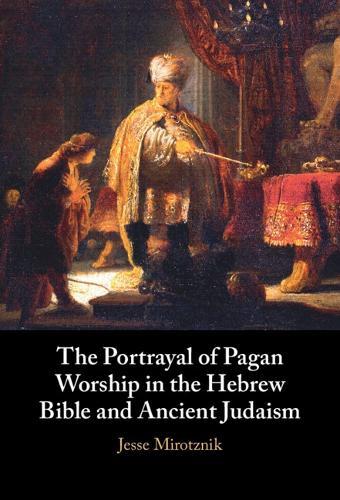
How did Jews in the ancient world depict the practices of their pagan contemporaries? In this study, Jesse Mirotznik investigates the portrayal of pagan worship in the Hebrew Bible and ancient Jewish literature. Scholars have assumed that the portrayals in these corpora are consistent over time. Mirotznik, however, shows that there is a fundamental discontinuity between earlier and later depictions of pagan worship. In the Hebrew Bible, these forms of worship are, for the most part, simply assumed to be sincere. By contrast, in ancient Jewish texts from approximately the end of the third century BCE and onward, such worship is increasingly presented as insincere, performed only instrumentally in the service of an ulterior motive. While the worshipers of other gods seem genuine in their devotion, these texts contend, they too must recognize the folly of such worship.
Full Product Details
Author: Jesse Mirotznik (The Hebrew University of Jerusalem)
Publisher: Cambridge University Press
Imprint: Cambridge University Press
Weight: 0.499kg
ISBN: 9781009691970
ISBN 10: 100969197
Pages: 266
Publication Date: 09 April 2026
Audience:
College/higher education
,
Postgraduate, Research & Scholarly
Format: Hardback
Publisher's Status: Active
Availability: Manufactured on demand

We will order this item for you from a manufactured on demand supplier.
Reviews
'While attitudes toward idolatry are fundamental to comprehending ancient Judaism, scholars have devoted surprisingly little attention to how idolatry was conceptualized in Jewish thought. This book offers a brilliant analysis of attitudes toward idolatry from the Bible to rabbinic literature, with an emphasis on changes in perception over time. A must-read for anyone interested in Jewish theologies and their relationship with their surroundings.' Ishay Rosen-Zvi, Professor of Jewish Philosophy and Talmud at Tel-Aviv University
'While attitudes toward idolatry are fundamental to comprehending ancient Judaism, scholars have devoted surprisingly little attention to how idolatry was conceptualized in Jewish thought. This book offers a brilliant analysis of attitudes toward idolatry from the Bible to rabbinic literature, with an emphasis on changes in perception over time. A must-read for anyone interested in Jewish theologies and their relationship with their surroundings.' Ishay Rosen-Zvi, Professor of Jewish Philosophy and Talmud at Tel Aviv University 'Academic scholarship has devoted little attention to how biblical and ancient Jewish thinkers understood the appeal of polytheism. Mirotznik's cutting edge study on this topic shows how earlier biblical views of such pagan worship as sincere (if misguided) shifted in the 3rd century BCE, when ancient Jewish sources began describing idol-worshipping polytheists as motivated by sex or money rather than by sincere belief. Scholars will see the texts Mirotznik discusses in a new and richer light after reading this fascinating monograph.' Joel S. Kaminsky, Morningstar Family Professor of Jewish Studies, Smith College
Author Information
Jesse Mirotznik is a postdoctoral fellow at The Hebrew University of Jerusalem.