Overview
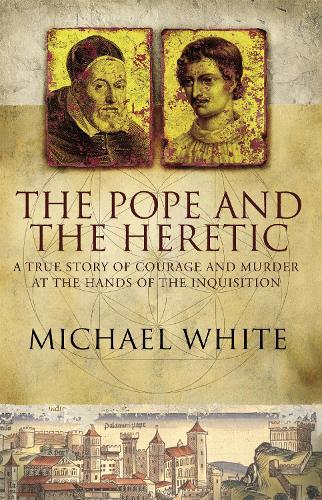
Giordano Bruno (1548-1600) was a mystic, philosopher and scientist whose ideas were decades ahead of their time. A proponent of a unificatory vision of science, he was both a champion of the occult as Newton would be after him, and a torch-bearer for the sort of holistic dreams that Leonardo had cherished before him. As such he is perfect material for the third in Michael White's loose trilogy of science biographies - after Newton, the last sorcerer, and Leonardo, the first scientist, we have Bruno, science's first martyr. THE POPE AND THE HERETIC re-creates not just the vibrancy of intellectual life at the height of the Renaissance but also the horrific cost of pursuing ideas which ran counter to the orthodoxy of the Catholic Church. After almost eight years' imprisonment and torture at the hands of the Inquisition, Bruno was burned at the stake for his beliefs - or rather, his refusal to accept that intellectual investigation was limited by the dictats of Rome. His life and martyrdom are the subjects of this fascinating book.
Full Product Details
Author: Michael White
Publisher: Little, Brown Book Group
Imprint: Abacus
Edition: New edition
Dimensions:
Width: 12.60cm
, Height: 1.50cm
, Length: 19.60cm
Weight: 0.185kg
ISBN: 9780349113494
ISBN 10: 0349113491
Pages: 224
Publication Date: 02 March 2006
Audience:
General/trade
,
General
Format: Paperback
Publisher's Status: Active
Availability: Manufactured on demand

We will order this item for you from a manufactured on demand supplier.
Reviews
'The Pope and the Heretic asks why, on the morning of February 19, 1600, following years of hideous torture, philosopher Giordano Bruno was led out to a stake in the middle of the Field of Flowers in Rome, to burn to death. This lucid and illuminating book is an attempt to find the answer. One reason, carefully and cleverly teased out by Michael White, author of the bestselling Leonardo: The First Scientist, is the era that Bruno was unfortunate enough to live and work in. The late 16th century was a time of savage religious and ideological conflict across Europe. A ruthlessly honest, determinedly original, exuberantly syncretist thinker like Bruno, willing to question the theological and historiographical verities espoused by the Vatican, was a noisome thorn in the flesh of a Roman Catholic Church already wrestling with Protestant dissent. Another reason, not elided by White, was Bruno's intellectually pugnacious personality. As White says, If he had applied more cunning, as did Erasmus, he may have lived to enjoy old age. Instead, Bruno actually courted danger and controversy, confronting his enemies head-on. A third reason for Bruno's terrible fate was the Inquisition. This institution could have been expressly designed to root out someone like Bruno, who was cheerfully willing to add a dash of occultism and Greek philosophy to the pure dogma of Catholic thought. The Inquisition certainly relished Bruno's demise: after his charred corpse was brought down from the stake, the remaining flesh was pulverised with gavels and the ashes hurled to the wind, as if to nullify for all time Bruno's repellent heresies. The Inquisition failed, of course. Bruno's original and clairvoyant contributions to the fields of psychology and theology continue to resonate to this day. This elegantly concise, pleasingly readable book is a fitting memorial to such a remarkable thinker.' - Sean Thomas, AMAZON.CO.UK
A noteworthy victim of the Inquisition-not altogether innocent, but a victim all the same-earns homage in this slender, somewhat unsatisfying biography. Giordano Bruno came of age at a time when the papacy was desperately seeking to retain power and much of Europe was desperately seeking to step free of it. Super-intelligent and vastly erudite, as science journalist White (Acid Tongues and Tranquil Dreamers, 2001, etc.) cheerfully puts it, Bruno got himself into trouble with Church authorities while a novice seminarian; ratted on by a fellow student, he was caught reading Erasmus in the privy and summarily excommunicated. For the next 20-odd years, then, he wandered from one European capital to another, living off his wits and the largesse of reform-minded nobility. Bruno was never quite a Protestant-he examined Luther's doctrines and found them wanting, and he could find no safe haven in Calvinist lands, where a fellow Catholic dissident had been slowly roasted on suspicion of heresy-but, especially after he began poking in Gnostic texts, he was never quite redeemable as a lapsed Catholic, either. All of which makes it a deeply curious turn of history that Bruno decided to return to Italy in the hope of mending fences with the relatively liberal Pope Clement VIII, who, though interested in Bruno as an intellectual specimen, nonetheless allowed the Inquisitors to have their way with him. And so they did, as White writes, torturing Bruno for six years and then burning him at the stake in Rome's Campo dei Fiori. White's account of these events is marred by a considerable amount of hedging and guesswork-understandable, given that the Church's records of Bruno's imprisonment have disappeared-and by a tendency to dumb down Bruno's doctrines (as well as to overlook key texts such as the Cabala of Pegasus). Still, he does a good job of placing Bruno's revolt in the freethinking context of the time, of showing the injustice of Bruno's fate, and even of showing the relevance of Bruno's ideas to the subsequent development of higher mathematics. Solid if never thrilling-a shame, given the inherently fascinating nature of the subject. (Kirkus Reviews)
On February 19, 1600, Giordano Bruno, a philosopher and Dominican monk who had questioned the Vatican's teaching, was burned alive in Rome. In this fascinating book Michael White investigates the background to this barbarous punishment. Bruno was a brilliant and original thinker, who wrote: 'he who desires to philosophise must first of all doubt all things'. He was fascinated by the occult and tried to create a unified theory of science and theology like Leonardo da Vinci before him. But he was reported to the church authorities by a fellow monk for reading banned texts by Erasmus, another Catholic monk whose fresh thinking had been deemed heretical. The Vatican already felt under siege from the rapid growth of Protestantism and could not tolerate dissent within its ranks. At this point the Inquisition took a hand, and White does not shy from describing its infamous methods of interrogation - starting with one-sided court hearings and progressing to the rack. White's account is scholarly but highly readable. He presents Bruno's tragedy as a story, supported by witness statements and reports, and brings the intellectual vitality and institutional repression of 16th-century Rome to life. In a fascinating preface he outlines the efforts of previous historians to research Bruno and sheds light on the Vatican's policies regarding the opening of archives - censorship is not entirely a thing of the past. This is an illuminating account of a brave and original scholar whose thought endures though he himself met a wretched fate. (Kirkus UK)
Author Information
Michael White is a former science writer for GQ magazine. In a previous incarnation he was a member of the Thompson Twins pop group, before becoming a full-time writer in 1991.