Overview
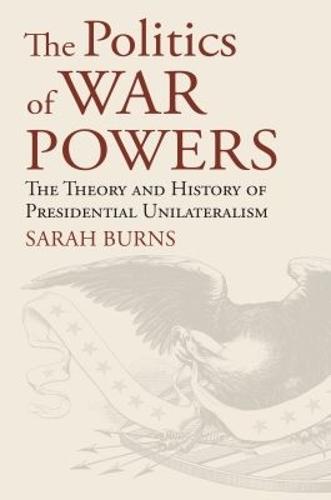
The Constitution of the United States divides war powers between the executive and legislative branches to guard against ill-advised or unnecessary military action. This division of powers compels both branches to hold each other accountable and work in tandem. And yet, since the Cold War, congressional ambition has waned on this front. Even when Congress does provide initial authorization for larger operations, they do not provide strict parameters or clear end dates. As a result, one president after another has initiated and carried out poorly developed and poorly executed military policy. The Politics of War Powers offers a Measured, deeply informed look at how the American constitutional system broke down, how it impacts decision-making today, and how we might find our way out of this unhealthy power division. Sarah Burns starts with a nuanced account of the theoretical and historical development of war powers in the United States. Where discussions of presidential power often lean on the concept of the Lockean Prerogative, Burns locates a more constructive source in Montesquieu. Unlike Locke, Montesquieu combines universal normative prescriptions with an emphasis on tailoring the structure to the unique needs of a society. In doing so, the separation of powers can be customized while maintaining the moderation needed to create a healthy institutional balance. He demonstrates the importance of forcing the branches into dialogue, putting them, as he says, “in a position to resist” each other. Burns’s conclusion—after tracing changes through Franklin Delano Roosevelt’s administration, the Cold War, and the War on Terror—is that presidents now command a dangerous degree of unilateral power. Burns’s work ranges across Montesquieu’s theory, the debate over the creation of the Constitution, historical precedent, and the current crisis. Through her analysis, both a fuller picture of the alterations to the constitutional system and ideas on how to address the resulting imbalance of power emerge.
Full Product Details
Author: Sarah Burns
Publisher: University Press of Kansas
Imprint: University Press of Kansas
Dimensions:
Width: 16.20cm
, Height: 3.30cm
, Length: 23.60cm
Weight: 0.643kg
ISBN: 9780700628735
ISBN 10: 0700628738
Pages: 312
Publication Date: 30 November 2019
Audience:
Professional and scholarly
,
Professional & Vocational
Format: Hardback
Publisher's Status: Active
Availability: Temporarily unavailable

The supplier advises that this item is temporarily unavailable. It will be ordered for you and placed on backorder. Once it does come back in stock, we will ship it out to you.
Reviews
Read as a diagnosis of presidential excess in a system designed to encourage moderation and accountability, Burns' book is provocative and timely.--Congress & the PresidencyIf you want to understand the growth of government, particularly the increased scope of executive power, read this book.--The Independent Review A welcome addition to debates about the rise of presidential power generally and presidential dominance of foreign policy in particular.--Review of Politics Burns takes the reader on an exploration of American political thought (emphasizing Montesquieu), founding-era leaders, WWI and WWII, and the war on terror, bemoaning the decline of cross-institutional deliberation, engagement, and ambition. Highly recommended--Choice Sarah Burns has written a sweeping account of the contentious debate over war powers through the eyes of Montesquieu, Locke, and an array of American statesmen. The author's mastery of the philosophical debates over war powers coupled with her sound grasp of history makes for a remarkable read. Her insightful discussion of Abraham Lincoln's interpretation of presidential war powers and prerogative power is worth the price of admission alone.--Stephen F. Knott, professor in the Department of National Security Affairs, United States Naval War CollegeSarah Burns's The Politics of War Powers is a careful and illuminating study of the expansion of the president's war-making powers at the expense of an often neglectful Congress. Beginning with a discussion of the founders' thoughtful use of Montesquieu's understanding of political moderation, Professor Burns then traces presidential understanding of these powers from Washington to the present. She argues convincingly that legal attempts to justify growing presidential control too often today replace debate and discussion about the prudence of military action.--Mark Blitz, Fletcher Jones Professor of Political Philosophy, Claremont Graduate University Those who ponder presidential power and America's constitutional order have long needed such a comprehensive yet original book as Sarah Burns delivers. The Politics of War Powers articulates the lost Montesquieuan argument behind the letter and spirit of our unique constitutional frame and its distinctive executive power--and with an appropriate eye toward policy relevance for current and expected challenges. This broader view connects the big ideas about war and peace, the high politics of national strategy, and how these have played out in America's history. A judicious yet urgent call to restore America's constitutional moderation, it deserves to reset the terms of debate among scholars, lawyers, and our political leaders.--Paul Carrese, director of the School of Civic and Economic Thought and Leadership, Arizona State University
Sarah Burns has written a sweeping account of the contentious debate over war powers through the eyes of Montesquieu, Locke, and an array of American statesmen. The author's mastery of the philosophical debates over war powers coupled with her sound grasp of history makes for a remarkable read. Her insightful discussion of Abraham Lincoln's interpretation of presidential war powers and prerogative power is worth the Price of admission alone. - Stephen F. Knott, professor in the Department of National Security Affairs, United States Naval War College
Author Information
Sarah Burns is assistant professor of political science at Rochester Institute of Technology.