Overview
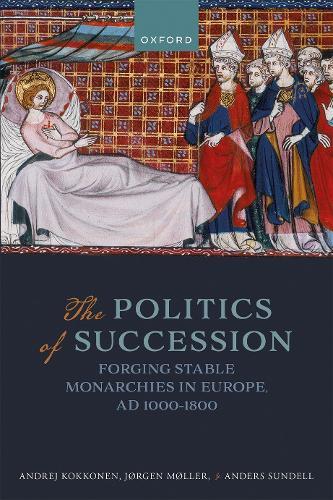
The death of the ruler poses a significant threat to the stability of any polity. Arranging for a peaceful and orderly succession has been a formidable challenge in most historical societies, and it continues to be a test that modern authoritarian regimes regularly face and often fail. Drawing on a unique dataset of the life and fates of monarchs in all major monarchies in Medieval and Early Modern Europe, The Politics of Succession documents how succession have historically been moments of violence and insecurity. Deaths of rulers were often associated with civil war, and the shadow cast by looming successions caused coups and depositions. But this book also shows that the development and spread of primogeniture - the eldest-son-taking-the-throne - mitigated the problem of succession in Europe in the period after AD 1000. The predictability and stability that followed from a clear hereditary principle outweighed the problems of incompetent and irrational rulers sometimes inheriting power. The data used in the book demonstrates that primogeniture reduced the risk of depositions and civil war following the inevitable deaths of leaders. In this way, hereditary monarchy helped create political stability and lengthen the time horizons of rulers and elites alike, thereby facilitating state-building. The book thus sheds light on the rationale of a system of leader selection that today often appears illogical and outdated - and it uses these findings to shed light on the key advantage of modern representative democracy: its ability to complete power transfers peacefully.
Full Product Details
Author: Andrej Kokkonen (Associate Professor, Department of Political Science, Associate Professor, Department of Political Science, University of Gothenburg) ,
Jørgen Møller (Professor, Department of Political Science, Professor, Department of Political Science, Aarhus University) ,
Anders Sundell (Associate Professor, Department of Political Science, Associate Professor, Department of Political Science, University of Gothenburg)
Publisher: Oxford University Press
Imprint: Oxford University Press
Dimensions:
Width: 16.70cm
, Height: 24.00cm
, Length: 2.40cm
Weight: 0.568kg
ISBN: 9780192897510
ISBN 10: 0192897519
Pages: 268
Publication Date: 20 July 2022
Audience:
General/trade
,
General
Format: Hardback
Publisher's Status: Active
Availability: In Print

This item will be ordered in for you from one of our suppliers. Upon receipt, we will promptly dispatch it out to you. For in store availability, please contact us.
Reviews
Compelling read. * Choice *
Author Information
Andrej Kokkonen is Associate Professor at the Department of Political Science, University of Gothenburg. His research interests include the populist radical right, anti-immigrant attitudes, affective polarization, authoritarian institutions, and historical state building and state formation processes. Recently he has studied succession arrangements in authoritarian states in a historical perspective and populist challenges to democracy. His work has been published in journals such as the American Political Science Review, British Journal of Political Science, British Journal of Sociology, Comparative Political Studies, European Journal of Political Research, European Sociological Review and the Journal of Politics. Jørgen Møller is Professor at the Department of Political Science, Aarhus University, Denmark, where he teaches Comparative Politics and International Relations. He has a PhD from the European University Institute, Italy. His research interests include conceptualization of democracy and the rule of law, dynamics of democratization, conflict and democratic stability, patterns of state formation, regime change and international order, and comparative methodology. Most of his recent work revolves around the medieval origins of the modern state and modern democracy. His work has been published in journals such as International Studies Quarterly, Perspectives on Politics, Journal of Politics, International Organization, and Sociological Methods & Research and in books with Routledge, Palgrave Macmillan, and Oxford University Press. Since 2015, he has been a member of The Royal Danish Academy of Sciences and Letters. Anders Sundell is an Associate Professor at the Department of Political Science, University of Gothenburg. His research has focused on political succession, quality of government, and most recently, equality of representation and the opinion-policy link. His work has been published in journals such as American Political Science Review, Journal of Politics, Comparative Political Studies, Electoral Studies and Public Administration.